Internal Links in AI Answers: What the Evidence Actually Shows
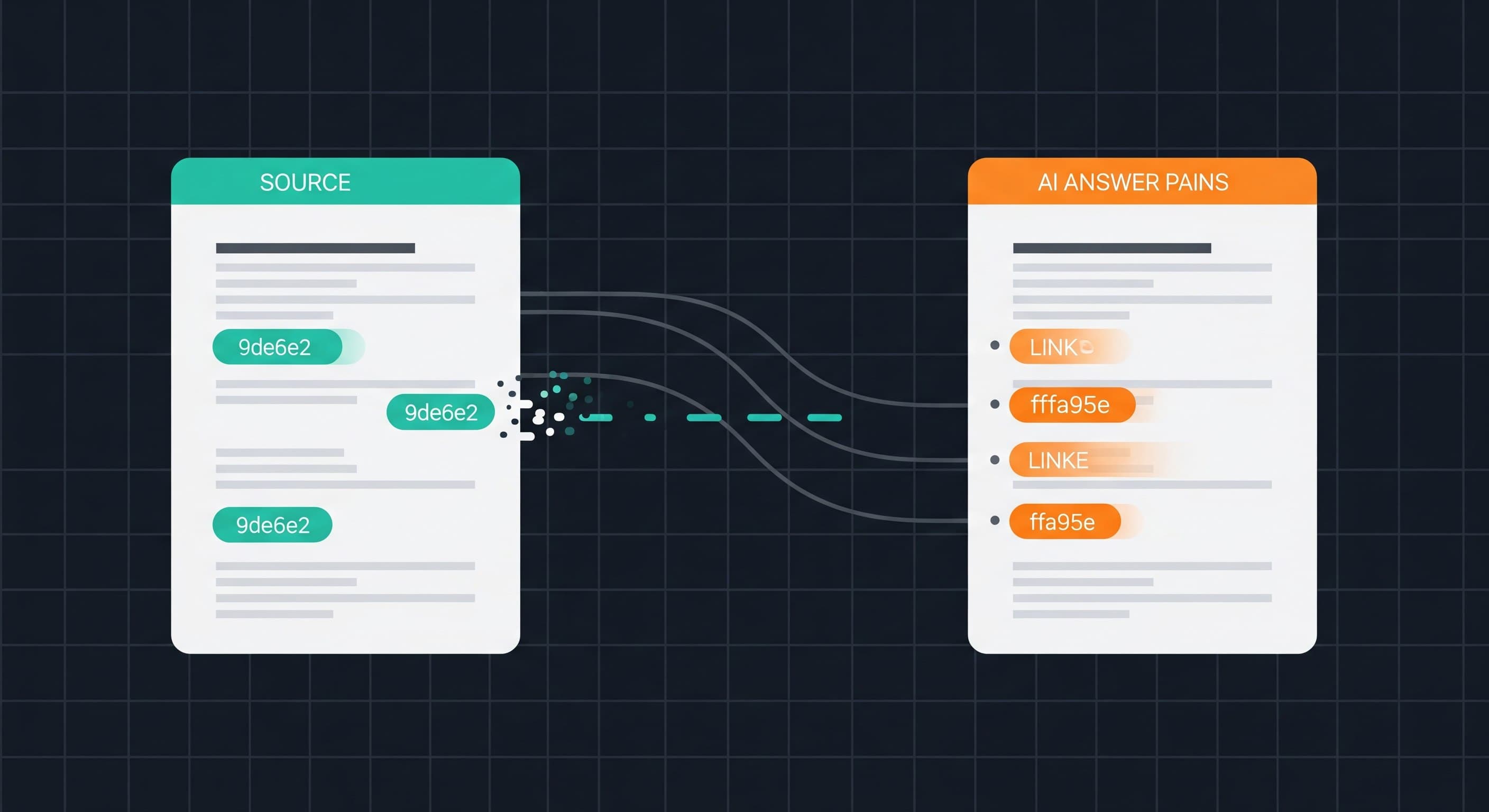
A claim has been circulating in SEO communities since late 2025: internal links in AI answers can be inherited straight from your page - when an AI cites your content, the links inside the cited chunk survive as clickable links in the answer itself. Put a product link in every citable paragraph, the advice goes, and ChatGPT or Google will carry it into the response - free clicks from inside the AI's own words.
We planned to write that how-to. Then we ran the evidence review: four research passes, the primary sources, and a month of our own citation data. The preservation story does not hold up - as of July 2026 we could not find one documented example, and internal links in AI answers are almost always the platform's own creation. But what internal links actually do for AI visibility is better documented than the myth, and more useful. This is the audit: what is real, what is telephone-game distortion, and where linking effort actually pays.
Key Takeaways
- As of July 2026 we found zero documented cases of a publisher's internal link surviving as a clickable anchor inside an AI answer - across AI Overviews, AI Mode, ChatGPT, Perplexity, and Copilot.
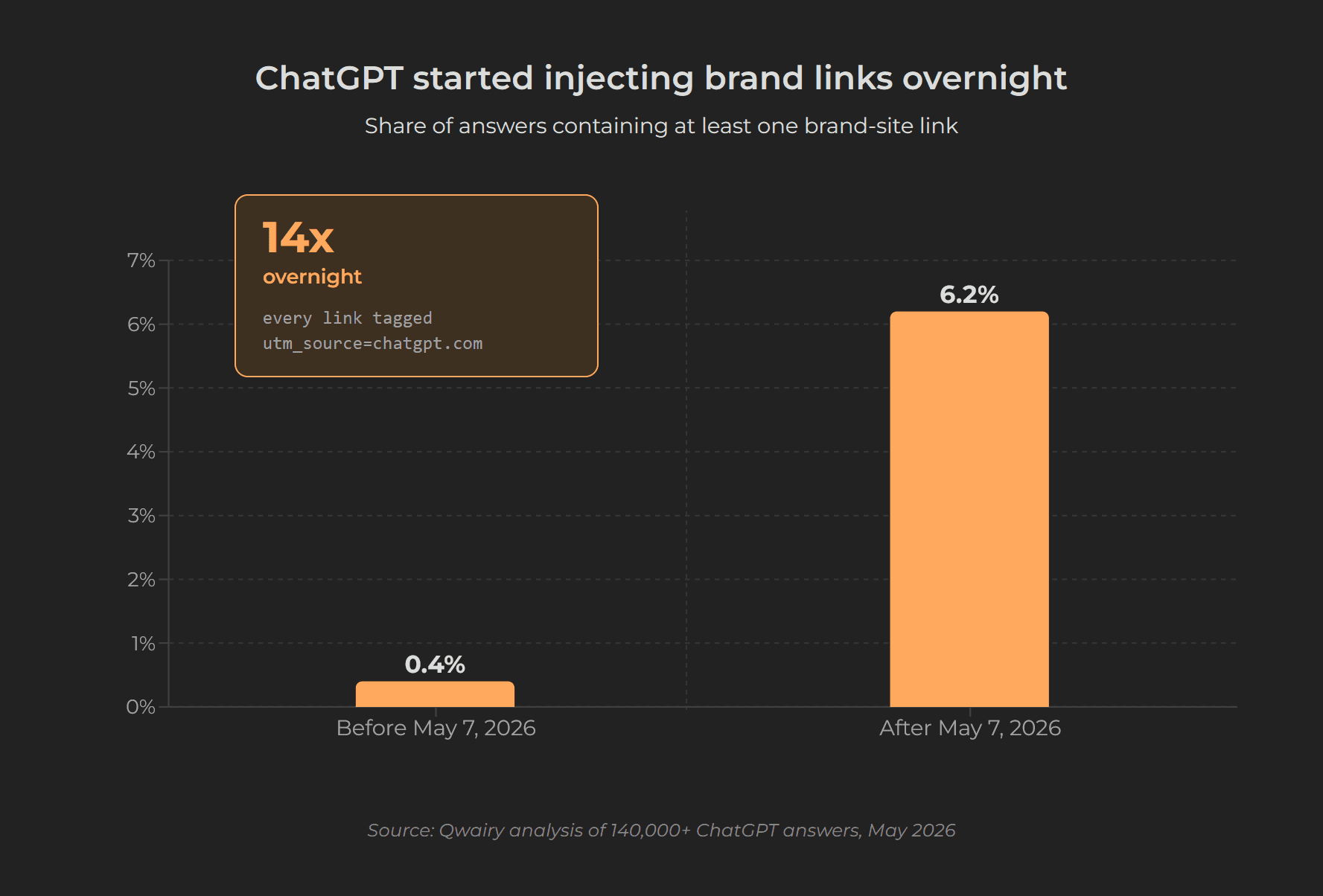
- Links inside AI answers are AI-authored: ChatGPT began injecting brand links on May 7, 2026 - from 0.4% to 6.2% of answers overnight, every link tagged utm_source=chatgpt.com.
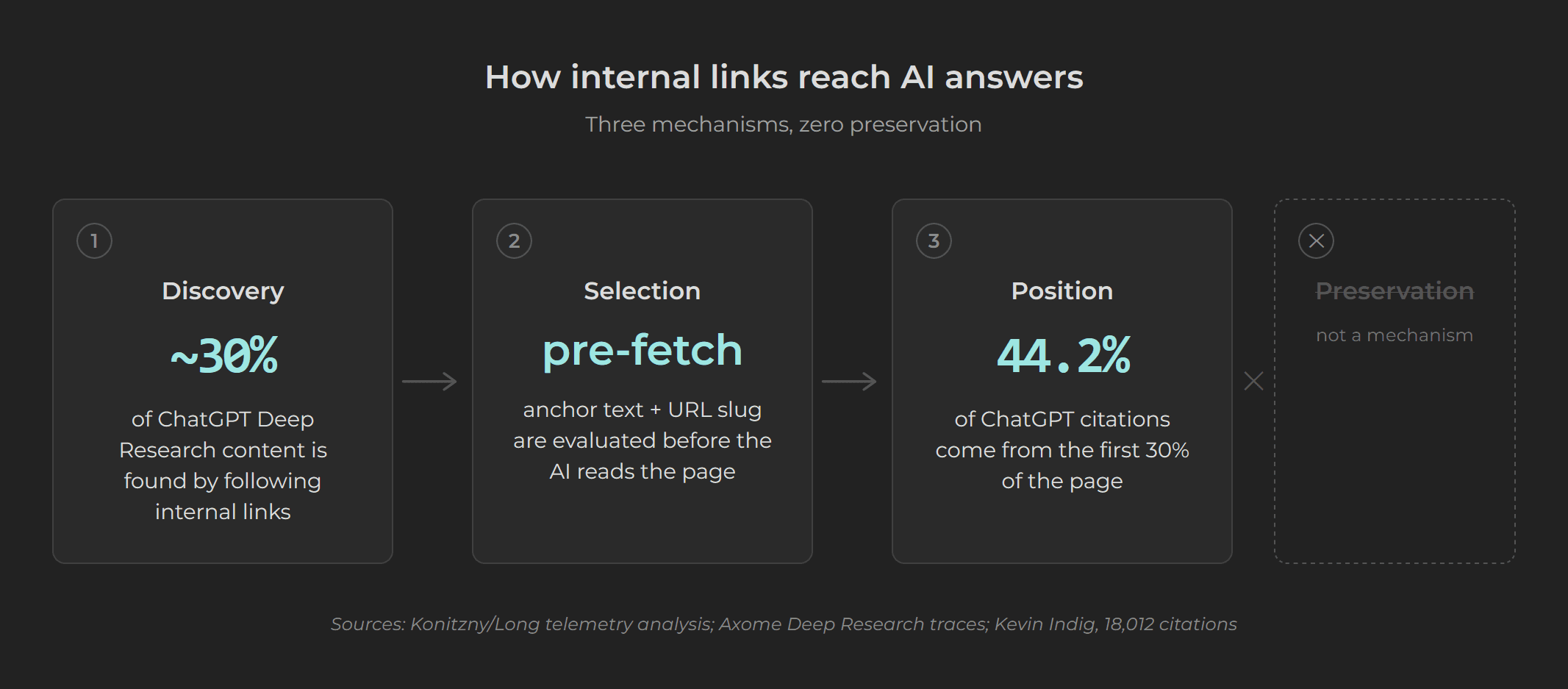
- Internal links still shape AI visibility through discovery and selection: roughly 30% of ChatGPT Deep Research content is found by following internal links, and anchor text is evaluated before the AI fetches the page.
- Position bias is sharp: 44.2% of ChatGPT citations and 55% of AI Overview citations come from the first ~30% of the page - links belong in early, answer-first sections.
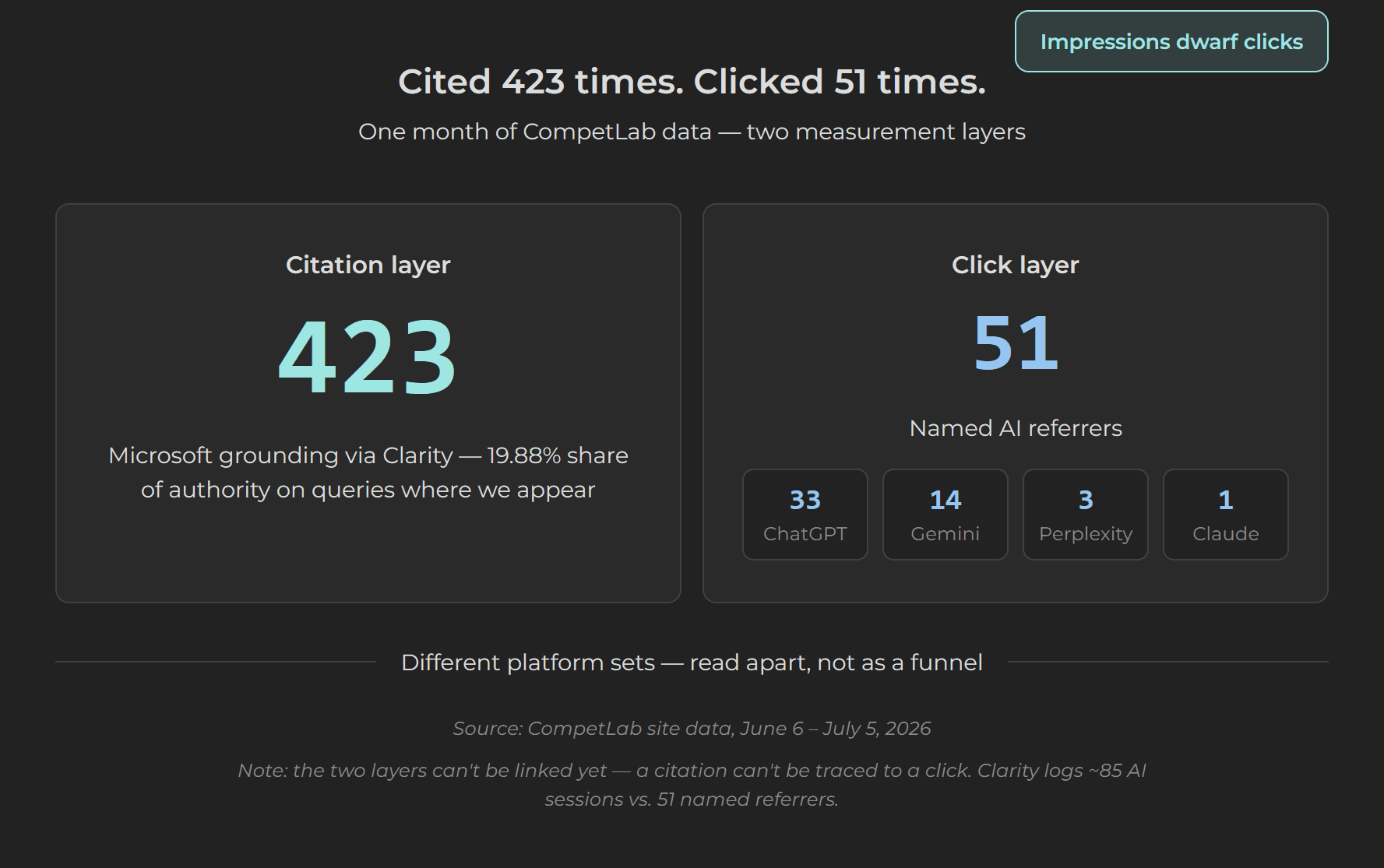
- Our own 30 days: 423 citations on Microsoft AI surfaces and 51 sessions from named AI referrers - disjoint platform sets, so no clean ratio, but both layers say impressions dwarf clicks. Measure citations and share of authority, not just referral traffic.
- Action: write 3-8-word descriptive anchors into answer capsules in the first third of the page, cap density at 1-2 links per section, and track citations in Bing Webmaster Tools and Clarity.
- CompetLab measures the discovery-and-selection half described here: for Perplexity and Google AI Overviews it reports, per engine, which pages each one retrieved while answering a set of buying questions, so a linking change can be checked against what the engines actually opened.
Do internal links survive into AI answers?
Almost never - and in four research passes we could not find one documented case. As of July 2026: no screenshot, no dataset, no controlled test showing a publisher's own internal link preserved as a clickable anchor inside an AI answer - not in Google AI Overviews, not in AI Mode, not in ChatGPT, Perplexity, or Copilot.
The claim comes from real research that got simplified in transit. Dan Petrovic of Dejan reverse-engineered Google's AI Mode across 2025 and found two things worth knowing. First, AI Mode's grounding pipeline passes search snippets to Gemini with HTML formatting intact - his captures show <b> tags inside the snippet text. Second, snippet selection favors structure: content in headings, bold text, and bullet sections gets picked more often than flat prose.
Petrovic's tactical frame is about placement probability, not preservation. His team trained LinkBERT, a model that predicts where readers expect links to sit in a sentence, on the theory that naturally placed links are likelier to survive whatever the answer engine does downstream. A reasonable theory from a serious researcher. Not a measured rate.
By the time this reached SEO Telegram channels and LinkedIn, it had become "raw HTML now enters Google's context, so links in your cited chunks appear in AI answers." That version outruns the evidence. The companion claim - "Google never invents a hyperlink from a brand name" - traces to a Gemini system prompt Petrovic extracted: "Only use URLs directly extracted from tool outputs. Never use URLs from your knowledge or invent URLs." That instruction is about URL provenance. It says the model cannot make URLs up. It does not say the model reuses your anchors.
We went hunting for a single in-the-wild example on top of those passes - a post, a screenshot, anyone showing their own anchor alive inside an AI answer. Nothing. Treat preservation as unproven until someone demonstrates it. The interesting question is what happens instead.
Where do the links in AI answers actually come from?
The AI writes them. Every major answer engine renders links through its own citation layer - chips, footnotes, or inline anchors the model generates at answer time - rather than carrying anchors over from source HTML. When you see a clickable link inside an AI answer, the platform authored it.
The clearest evidence carries a date: May 7, 2026. Qwairy, an AI-visibility tracking vendor, analyzed 140,000+ ChatGPT answers and caught ChatGPT switching on in-answer brand links overnight. The share of answers containing at least one link to a brand site jumped from 0.4% to 6.2% - a 14x shift in a day. Every one of those links carries utm_source=chatgpt.com, a tag ChatGPT appends itself. Generated at render time, preserved from no one's page.
Every engine follows the pattern, each with its own citation furniture. ChatGPT uses inline links plus a sources panel. Perplexity numbers its footnotes. Claude attaches source links when it searches. Copilot numbers citations against Bing's index. AI Overviews show a small cluster of supporting pages - and Google reported in August 2024 that testing links inside the answer text drove more publisher clicks than the chips below it. SE Ranking's 100,000-keyword study shows how far the platform's own logic runs: 43% of AI Overview links point back to Google properties, not to the open web.
Retrieval mechanics make preservation structurally unlikely anyway. Most retrieval pipelines strip pages to clean text before the model reads them - the HtmlRAG paper (WWW 2025) describes plain-text extraction as the industry default, and proposes HTML-aware retrieval precisely because everyone else discards the markup. In that default flow, your anchor text survives as words. The href dies.
So the tactical question flips. You cannot place a link inside an AI answer. You can only become the URL the AI links to when it assembles one. That is a selection problem, and internal links matter for it - just not the way the preservation story said.
What do internal links actually do for AI visibility?
Three mechanisms are documented: internal links help AI systems discover your pages, anchor text influences which pages get selected, and page structure decides which chunks exist to cite. None of them require your link to survive into the answer. All of them affect whether you appear at all.
Discovery. ChatGPT's Deep Research telemetry contains a clicked_from_url field, and analysis of it (surfaced by David Konitzny and Chris Long in early 2026) showed roughly 30% of the content it reads is found by following internal links from pages it already fetched. An orphan page is invisible to that crawl pattern. How ChatGPT search actually behaves is its own topic; the short version is that agents navigate your site the way impatient readers do - through the links in your body copy.
Selection. Axome's protocol-level traces of ChatGPT Deep Research link handling show the model evaluating anchor text and URL slug before it fetches the destination. "Learn more here" gives it nothing to evaluate. "Competitive intelligence platform for B2B SaaS" is a promise about the destination that either matches the query or does not. Petrovic's AI Mode findings point the same direction: structure and formatting influence which snippets get picked.
Position. Kevin Indig's analysis of 18,012 verified ChatGPT citations found 44.2% come from the first 30% of the page, with a ski-ramp drop after. CXL's 100-citation analysis found 55% of AI Overview citations in the top 30% of content. SE Ranking's 216,000-page study found sections of 120-180 words earn 4.6 AI citations on average against 2.7 for sections under 50 words. A link buried in your page's back half sits in a chunk the AI rarely reads.
The measured payoff is real but comes with labels. LLMVisibility's 2025 test, reported in the tools8020 internal linking study, tied 3-5 contextual internal links per target page to a 100-150% lift in AI-search traffic. Vendor-reported, so treat it as directional. SearchPilot's controlled tests supply the negative result: adding related-article widget links produced no measurable benefit to the receiving pages. Contextual body links move outcomes. Link modules do not.
How should you place internal links for AI search?
Write descriptive anchors into the first third of the page, inside answer-first sections, at a density of one to two links per section. That is the whole playbook. The table is the evidence-backed version.
| Rule | Do this | Because |
|---|---|---|
| Anchor length | 3-8 words naming the destination | Practitioner consensus range: single words are too generic to evaluate, full sentences get paraphrased |
| Anchor style | Brand + concept ("CompetLab competitive intelligence platform"), phrased like a real query | Anchor text and URL slug are evaluated before the fetch; "learn more" gives the model nothing |
| Placement | First 30% of the page, inside the 40-60-word answer under each H2 | 44-55% of citations come from the top third of content |
| Tables and lists | Link in the prose before or after, not inside cells | Observed in AI Overviews: tables get re-drawn as plain text, and cell anchors die with the markup |
| Density | 1-2 links per 150-200-word section, 3-5 priority links per page | Modest contextual linking showed lift; widgets showed none |
| Anchor mix | Keep exact-match anchors under 60% per page | Traditional-SEO discipline that carries over: over-concentration reads as manipulation |
| URLs | Clean canonical paths - no #fragments, no tracking parameters | Standard link hygiene: fragment and parameter survival is inconsistent in observed AI answers |
| Hygiene first | Fix orphan pages, 4xx targets, redirect chains before touching anchors | A link to a dead page deletes a citation surface |
Two placements earn extra attention. Answer capsules - the 40-60-word direct answers that open each section, the same extraction surface behind TL;DR blocks for AI visibility - are the chunks AI engines lift most often, so a link there sits in the most-read real estate on your page. FAQ answers work the same way, with one caveat from Ahrefs' 1,885-page test: adding FAQPage schema markup produced a negative change in AI Overview citations versus controls. The visible Q&A text earns citations. Markup alone does not.
What not to do is shorter. No "click here" anywhere AI-visible. No link in every sentence. No identical commercial anchor repeated across dozens of pages. And no waiting for anchor-preservation magic: Google's own May 2026 guide to generative AI features says the quiet part - no llms.txt, no chunk-formatting tricks, no AI-specific markup. Structure pages for readers. The machines read the same page.
What can you measure about links in AI answers?
Not preservation. No tool tracks whether a specific anchor survived into an answer - not GA4, and none of the AI-visibility platforms (Profound, Peec, Otterly, Semrush) go deeper than which URLs get cited. What you can measure in 2026 sits in three layers: citations, share of authority, and AI-referred sessions.
We track our own site with exactly those layers, so here are our unvarnished numbers for June 6 to July 5, 2026. CompetLab is a young site and the absolute figures are small on purpose - this is what a real baseline looks like, not a vendor case study.
- 423 citations. 51 sessions. Read them apart, not as a funnel. Microsoft's grounding data, surfaced in Clarity's AI dashboard, counted our pages cited 423 times in AI answers over the month - a 19.88% share of authority on queries where we appear at all, one citation in five. Separately, named AI referrers (chatgpt.com, Gemini, Perplexity, Claude) sent 51 click-sessions, while Clarity's channel tile reads 2.32% of traffic, roughly 85 sessions - that 34-session gap is an open question in our own measurement. The two layers cover different platform sets, so we do not divide one by the other; citation-to-click conversion is unmeasured today, not measured-low. What both layers agree on: impressions dwarf clicks - the same shape as Pew's 2025 finding that only about 1% of users click a source link inside an AI Overview.
- ChatGPT leads the click layer. 33 of the 51 attributable sessions - just under two-thirds - came from chatgpt.com, the receiving end of the May 7 linking shift. Gemini sent 14, Perplexity 3, Claude 1. Small numbers: read the mix as direction, not a stable split.
- Citations compound fast. Our weekly Bing citation count ran 38, 78, 125, 209 across the month's four weeks - about 5.5x, monotonic, with cited-page diversity doubling.
- Deep pages win; the homepage does not appear. All 11 of our cited URLs are deep pages - articles, free tools, and docs. Zero homepage citations, zero product-page citations. Our two most-cited pages - the schema markup guide and the AI visibility pillar - hold 74% of the total. And Bing Webmaster Tools reports a 29.55% share on the grounding query where Copilot cites us: "how brands structure articles for AI citation." The machine cites our writing about getting cited.
Why chase citations if clicks are this rare? Because the click pool concentrates on whoever gets cited. Seer Interactive's tracking of 53 brands across 5.47 million queries found position-1 pages earn a 2.1% CTR when cited in an AI Overview versus 0.9% when not, and cited brands pulled 35% more organic clicks overall. Rare clicks still route through the cited few.
To see the same layers on your own domain as of mid-2026: Bing Webmaster Tools ships an AI Performance report, Microsoft Clarity surfaces citations and share of authority, and measuring AI visibility beyond referral traffic covers the full setup.
The honest summary: stop optimizing for a preservation behavior no one has demonstrated. Write descriptive anchors into citable chunks, keep the link graph clean, and watch the citation layer - that is where the shift is actually visible.
CompetLab tracks what ChatGPT, Claude, Gemini, Perplexity, and Google AI Overviews say about you and your competitors - which brands each engine names and recommends, which pages Perplexity and Google AI Overviews retrieved, and what to do about it. See what AI says about you: start the 14-day trial - no credit card, 2-minute setup.
Frequently Asked Questions
Do internal links from my content appear in ChatGPT answers?
We found no documented case of ChatGPT preserving a link from your page's HTML into an answer. The links you see in ChatGPT responses are generated by ChatGPT itself - since May 7, 2026 it injects brand links tagged with utm_source=chatgpt.com, and the share of answers carrying them jumped from 0.4% to 6.2% overnight. Your internal links still matter upstream: ChatGPT's Deep Research discovers roughly 30% of the content it reads by following links inside pages it already fetched.
Does Google preserve internal links from pages cited in AI Overviews?
We found no evidence that it does. Dan Petrovic's AI Mode research - the origin of the claim - documented HTML formatting inside grounding snippets and structure-biased snippet selection, not link preservation. Google renders its own supporting links, and SE Ranking's 100,000-keyword study found 43% of AI Overview links point back to Google properties. Assume anchors get stripped and optimize for being selected as a source instead.
How many internal links per page work best for AI search?
Practitioner data converges on 3-5 contextual links to priority pages, at a density of 1-2 links per 150-200-word section. LLMVisibility's vendor-reported test tied that range to a 100-150% lift in AI-search traffic, while SearchPilot's controlled tests found related-article widget links produced no benefit to receiving pages. Placement and anchor quality beat volume: descriptive 3-8-word anchors in the first third of the page, never 'click here.'
Do internal links inside FAQ answers help AI citations?
The visible Q&A text is a strong citation surface - each answer works as a self-contained chunk AI systems can lift whole. Place one contextual link in the first sentence of high-value answers and treat any preservation as a bonus. One warning from Ahrefs' 1,885-page test: adding FAQPage schema markup alone produced a slightly negative change in AI Overview citations versus controls. Write real questions with real answers; the markup does not do the work.
Can I track whether AI answers cite or link to my pages?
At the URL level, yes: Bing Webmaster Tools ships an AI Performance report with grounding queries and citation counts, Microsoft Clarity surfaces citations and share of authority, and referrer analytics catch sessions from chatgpt.com, perplexity.ai, and gemini.google.com. At the anchor level, no tool can tell you whether a specific link survived into an answer. In our own 30-day data the layers sat far apart - 423 citations on Microsoft AI surfaces, 51 sessions from named AI referrers - different platform sets, not a ratio, but the impressions-dwarf-clicks shape is unmistakable.
See your AI visibility
Find out how ChatGPT, Claude, Gemini, Perplexity and Google AI Overviews answer when buyers look for tools like yours — where you show up, and against whom.
Share this article