Schema Markup for AI Citations: What the Data Actually Shows
In December 2025, SearchAtlas published a study concluding that schema markup has "no effect" on AI visibility. Their data showed domains with 100% schema coverage performing identically to those with 0%.
That same month, page-level experiments from Search Engine Land, Relixir, and Agenxus documented 28-60% citation rate improvements from proper schema. Both findings are correct - and the gap between them explains why most sites get schema wrong.
Key Takeaways
- HowTo schema delivers 42% higher CTR from AI citations; FAQ schema delivers 34-50% improvement for question-based queries (Relixir 50-site study, Agenxus)
- Domain-level schema coverage has zero correlation with AI visibility - page-level implementation quality drives citations (SearchAtlas)
- Platforms diverge: Perplexity weights freshness (76.4% of top-cited pages updated within 30 days), ChatGPT weights data density, Google AI Overviews weight entity relationships
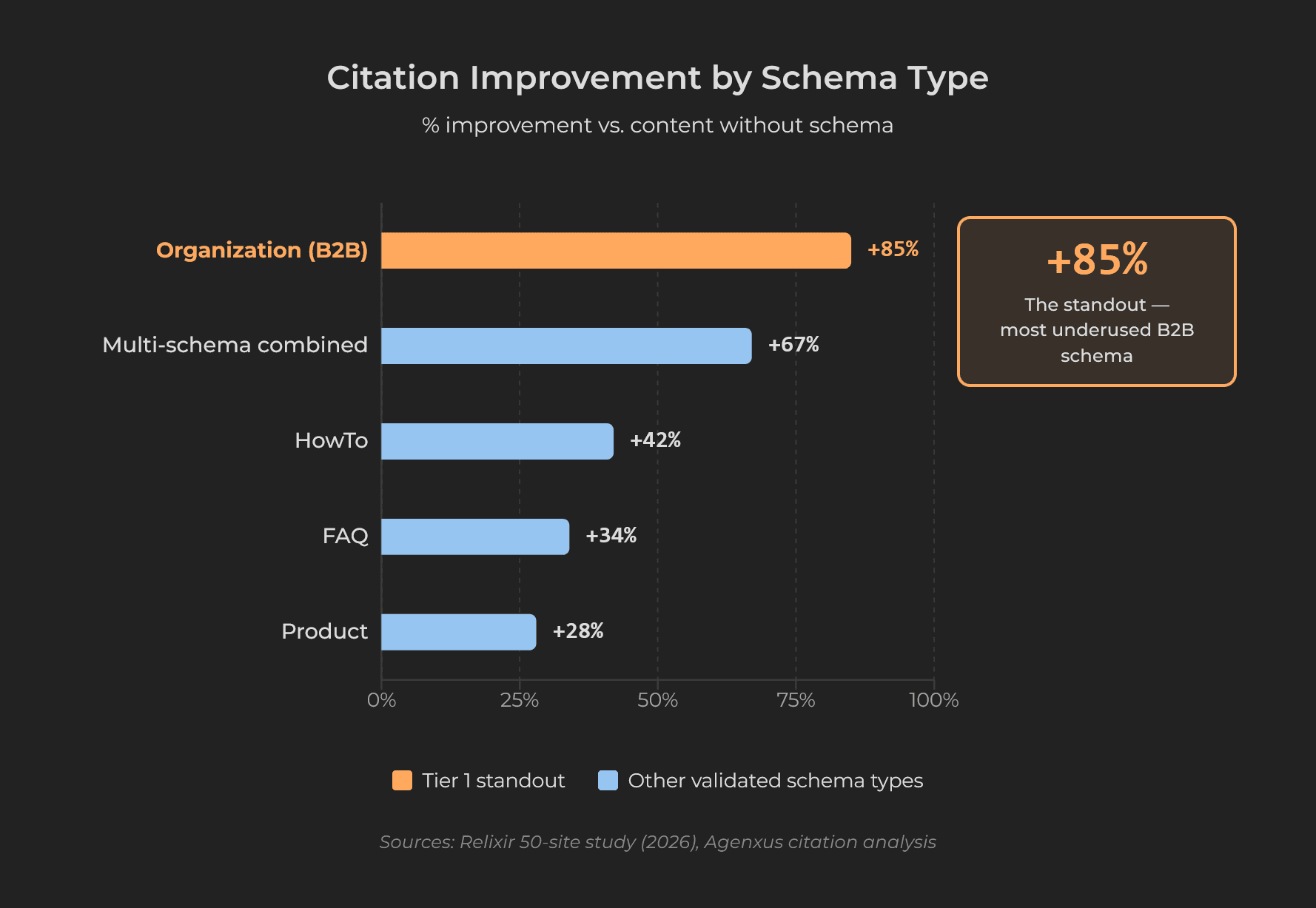
- Organization schema shows 85% citation improvement for B2B sites - the most underused high-impact schema type
- Common mistakes like fake freshness signals, semantic redundancy, and client-side rendering can reduce citation probability to zero
- Start with your top 10 pages, not your entire site - audit schema quality, not schema coverage
Why Does One Study Say Schema Doesn't Work While Others Say It Does?
SearchAtlas measured domain-level schema coverage - what percentage of a site's URLs contain any schema markup. They grouped domains into five buckets (0%, 1-30%, 31-70%, 71-99%, 100%) and compared visibility scores across OpenAI, Gemini, and Perplexity. No statistical difference between any bucket.
Page-level studies took a different approach. Search Engine Land tested three nearly identical pages differing only in schema quality. Only the page with well-implemented schema appeared in AI Overviews - and it ranked Position 3 versus Position 8+ for the others. Relixir's 50-site study measured 28-67% citation rate improvements depending on schema type. Agenxus found 40-60% more frequent citations for content with proper HowTo and FAQ schema.
Both findings are correct. They measure different things.
SearchAtlas didn't differentiate schema type, completeness, or quality. They acknowledged this directly: "The analysis measured the presence of schema markup, not the type, completeness, or quality of structured data." Page-level studies controlled for exactly those variables and found consistent improvements.
The distinction matters for how you invest time. "Adding schema to more pages doesn't improve visibility" is true at the domain level. "Adding quality schema to your best pages improves visibility" is true at the page level. Same system, different measurements, opposite-looking conclusions. Schema is one input within a larger model — the three-layer signal model that places schema as one input within the full content, entity, and off-site stack shows where schema sits among the other signals AI engines weigh.
Which Schema Types Actually Improve AI Citations?
Not all schema types carry the same weight. Research from Relixir, Agenxus, and Frase.io points to a clear hierarchy based on measured citation impact.
Tier 1: Highest impact (40-60% improvement)
| Schema Type | Citation Impact | Best For |
|---|---|---|
| HowTo | 42% higher CTR from AI citations | Procedural queries, how-to searches |
| FAQPage | 34-50% higher citation rate | Question-based searches |
| Article | Foundational baseline | All content types |
Tier 2: High value (25-85% improvement)
| Schema Type | Citation Impact | Best For |
|---|---|---|
| Organization | 85% improvement for B2B sites | Entity disambiguation, brand queries |
| Product | 28-31% higher CTR | E-commerce, shopping queries |
| Person/Author | E-E-A-T critical | Bylined content, YMYL topics |
The FAQ paradox. A peer-reviewed study of 100,000 ChatGPT prompts from SE Ranking found that pages with FAQ schema averaged fewer citations (3.6) than pages without (4.2). That looks like FAQ schema hurts you.
It doesn't. Pages that carry FAQ schema tend to be thin - support docs, product FAQs, single-sentence answers. The schema isn't the problem. The shallow content that typically accompanies it is.
FAQ schema works when the answers are substantive. Agenxus's analysis of 5,000+ FAQ pages found that FAQPage schema with 150-300 word answers generates 35-50% more citations than QAPage structure. FAQPage signals definitive, authoritative answers. QAPage's multi-answer format introduces ambiguity that reduces citation confidence.
HowTo outperforms FAQ for procedural queries. Match your schema type to the query intent, not to your content management convenience. Someone searching "how to implement schema markup" needs steps, not Q&A. HowTo schema gives AI systems the sequential structure they can extract directly.
Here's what a properly implemented FAQPage schema looks like:
{
  "@context": "https://schema.org",
  "@type": "FAQPage",
  "mainEntity": [
    {
      "@type": "Question",
      "name": "How does schema markup improve AI citation rates?",
      "acceptedAnswer": {
        "@type": "Answer",
        "text": "Schema markup helps AI systems extract content with higher confidence by providing explicit structure. FAQPage schema increases citation probability by 28-50% compared to unstructured content. The key requirement is substantive answers of 150-300 words. Generic single-sentence answers underperform regardless of schema quality."
      }
    }
  ]
}
And HowTo schema for procedural content:
{
  "@context": "https://schema.org",
  "@type": "HowTo",
  "name": "How to Implement Schema Markup for AI Citations",
  "totalTime": "PT1H30M",
  "step": [
    {
      "@type": "HowToStep",
      "position": 1,
      "name": "Audit existing schema",
      "text": "Run Google's Rich Results Test on your top content pages. Identify syntax errors and missing required properties. Fix critical errors first."
    },
    {
      "@type": "HowToStep",
      "position": 2,
      "name": "Add Article schema with author credentials",
      "text": "Every content page needs Article schema with headline, author linked to Person schema, datePublished, and dateModified in ISO 8601 format."
    }
  ]
}
For a deeper look at how AI engines decide which content to extract and cite, see How AI Answer Engines Actually Select Content.
How Do Different AI Platforms Handle Schema?
Each major AI platform treats schema differently. A strategy optimized for Google AI Overviews may underperform on Perplexity, and vice versa.
| Platform | Schema Signal | Top Priority | Key Data Point |
|---|---|---|---|
| Google AI Overviews | Highest | Entity relationships, nested schemas | 54% of citations from organic-ranking pages |
| ChatGPT | Moderate | Depth, data density, freshness | 19+ data points = 5.4 avg citations vs 2.8 |
| Perplexity | Medium-High | Freshness above all | 76.4% of top-cited pages updated within 30 days |
| Bing Copilot | High for HowTo | Procedural content, local data | HowTo schema: 9% to 24% citation share |
Google AI Overviews show the strongest schema response. In Search Engine Land's controlled experiments, a page with proper schema appeared in AI Overviews while identical pages without schema didn't appear at all. Google favors nested entity schemas - Person linked to Organization linked to Location. Build relationships between entities, not isolated labels.
ChatGPT pulls from Bing's index, so schema that improves Bing ranking indirectly improves ChatGPT citations. But ChatGPT weights content substance more than structure. Pages with 19+ statistical data points averaged 5.4 citations versus 2.8 for data-sparse content. Expert quotes pushed citation rates from 2.4 to 4.1. Schema helps, but depth drives ChatGPT more than markup.
For more on ChatGPT's retrieval mechanics, see How ChatGPT Searches Differently Than Google.
Perplexity performs real-time web searches and weights freshness above almost everything else. 76.4% of its top-cited pages were updated within 30 days. Schema combined with genuine freshness signals - dateModified, visible "Last updated" text, and sitemap lastmod - creates high citation velocity. Practitioners report citations appearing within 2 hours of publishing properly structured content.
Bing Copilot shows the most direct schema-to-citation relationship. A documented case study found that adding HowTo schema to developer setup guides increased citation share from 9% to 24% in three weeks. LocalBusiness schema also drives citations for location-based "near me" queries.
To track how schema changes affect your citation rates across platforms, see How to Measure Your AI Visibility.
What Are the Implementation Mistakes That Kill Schema's Value?
Some implementation errors reduce citation probability to zero. Others cut it by 30-80%. These failures explain why SearchAtlas found no correlation at the domain level - many sites' schema implementations are broken in ways that provide no benefit to AI systems.
Critical errors (eliminates all benefit):
- Blocking crawlers from schema pages. Schema on a noindex page or behind a disallowed URL is invisible to every AI system. Check your robots.txt and meta robots tags before anything else.
- Semantic redundancy. Using both Microdata and JSON-LD for the same data with conflicting values - price marked $299 in Microdata and $279 in JSON-LD - causes AI parsers to trust neither. Pick JSON-LD exclusively and remove legacy formats.
- Fake freshness signals. Updating dateModified without changing actual content triggers credibility penalties. AI systems detect mismatches between claimed dates and real changes. Update dateModified only for substantive edits: new data, expanded sections, updated methodology. Not typo fixes.
- Missing required properties. FAQPage schema without question-answer text. Article schema without author or date. Incomplete schema is ignored entirely.
High-impact errors (30-80% reduction):
- Client-side rendered schema. If your schema is generated by JavaScript after page load, many AI crawlers never see it. View your page source (not DevTools inspect). If the JSON-LD block isn't in the raw HTML, it's invisible to crawlers that don't execute JavaScript.
- Stale data. Outdated prices, old publication dates, dead sameAs links. Each erodes trust incrementally.
- Incorrect nesting. Product schema nested inside Article schema without proper contextual linking causes entity misclassification.
If your site relies on JavaScript rendering, see Lazy Loading and AI Visibility for how AI crawlers handle client-side content.
A properly structured Article schema with E-E-A-T signals looks like this:
{
  "@context": "https://schema.org",
  "@type": "Article",
  "headline": "Your Article Title Here",
  "datePublished": "2026-04-16T09:00:00Z",
  "dateModified": "2026-04-16T09:00:00Z",
  "author": {
    "@type": "Person",
    "name": "Your Name",
    "jobTitle": "Your Title",
    "affiliation": {
      "@type": "Organization",
      "name": "Your Company",
      "sameAs": "https://www.linkedin.com/company/your-company/"
    },
    "sameAs": ["https://www.linkedin.com/in/your-profile/"]
  },
  "publisher": {
    "@type": "Organization",
    "name": "Your Company",
    "logo": {
      "@type": "ImageObject",
      "url": "https://yoursite.com/logo.png"
    }
  }
}
Author links to Person. Person links to Organization via affiliation. Organization has sameAs to verified external profiles. This nesting lets AI systems verify entity relationships without inference.
Where Should You Start?
Don't implement schema across your entire site at once. Broad coverage without quality control is the trap the SearchAtlas data exposes - it produces zero benefit.
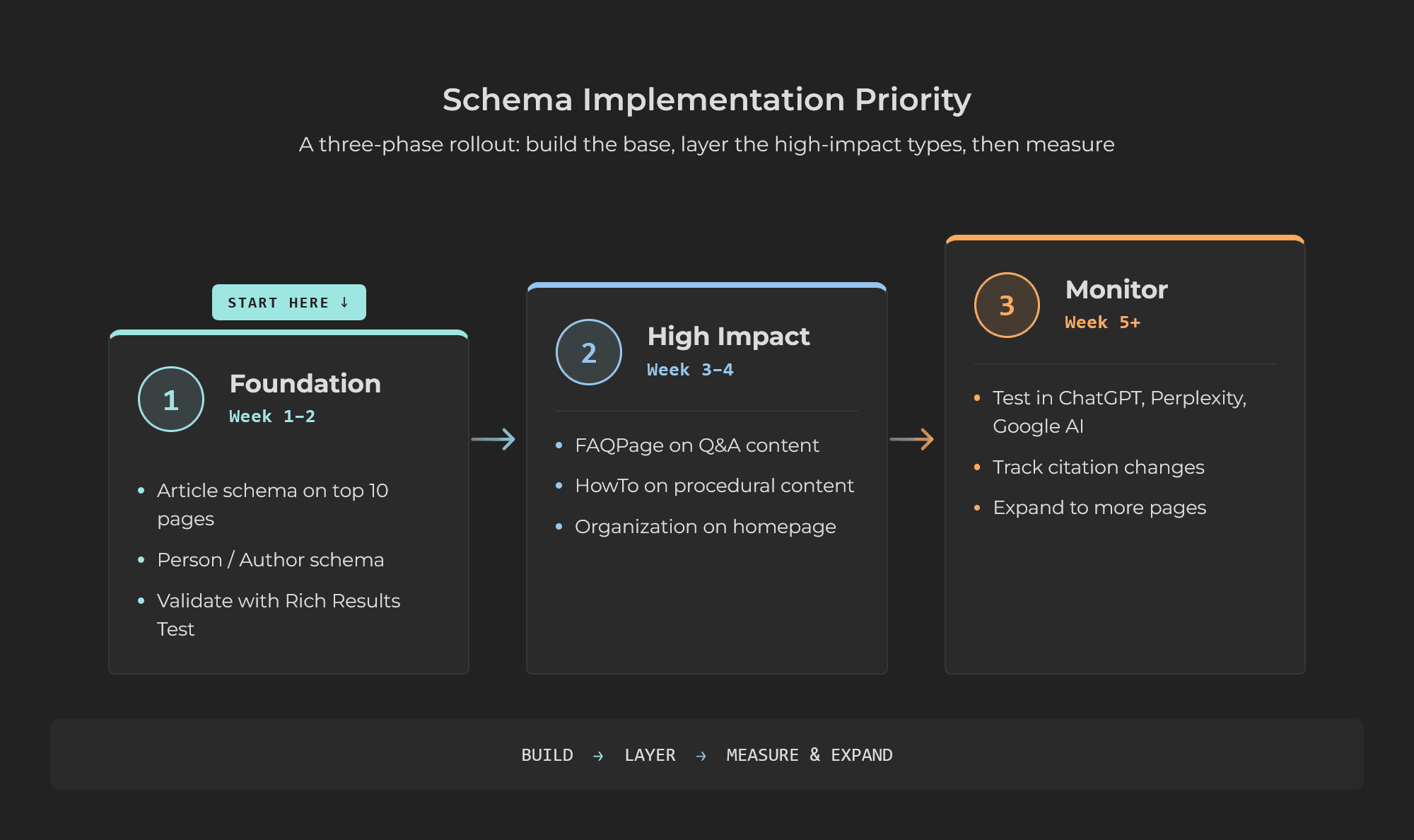
Week 1-2: Foundation
Identify your 10 highest-traffic content pages. Add Article schema to each with these required properties:
headlinematching the visible H1authorlinked to a Person schema with name, jobTitle, and affiliationdatePublishedanddateModifiedin ISO 8601 format with timezonepublisherlinked to your Organization schema
Validate every page with Google's Rich Results Test. Fix errors before expanding.
Week 3-4: High-impact additions
Pick schema type based on query intent:
- Question-based content gets FAQPage schema with 150-300 word answers
- Procedural content gets HowTo schema with all steps, tools, and time estimates
- Homepage and landing pages get Organization schema with sameAs links to LinkedIn, Crunchbase, Wikipedia
Week 5+: Monitor and adjust
Test in actual AI platforms. Ask ChatGPT, Perplexity, and Google your target queries. See whether you're getting cited. Compare before and after.
Schema changes show in AI citation patterns faster than most SEO work. Practitioners report shifts within 2-4 weeks. For Perplexity specifically, citation velocity can change within hours of publishing structured content.
CompetLab's AI Visibility tracking reports, per engine, how often ChatGPT, Claude, Gemini, Perplexity, and Google AI Overviews name your brand over time, and which pages Perplexity and Google AI Overviews retrieved - so you can measure whether schema changes actually changed what the engines open, not just hope they do.
Frequently Asked Questions
Does schema markup directly improve search rankings?
No. Google has confirmed that schema markup is not a direct ranking factor. Schema improves how your content is understood and displayed - rich results, AI Overview inclusion, citation probability - but it does not directly boost your position in traditional search results. The indirect benefits are real: better AI visibility, higher click-through rates from rich snippets, and improved entity recognition across platforms.
Should I use JSON-LD, Microdata, or RDFa for schema markup?
JSON-LD, exclusively. It's Google's recommended format, supported by all AI systems, and maintained separately from your HTML - making it easier to update and less prone to errors when templates change. Microdata embeds in HTML and breaks when you redesign. RDFa uses complex XML syntax with minimal adoption. If you have legacy Microdata or RDFa, consolidate to JSON-LD. Never use multiple formats for the same data - conflicting values cause AI parsers to ignore both.
How often should I update schema markup?
Update your dateModified property only when you make substantive content changes - new statistics, updated methodology, expanded sections. Perplexity heavily weights freshness, with 76.4% of top-cited pages updated within 30 days. But faking freshness by updating dates without real changes triggers credibility penalties. For tech and SaaS content, aim for monthly substantive updates. For evergreen content, quarterly reviews work. Always keep pricing, availability, and contact data current.
Does schema markup help with ChatGPT citations specifically?
Moderately. ChatGPT pulls 87% of its citations from Bing's top results, so schema that improves your Bing ranking indirectly helps. But ChatGPT weights content depth more than schema type. Pages with 19+ data points average 5.4 citations versus 2.8 for data-sparse content. For ChatGPT specifically, focus on comprehensive content with rich data first, then add schema as an enhancement layer.
What is the minimum schema every content page should have?
Article schema with four required properties: headline (matching your visible H1), author (linked to a Person schema with name and credentials), datePublished, and dateModified (both in ISO 8601 format with timezone). Add a publisher property linking to your Organization schema. This establishes the E-E-A-T signals that all AI platforms weight when deciding whether to cite your content. Validate with Google's Rich Results Test before publishing.
See your AI visibility
Find out how ChatGPT, Claude, Gemini, Perplexity and Google AI Overviews answer when buyers look for tools like yours — where you show up, and against whom.
Share this article