Add a TL;DR Block. Get More AI Citations and Higher Conversions.
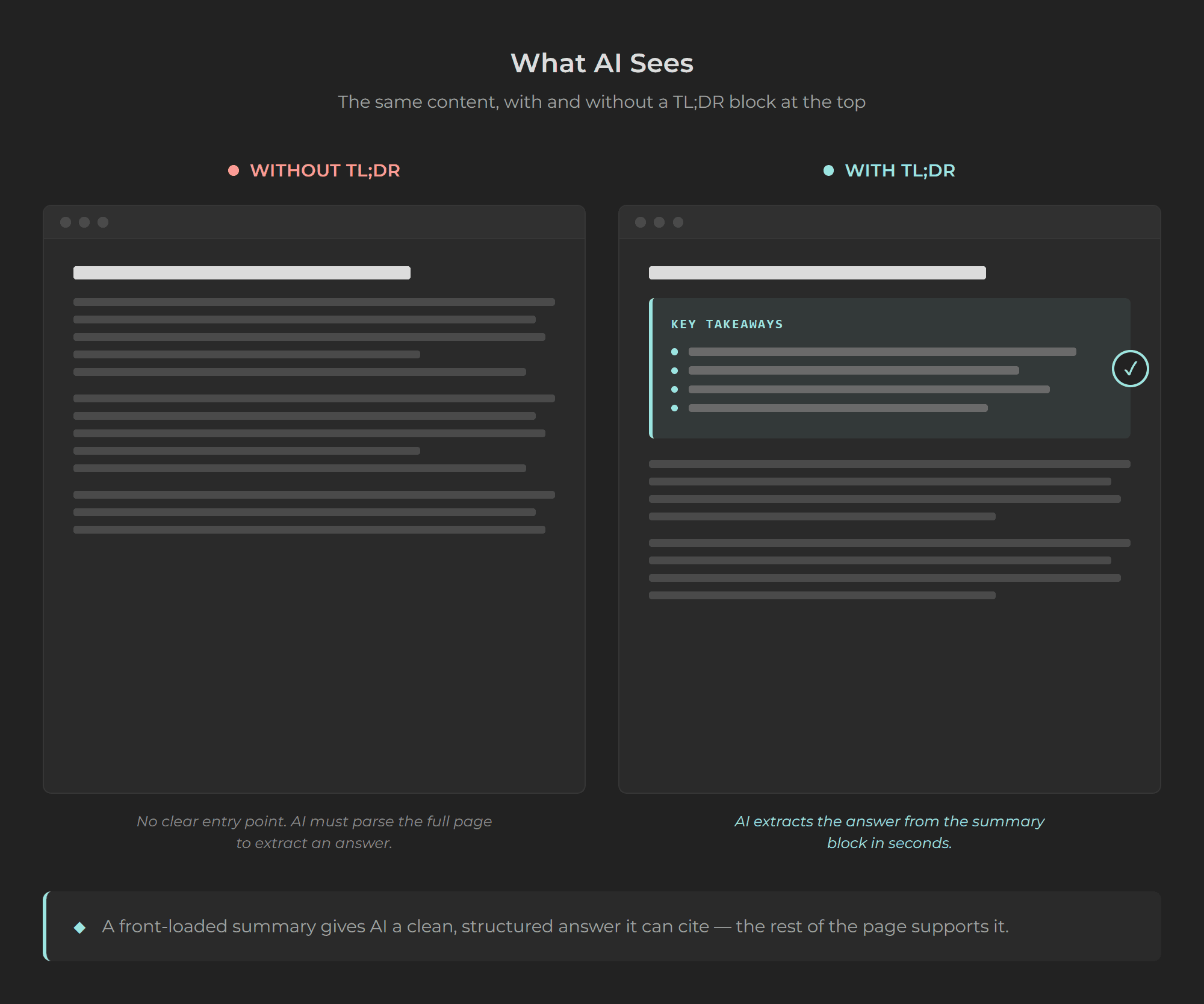
A TL;DR block is a short summary - typically 3-6 bullet points or 2-4 sentences - placed at the very top of a page, immediately after the heading. It tells both human readers and AI systems: here is what this page is about, here is the main finding, here is what to do about it.
The concept is not new. Wikipedia has lead paragraphs. Academic papers have abstracts. But two things changed in 2025-2026 that made TL;DR blocks urgent:
-
AI now selects content by extractability, not just ranking. An Ahrefs study of 863,000 keywords found that only 38% of pages cited in Google AI Overviews also rank in the top 10 organic results - down from 76% seven months earlier. Google's AI is reaching past traditional rankings to find content that is structured for extraction. A clear summary at the top of the page is the most extractable block you can offer.
-
AI Overviews now appear in 60%+ of searches. The Attention Labs GEO Intelligence Guide reports AI Overviews appearing in 60.32% of US Google searches by late 2025, up from 6.49% in January 2025. When AI Overviews are present, click-through rates to the top organic result drop 58%. Being cited BY the AI Overview is now more valuable than ranking below it.
TL;DR blocks position your content to be that cited source.
Key Takeaways
- Structured summaries (TL;DR blocks, key takeaways) correlate with 20-35% higher AI citation rates across major studies
- Pages that are "chunked, quotable, and schema-tagged" receive 3-5x more AI citations than unstructured pages
- One practitioner test showed TL;DR blocks reduced bounce rate 18%, increased time on page 22%, and triggered AI Overview appearances for 40+ new keywords
- The optimal format: 40-60 words, answer-first, placed immediately after the H1
- You can add TL;DR blocks to your entire blog in under 30 minutes using a CMS meta field and AI-generated summaries
- CompetLab tracks whether the change lands: it puts your buyers' questions to ChatGPT, Claude, Gemini, Perplexity and Google AI Overviews and reports how often each engine recommends your brand, and - for Perplexity and Google AI Overviews - which pages it retrieved to answer
Add a TL;DR Block. Get More AI Citations and Higher Conversions.
Does Adding a TL;DR Block Actually Improve Conversions?
The most cited case comes from a Reddit practitioner report: adding 2-3 sentence TL;DR summaries to both article and product pages produced a 33% conversion increase over a 2-week test. The mechanism is straightforward - faster comprehension, reduced confusion, quicker decision-making.
We should be honest about the limitations: this is one test, two weeks, no published statistical significance, and no control for confounding variables. The 33% figure should be treated as a hypothesis, not a benchmark.
But supporting evidence is consistent. A January 2026 LinkedIn case study reported that adding 100-word TL;DR blocks to a client's blog reduced bounce rate by 18% and increased time on page by 22%. UX research consistently shows that scannable, summary-first content improves task completion rates - readers who can confirm they are in the right place stay longer and convert more.
The conversion case is strong enough to act on, even if the exact percentages will vary by site. The downside risk of adding a well-written summary to your pages is effectively zero.
How Do TL;DR Blocks Affect AI Citations?
This is where the data gets heavy. Multiple 2025-2026 studies converge on the same finding: structured, answer-first content gets cited more by AI systems.
The big numbers:
| Study | Sample | Finding |
|---|---|---|
| Semrush (via Attention Labs) | 304,805 cited URLs | Clarity/summarization: +32.83% citation rate. Section structure: +22.91%. Q&A formatting: +25.45% |
| OtterlyAI 2026 | 1M+ AI citations | Chunked, quotable, schema-tagged pages: 3-5x more citations than unstructured |
| Princeton GEO study | 10,000 queries | Statistics addition: +22-41%. Quotation addition: +28-37%. Citation addition: up to +115% |
| SE Ranking | Large keyword set | Pages with 120-180 words between headings: 70% more ChatGPT citations |
Sources: Attention Labs, OtterlyAI, Princeton GEO
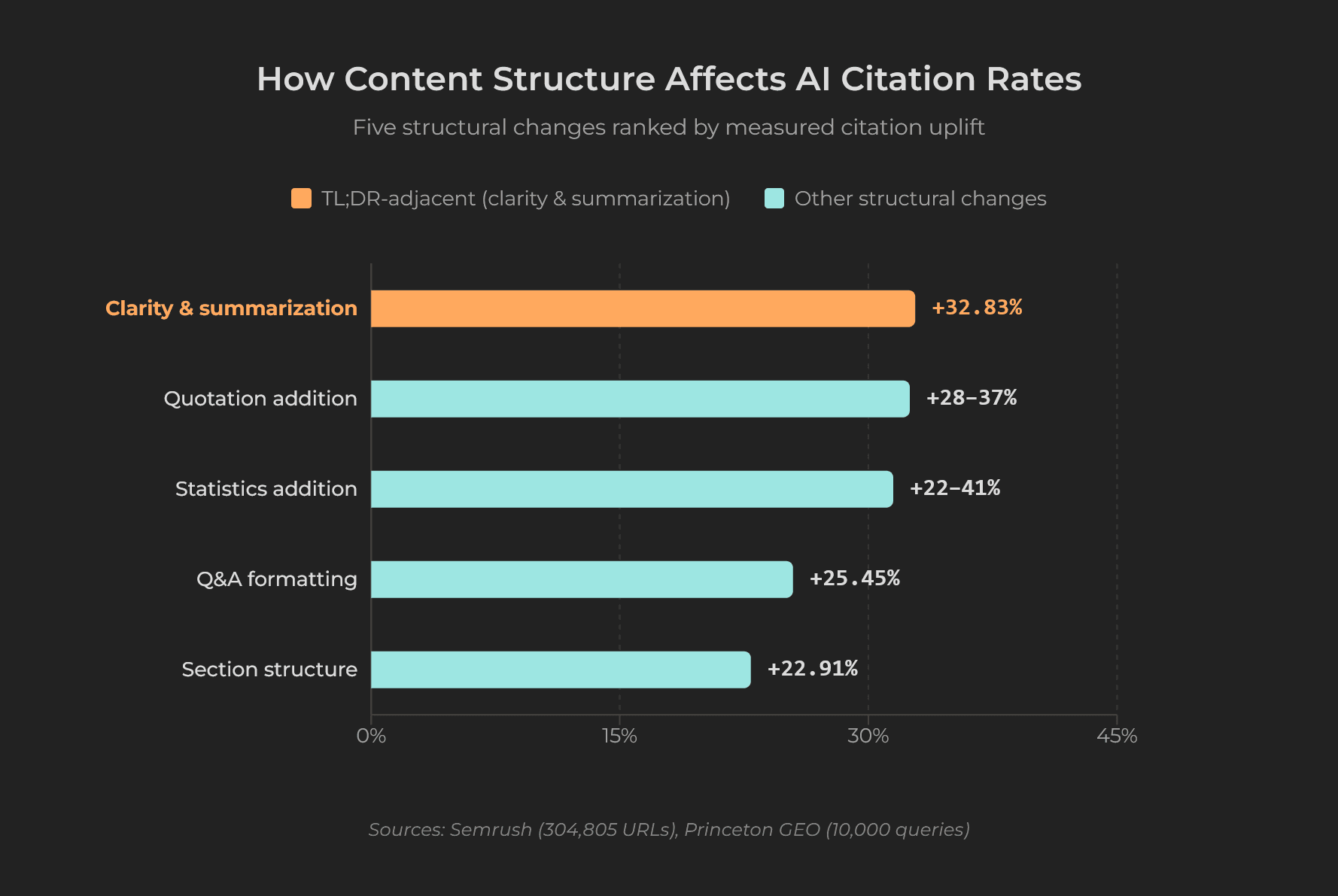
The key insight from OtterlyAI's million-citation study: AI does not just prefer good content. It prefers content that is already formatted for extraction. A self-contained paragraph that answers a question in 40-60 words, backed by a statistic, with a clear heading above it - that is what gets lifted into an AI answer. A TL;DR block is exactly this format, placed at the most prominent position on the page.
What "quotable" means in practice: OtterlyAI defines it as "self-contained sentence or bullet blocks that can be reused without additional context." A TL;DR block that says "Pages with structured summaries receive 3-5x more AI citations than unstructured pages (OtterlyAI, 2026)" is a quotable block. A paragraph that buries the same fact in the middle of a 200-word discussion is not.
A caveat the research demands: No large-scale study has isolated TL;DR blocks as the single variable. The 20-35% citation improvements come from broader structural changes - answer-first architecture, chunked sections, schema markup, and statistical density working together. TL;DR blocks are the highest-leverage single entry point into this pattern, but they work best as part of the full system. The "full system" in question is mapped here - the broader citation-decision stack that makes summary blocks pay off - content structure, entity signals, and off-site density working together frames where this single entry point sits inside the surrounding architecture.
How Should You Format a TL;DR Block?
Multiple 2026 GEO frameworks converge on the same pattern:
The format:
- Place immediately after the H1, before any other content
- 40-60 words for a single-paragraph summary, or 4-6 bullet points for a list format
- Lead with the main finding or answer, not background or context
- Include at least one specific number or data point
- Make each bullet independently quotable - it should make sense without the rest of the article
What to call it:
- "Key Takeaways" works best for blog articles and guides
- "TL;DR" works for technical content and developer audiences
- "Summary" or "At a Glance" works for product pages and landing pages
- The label matters less than the placement and content quality
Example (blog article):
## Key Takeaways
- Structured summaries correlate with 20-35% higher AI citation rates
- Pages that are chunked and quotable receive 3-5x more citations
- Optimal length: 40-60 words per summary block
- Place immediately after the H1, before any other content
Example (product page):
## TL;DR
CompetLab tracks how AI recommends your brand across ChatGPT,
Claude, Gemini, Perplexity, and Google AI Overviews. 6 competitive
dimensions. Action plans, not just dashboards. $99/month, 14-day
free trial.
The human problem with Key Takeaways
Here is a tension worth naming: the research says AI loves summary blocks at the top. But an SEO practitioner we spoke to - one who works with multiple clients on LLM visibility - said the opposite for humans: "Don't start with Key Takeaways. It's a direct path to low behavioral metrics. People open it and think 'written by robots for robots.'"
She is currently fixing this on client blogs by hiding Key Takeaways under a collapsible accordion. Intro first, then Key Takeaways behind a click. AI crawlers read the content either way - they do not care about accordions. Humans get the intro they need to stay engaged.
The fix: write the Key Takeaways block. Put it near the top. But wrap it in a collapsible element and lead with a short intro paragraph that earns the reader's attention first. You get the AI citation benefit without the "robot content" bounce.
What NOT to do:
- Do not write a TL;DR that is just a restatement of the title
- Do not use vague language ("this article explores...") - state the finding
- Do not skip the data point - a TL;DR without a number is a tagline, not a summary
- Do not put Key Takeaways first without an intro - use a collapsible accordion if your audience bounces on summary-first content
How to Add TL;DR Blocks to Your Entire Blog in 30 Minutes
This is a batch operation, not a page-by-page rewrite.
Step 1: Export your URLs (5 minutes) Pull all blog post URLs from Google Search Console or your CMS. Export to a spreadsheet.
Step 2: Generate summaries with AI (10 minutes) Use any LLM (ChatGPT, Claude, or a spreadsheet plugin like GPT for Sheets) with this prompt:
"Read this URL and generate 4-5 key takeaways as bullet points. Each bullet should be one sentence, include a specific finding or number where possible, and make sense without the rest of the article."
Run in batch across all URLs.
Step 3: Create a CMS meta field (5 minutes) Add a custom field called "Key Takeaways" to your blog post template, configured to display immediately after the H1 and before the body content.
Step 4: Upload in bulk (10 minutes) Push the generated takeaways from your spreadsheet into the CMS field using your platform's bulk import tool (Matrixify for Shopify, CSV import for WordPress, API for custom CMS).
Result: Every blog post now has an AI-extractable, reader-friendly summary block. Review the generated summaries for accuracy - AI gets most of them right, but spot-check anything with specific numbers or claims.
One important technical check: OtterlyAI's study found that 73% of sites in their sample had technical barriers preventing AI crawlers from accessing content at all. Before adding TL;DR blocks, verify that the answer-time crawlers are not blocked in your robots.txt: OAI-SearchBot and ChatGPT-User, Claude-SearchBot and Claude-User, and PerplexityBot. Those are the ones that decide whether an assistant can cite you. GPTBot, ClaudeBot and Google-Extended are training controls, and blocking them carries no documented cost to search or AI answers. The best summary in the world does nothing if the crawlers that cite you cannot reach it.
What We Are Testing on Our Own Blog
Our first five posts split on this. The January 2026 articles went out without Key Takeaways blocks. Everything published since - including this one - carries them.
That split is a small natural experiment: do the articles with structured TL;DR blocks get picked up by AI Overviews faster than the ones without? We watch AI Overview inclusion for both groups in Search Console, and CompetLab reports, per engine, how often ChatGPT, Claude, Gemini, Perplexity, and Google AI Overviews recommend us and which pages Perplexity and Google AI Overviews retrieved.
It is a small sample. It is not a controlled experiment. But it is ours.
Frequently Asked Questions
Do TL;DR blocks hurt SEO or duplicate content?
No. A summary at the top of a page is not duplicate content - it is a structural element, like a meta description or a table of contents. Google has never penalized pages for including summaries. If anything, it improves crawl efficiency by giving search engines the core information faster.
Should I add TL;DR blocks to product pages or just blog posts?
Both. The original Reddit case study tested both article and product pages and reported conversion improvements on both. For product pages, frame it as a "TL;DR" or "At a Glance" section: what the product does, who it is for, and the key differentiator in 2-3 sentences.
How long should a TL;DR block be?
40-60 words for a single-paragraph format, or 4-6 bullet points with one sentence each. SE Ranking data shows pages with 120-180 words between headings get 70% more ChatGPT citations than pages with very short sections, so aim for a substantive summary, not a one-liner.
Does this work for AI Overviews specifically?
Yes. Multiple 2026 sources confirm that Google AI Overviews frequently extract information from concise summaries at the beginning of an article. The January 2026 practitioner case reported new AI Overview appearances for 40+ keywords after adding TL;DR blocks. The mechanism is direct: you are giving the AI a pre-formatted answer block to extract.
Should I hand-write TL;DR blocks or use AI to generate them?
AI generation works for the initial batch - it is fast and usually accurate. But review every generated summary before publishing. AI tends to produce generic summaries that miss the most interesting finding. The best TL;DR blocks highlight the one thing a reader will not find anywhere else, and that requires human judgment.
See your AI visibility
Find out how ChatGPT, Claude, Gemini, Perplexity and Google AI Overviews answer when buyers look for tools like yours — where you show up, and against whom.
Share this article