ChatGPT Search Behavior: How AI Queries Differ From Google (And What It Means for Your Content)

Why Does ChatGPT Search Differently Than Google?
Your content ranks on Google but ChatGPT never mentions it. You've done the SEO work. You have the backlinks. Google rewards you. ChatGPT ignores you.
Key Takeaways
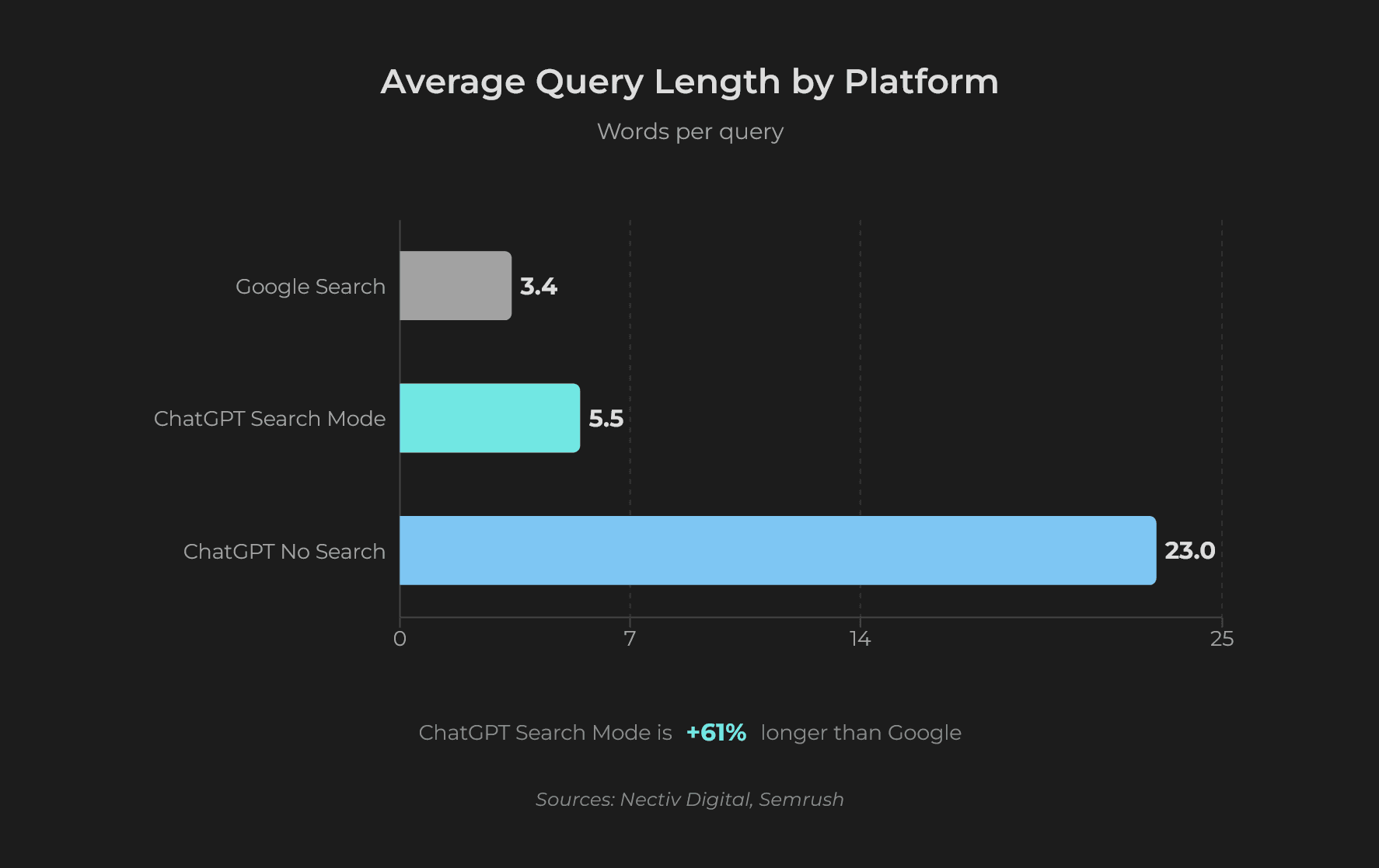
- ChatGPT queries average 5.48 words - 61% longer than Google's 3.4-word average
- 67% of ChatGPT prompts trigger multiple internal searches (3.51 average), not just one
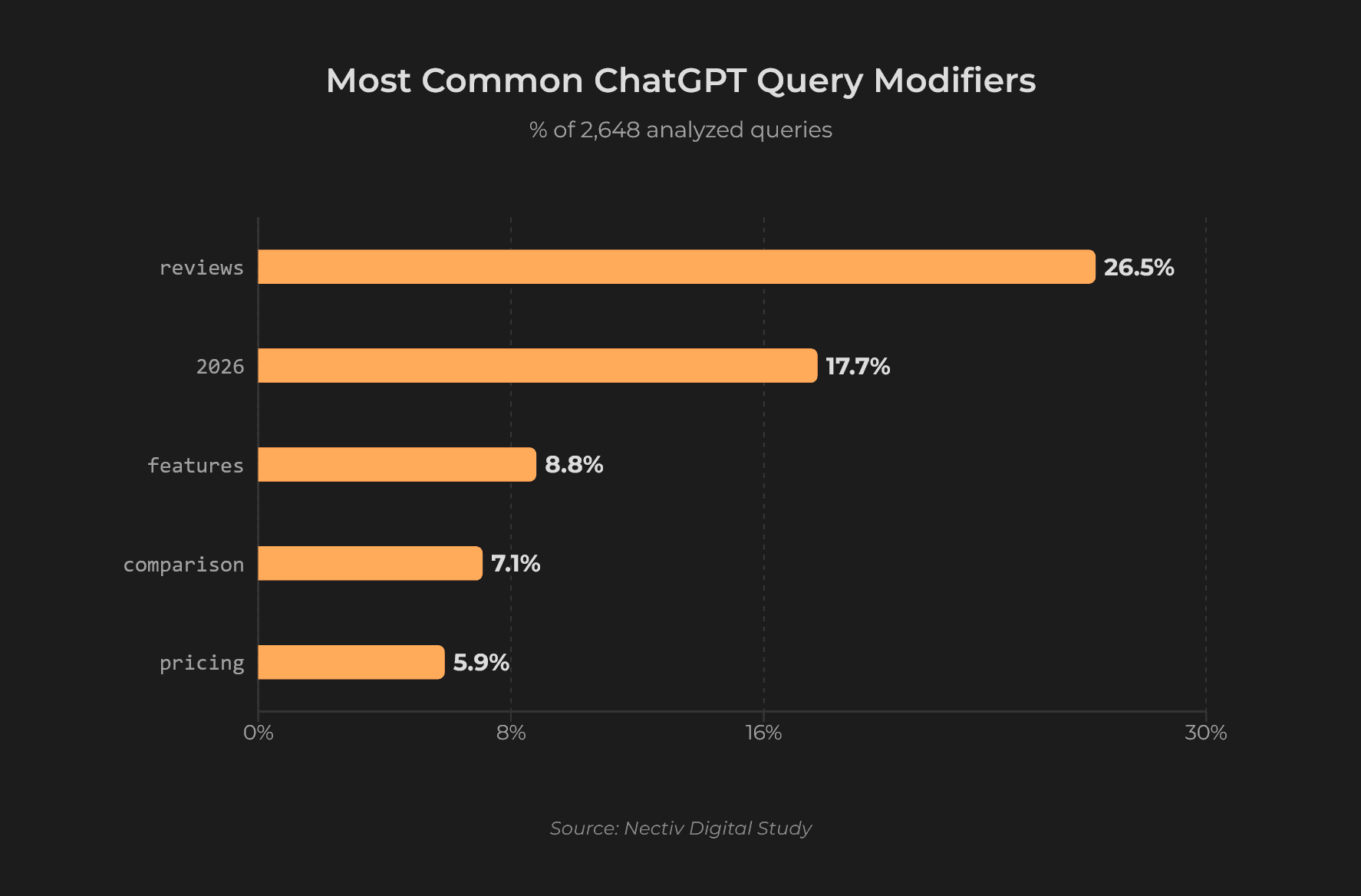
- Top query modifiers: "reviews" (26.5%), current year (17.7%), "features" (8.8%), "comparison" (7.1%)
- Traditional single-keyword SEO fails for AI visibility - you need semantic cluster coverage
- Action: Audit your content for 5+ word natural language phrases and year/modifier coverage
The disconnect isn't random. ChatGPT search behavior follows different rules entirely. While Google matches keywords, ChatGPT runs conversational queries that your short-tail content doesn't match.
People type to ChatGPT like they're talking to a colleague - full sentences, context, and follow-up questions. Google trained us to think in keywords. ChatGPT undid that training in months.
The data confirms this shift. A Nectiv Digital study analyzing 8,500+ prompts found that ChatGPT's internal search queries average 5.48 words. That's 61% longer than Google's average of 3.4 words, according to Semrush data.
Even more striking: 77% of ChatGPT queries contain five or more words. The maximum observed query length hit 12 words - phrases like "best interchange rate credit card USA interchange fee rates credit card issuer."
Why the length difference matters
Google's algorithm was built for keywords. Type "best CRM" and it knows what you want. ChatGPT works differently. It processes natural language, which means it generates search queries that mirror how humans actually think about problems.
When someone asks ChatGPT "What project management tool should I use for a remote team of 15 people with a tight budget?", ChatGPT doesn't search for "project management tool." It breaks that prompt into multiple specific queries that capture the nuances - team size, remote work, budget constraints.
This architectural difference creates a visibility gap. Content optimized for short head keywords ranks on Google but never surfaces in ChatGPT responses. The queries ChatGPT runs simply don't match.
What Is Query Fan-Out and Why Does It Matter?
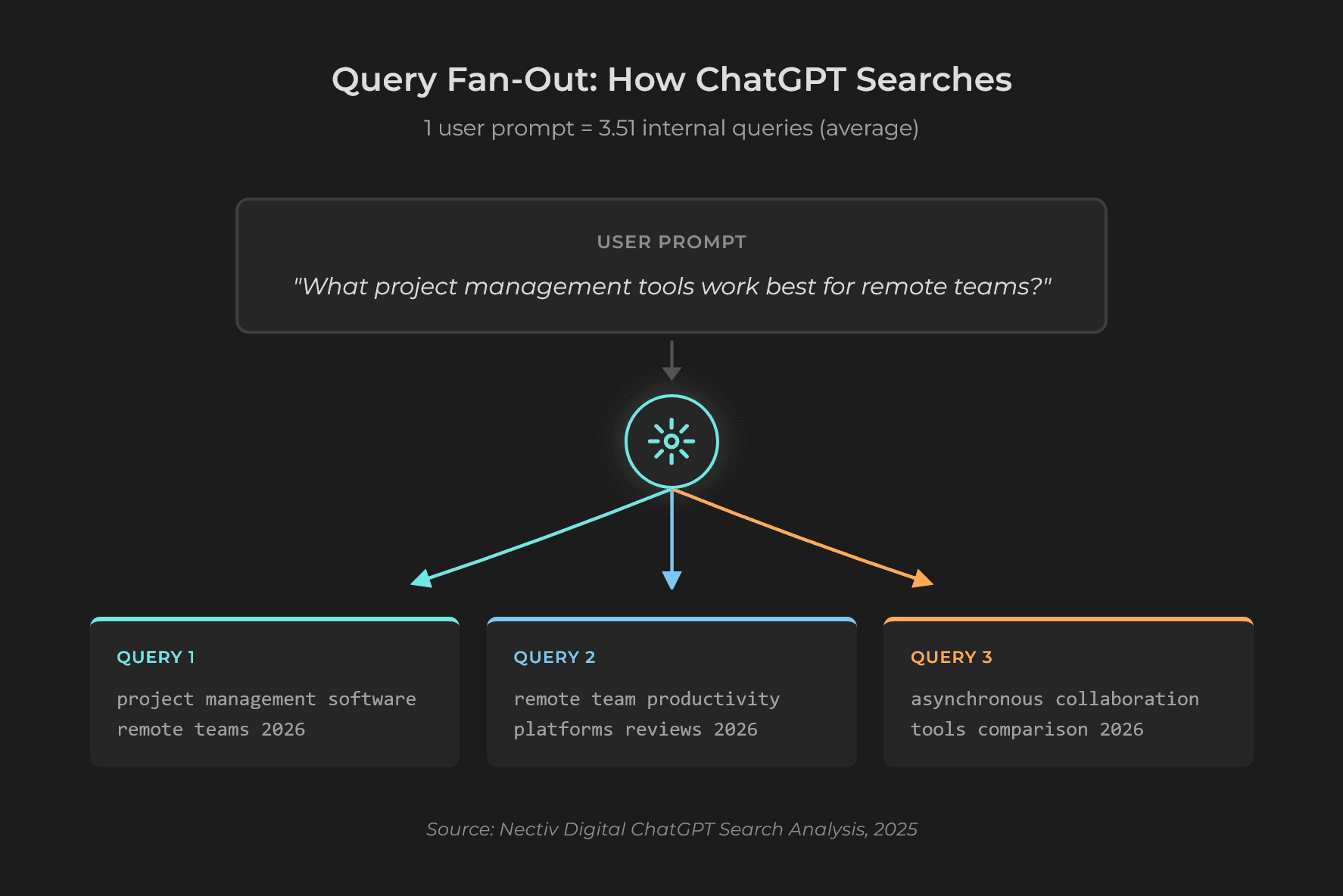
Query fan-out is the process where ChatGPT runs multiple internal searches for a single user prompt. Instead of one query, ChatGPT sends 2-4 searches to gather comprehensive information before generating a response.
The numbers are significant. ChatGPT averages 3.51 queries per prompt, with 67.3% of prompts triggering multiple searches. The most common pattern is 3 queries per prompt, with a maximum cap of 4 observed in the Nectiv study.
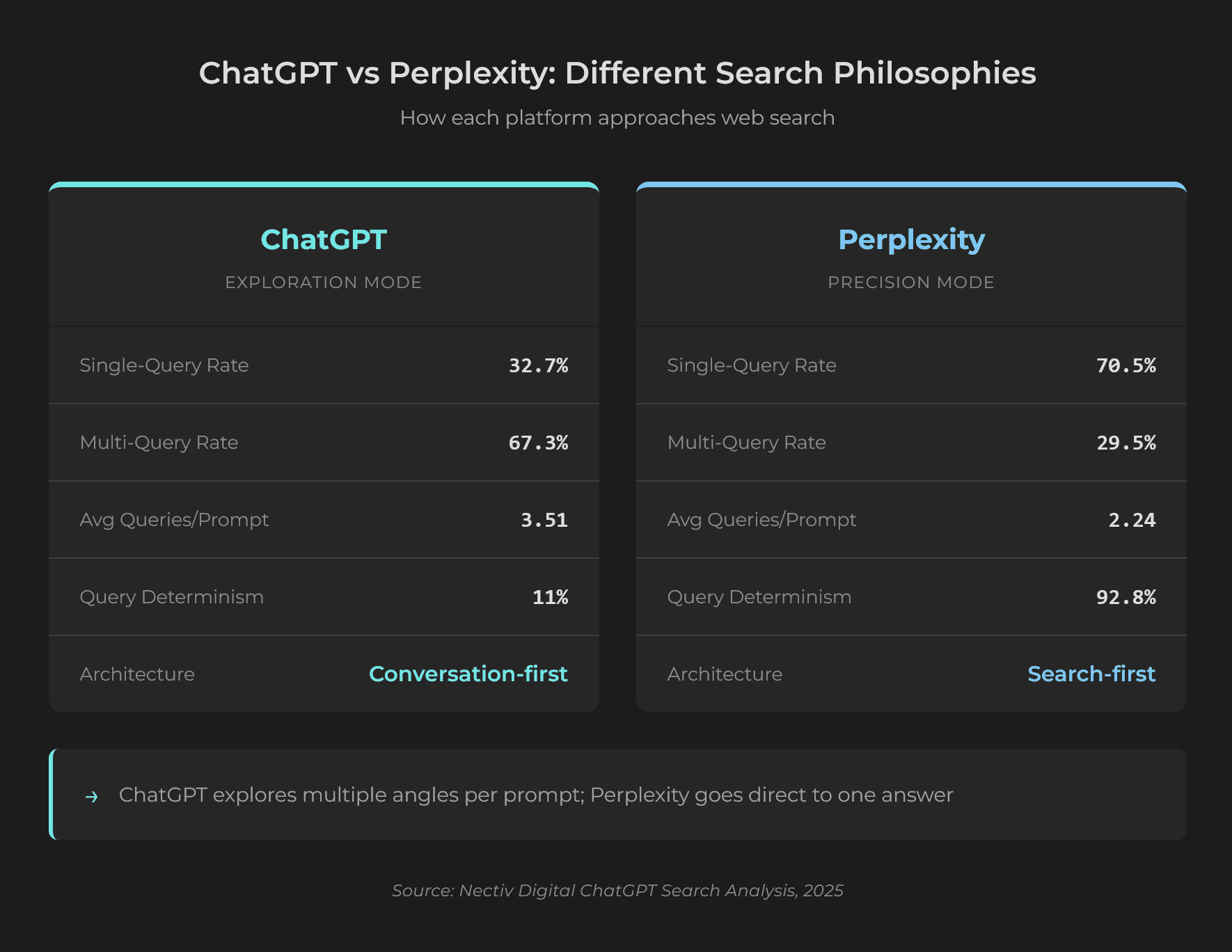
| AI Platform | Single-Query Rate | Multi-Query Rate | Avg Queries/Prompt |
|---|---|---|---|
| ChatGPT | 32.7% | 67.3% | 3.51 |
| Perplexity | 70.5% | 29.5% | 2.24 |
| Average | 55.8% | 44.2% | 2.65 |
Source: Qwairy 102K Query Study (Q3 2025 data)
The 8 query variant types
A Google Patent (US 11663201 B2) describes how AI systems generate query variants:
- Equivalent - Same meaning, different phrasing
- Specification - Narrower focus
- Generalization - Broader context
- Follow-up - Natural conversation progression
- Comparison - Entity relationships
- Clarification - Disambiguation
- Related aspects - Connected topics
- Temporal - Time-dependent queries
When you ask "best project management tools for remote teams," ChatGPT might generate:
- "project management software remote teams 2026"
- "asynchronous collaboration tools comparison"
- "remote team productivity platforms reviews"
If your content only targets the first query, you miss the other two. That's a 66% visibility loss from a single prompt. How to actually inspect ChatGPT's fan-out queries with the ?hints=search URL parameter walks through the methodology for seeing the fan-out for any prompt yourself rather than inferring it.
ChatGPT vs Perplexity: Different strategies needed
The platforms have opposite architectures. ChatGPT is conversation-first - it explores broadly to understand context. Perplexity is search-first - it prioritizes precision over exploration.
This matters for your content strategy:
- For ChatGPT: Cover semantic clusters. Your content needs to appear across multiple query variants because ChatGPT rewards comprehensive coverage.
- For Perplexity: Win the primary query. With 70.5% single-query prompts and 92.8% query determinism, ranking #1 for the main keyword matters more.
Understanding these differences helps you prioritize. If your audience uses ChatGPT heavily, cluster coverage beats single-keyword dominance. ChatGPT and Perplexity are two of five engines that diverge here - the per-platform mix and divergence patterns across ChatGPT, Claude, and Gemini in 2026 maps the full picture across all five.
Which Query Modifiers Does ChatGPT Use Most?
ChatGPT's internal queries follow predictable patterns. The Nectiv study identified the most common modifiers across 2,648 extracted queries:
| Modifier | Instances | % of Queries | Why It Matters |
|---|---|---|---|
| reviews | 702 | 26.5% | Evaluation intent |
| 2026 | 468 | 17.7% | Recency bias |
| features | 234 | 8.8% | Product discovery |
| comparison | 187 | 7.1% | Competitive evaluation |
| pricing | 156 | 5.9% | Commercial intent |
The recency bias is particularly strong. Current year modifiers appear 184x more frequently than the previous year, even when users don't explicitly request current information. ChatGPT's architecture prioritizes fresh content to compensate for knowledge cutoffs.
Industry-specific patterns
Different industries trigger different modifier patterns:
- Software: "tools" and "pricing" appear alongside core modifiers
- Commerce: "features" and "free" show higher prominence
- Local: Geographic modifiers dominate ("near me," city names)
- Jobs/Careers: Highest query depth (2.97 average) with complex information needs
For SaaS companies, this means your content strategy should include:
- Feature comparison pages with current year in the title
- Pricing pages that are regularly updated
- Review aggregation or testimonial pages
- Direct competitor comparison content
Content missing these modifiers is effectively invisible to a significant portion of ChatGPT's internal queries.
How Should You Adapt Your Content Strategy?
The shift from Google-style SEO to AI visibility requires specific changes. Here's what works and what doesn't.
What doesn't work anymore
Mistake 1: Optimizing only for head keywords
Targeting "CRM software" worked for Google. ChatGPT's query fan-out means your content needs to answer "CRM software for small teams," "CRM pricing comparison 2026," and "CRM features for sales teams" - all from a single user prompt.
Mistake 2: Ignoring year and recency modifiers
Content without current year markers gets deprioritized. ChatGPT auto-appends year modifiers to queries, and content dated "2024" or with no date signals loses to fresher alternatives.
Mistake 3: Not covering query variants
Single-topic pages miss 66%+ of potential visibility. When ChatGPT runs 3-4 queries per prompt, appearing in only one means losing the other citation opportunities.
What works for AI visibility
Target 5-12 word natural language phrases. This matches 77% of ChatGPT's query patterns. Instead of "project management," target "best project management tools for remote teams 2026."
Include modifiers in titles and H1s. Add "reviews," current year, "comparison," or "features" where relevant. These match ChatGPT's most common query patterns.
Build pillar + cluster architecture. Create comprehensive pillar pages that link to focused cluster articles. This coverage model matches how ChatGPT explores topics across multiple queries.
Update content with current year markers. Add the year to titles, update statistics, refresh examples. The recency bias is real and measurable.
Ensure technical accessibility. AI crawlers have specific technical requirements - page speed, JavaScript rendering, and crawlability affect whether your content even gets indexed for AI retrieval.
Build authority signals. Backlinks still matter for AI visibility because they signal which sources are trustworthy enough to cite. AI systems favor well-known brands and frequently cited sources when synthesizing responses.
Quick audit checklist
Run this against your top 10 pages:
- Does the title contain a natural language phrase (5+ words)?
- Is the current year included in title or H1?
- Does the page include modifier-rich content (reviews, comparison, features)?
- Does the content answer related questions, not just the primary topic?
- Is the page technically accessible to AI crawlers?
Pages failing 3+ checks need immediate attention for AI visibility.
Tools like CompetLab can track which companies ChatGPT, Claude, Gemini, Perplexity, and Google AI Overviews recommend in your category, and whether you are among them - giving you visibility into whether your content optimization is actually working.
What to Do Next
Start with the quick audit checklist above on your top 10 pages. If three or more checks fail, prioritize fixing those pages first - they're likely invisible to ChatGPT despite ranking on Google.
Frequently Asked Questions
Does ChatGPT use Google or Bing for searches?
ChatGPT uses Bing through Microsoft's Prometheus integration. When ChatGPT triggers a web search, it sends queries to Bing's index, retrieves 20-30 top results, and synthesizes them using its own logic rather than Bing's native ranking. This means Bing SEO fundamentals matter, but ChatGPT applies its own relevance filtering on top. Your content needs to rank well in Bing AND be structured for AI extraction.
How often does ChatGPT trigger a web search vs use training data?
According to Semrush clickstream analysis of 80 million records, 46% of ChatGPT interactions utilize the web search feature. The remaining 54% rely on training data alone. Search activation varies by industry - local queries trigger searches 59% of the time, while fashion queries only trigger searches 19% of the time. Complex, time-sensitive, or comparison queries are most likely to trigger web searches.
Can I see what queries ChatGPT runs for my prompts?
Not directly within ChatGPT's interface. The internal queries happen behind the scenes. However, tools like Nectiv's AI Tracker can monitor what queries ChatGPT generates for specific prompts. Some users have also discovered the ?hints parameter in ChatGPT's research mode that exposes query behavior. For most users, the practical approach is understanding the patterns (5+ words, modifiers, fan-out) and optimizing content accordingly.
See your AI visibility
Find out how ChatGPT, Claude, Gemini, Perplexity and Google AI Overviews answer when buyers look for tools like yours — where you show up, and against whom.
Share this article