AI Visibility for B2B SaaS: The 2026 Complete Guide
A B2B buyer asks ChatGPT for "best competitive intelligence tools." Three names come back. Yours is not one of them. The buyer builds a shortlist of five. Four came from the AI. By the time your sales team hears about the account - if they hear at all - the decision has already filtered to the top two AI-recommended vendors.
This is not a future scenario. Forrester's 2026 State of Business Buying report puts generative AI at the top of buyer research interactions, ahead of Google and ahead of peer referrals. DerivateX's 2026 benchmark of 50 SaaS companies across 1,400 buyer-intent prompts found 44% of them functionally invisible to AI buyers. The math behind that invisibility - and the specific moves that have shifted brands off zero in 2025-2026 - is what this guide covers, layer by layer.
Key Takeaways
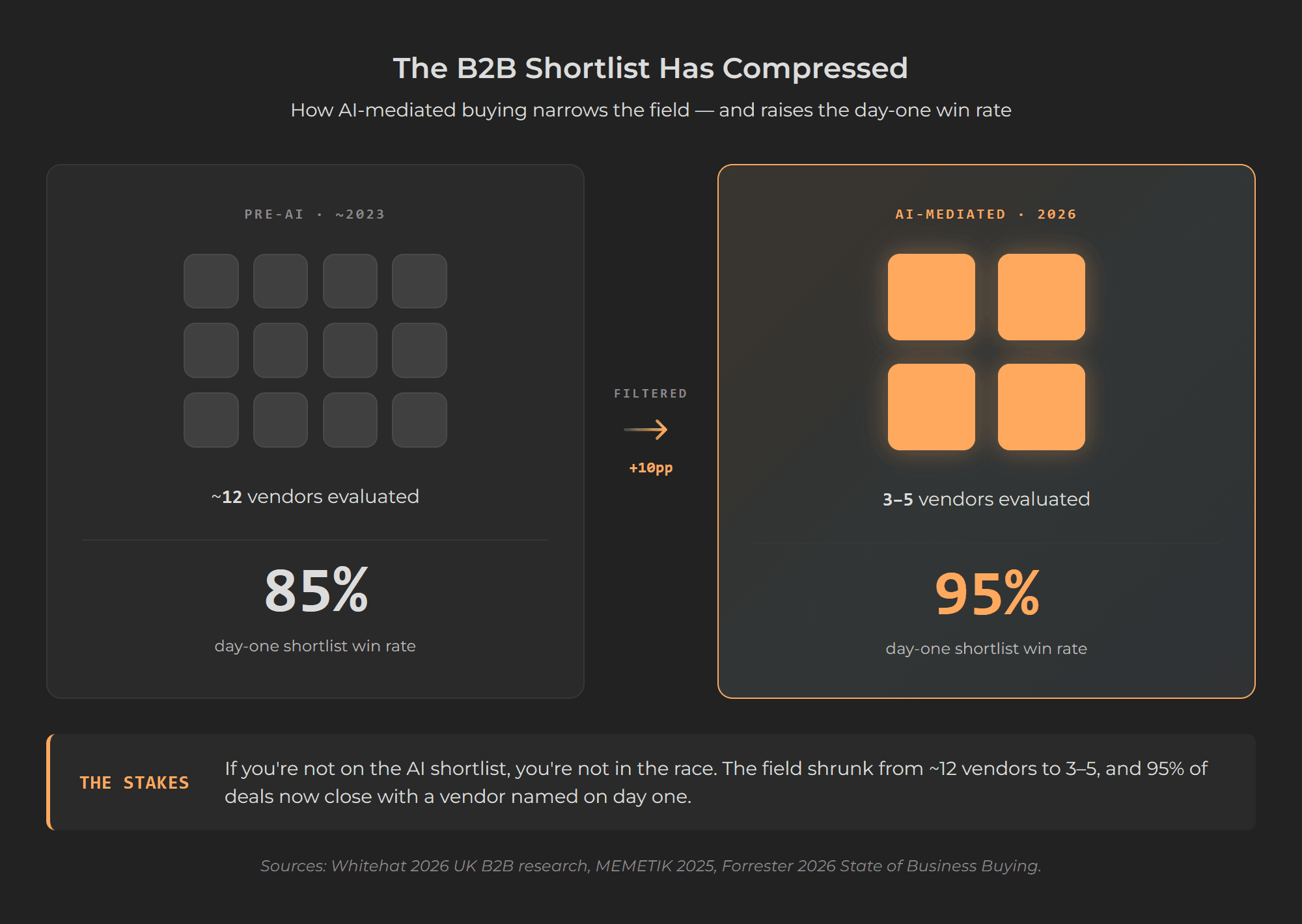
- AI assistants compress B2B vendor shortlists from ~12 evaluated vendors to 3-5; 95% of winners are on the day-one shortlist (Whitehat 2026, MEMETIK 2025, Forrester)
- 44% of B2B SaaS companies are functionally invisible to AI buyers — DerivateX's 2026 benchmark of 50 SaaS firms across 1,400 prompts found average AI Presence Score 56.9/100, bottom half below 50
- The same 15 domains capture 68% of all citations across ChatGPT, Claude, Gemini, Perplexity, and AI Overviews (5WPR 2026, 680M citations) — visibility is mediated by a small cross-platform hub set
- Retrieval-time wins are fast (Perplexity hours, Google AI Mode 24h, ChatGPT search 8% day-1 → 42% day-30); training-time wins are quarters-to-years and vendor-opaque
- Per-LLM tuning is unavoidable — four agent-readiness signals predict opposite outcomes in Claude vs GPT (FDR-significant in both directions); a universal AI visibility score is unreachable in current data
- The realistic horizon for moving from 0% to measurable visibility is 6-8 months: technical floor → content structure → entity layer → off-site signals, with per-engine measurement throughout
Why is AI visibility now load-bearing for B2B SaaS pipeline?
AI assistants have become the primary entry point for B2B vendor research. Buyers compress 12-vendor consideration sets to 3-5 vendors before any sales conversation begins, and 95% of winning vendors are on the day-one shortlist. If your brand is not in the AI's answer, you are not in the consideration set.
The shift is documented across multiple 2025-2026 sources. MEMETIK's analysis of 50,000+ B2B buying journeys found 70% of B2B purchases now start with AI assistant queries, with consideration sets shrinking from approximately 12 vendors to 3-5. Whitehat's 2026 UK B2B research reports that 94% of buyers used an LLM during their purchasing journey, and that 95% of winning vendors were on the day-one shortlist - up from 85% in 2024. DeepMarketing's 2026 GEO guide, drawing on Forrester and Gartner data, characterizes Stage 1 of the AI-first buyer funnel as an LLM conversation that produces a 3-5 vendor shortlist with pros and cons.
The pipeline impact is consistent across studies. Memetik's data, taken directionally because Memetik is a vendor in the AI visibility space, reports 2.3x demo request rates, 34% shorter sales cycles, and 47% of buyers selecting one of the top two AI-presented options. Forrester's 2026 State of Business Buying puts generative AI at the top of buyer research interactions, ahead of Google and ahead of peer referrals. Buyers using generative AI arrive more qualified, close faster, and rely on fewer total vendor interactions before purchase.
DerivateX's 2026 B2B SaaS benchmark provides the cleanest B2B-specific picture. 50 companies across 1,400 buyer-intent prompts, scored 0-100 across ChatGPT, Perplexity, Claude, and Gemini. The average score: 56.9. The bottom 44% scored below 50, classified as functionally invisible. The spread is wide: Ahrefs scored 83 in SEO analytics versus Semrush at 68, ServiceTitan 68 versus Jobber 41 in field service management, Zapier 63 versus Make 40 in workflow automation. Category leaders are pulling ahead of challengers in AI mention frequency by margins traditional marketing channels rarely produce.
The category-leader advantage compounds. Whitehat's UK research found buying cycles compressed 20% - from 10 months to 8 months - between 2024 and 2026, with AI chatbots becoming the number-one influence on shortlists at 17.1%, ahead of review sites and vendor websites. Faster cycles favor vendors already in the AI's answer; they harm late entrants.
A practical caveat. AI is not the only channel. Enterprise procurement still routes through Gartner reports, RFPs, and analyst briefings. Some buyers, especially in regulated verticals, bypass AI tools entirely. But the trend line is the load-bearing observation. AI-using buyers arrive faster and pre-qualified, the share of buyers using AI grew through 2025 and 2026, and the cost of being absent from the AI's recommendation list has become a real pipeline cost rather than a hypothetical one. We measured this on ourselves at CompetLab and confirmed it - the full 0% case study walks through what we found and what shifted in the 30-day re-run.
How do AI engines decide which brands to mention?
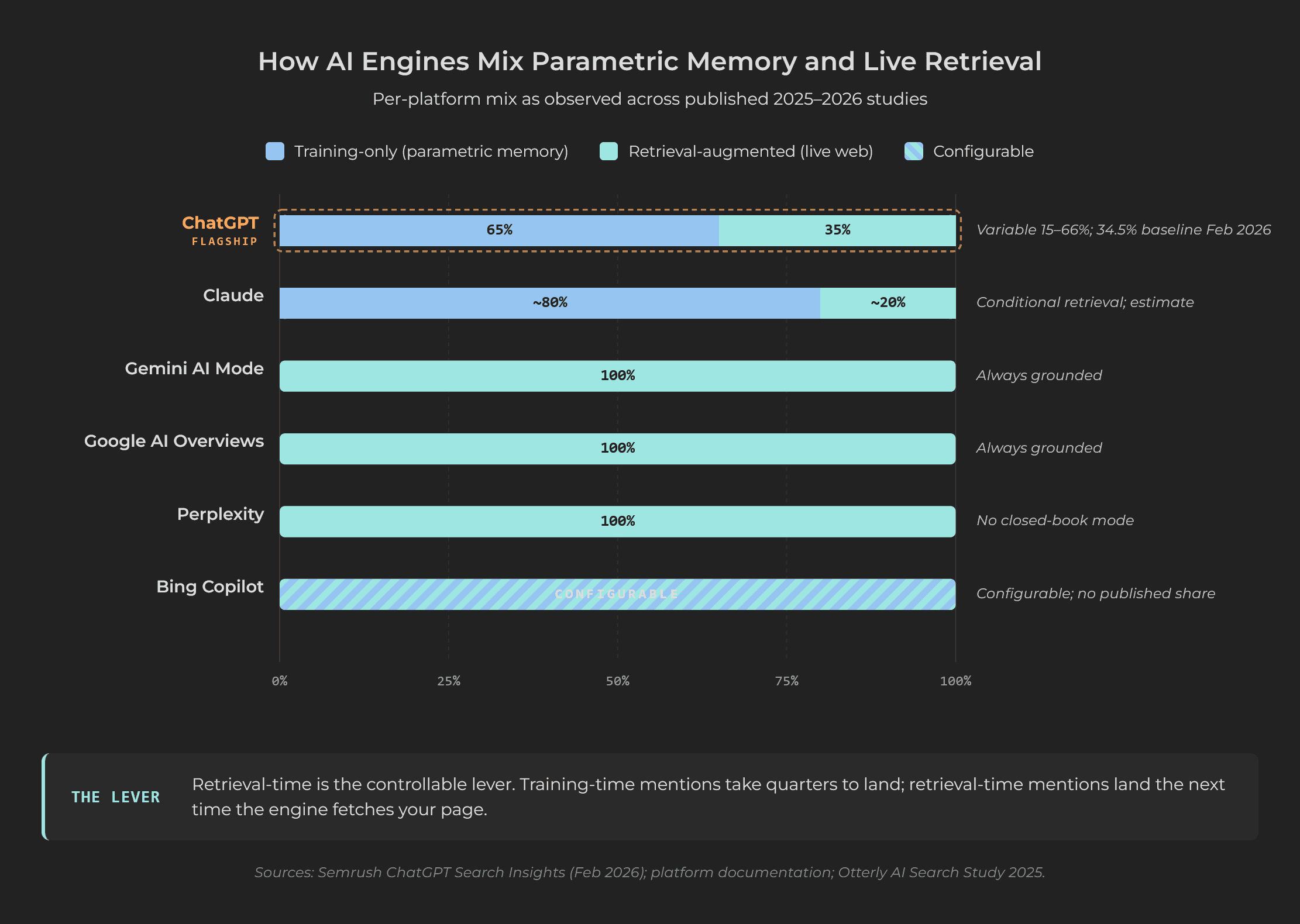
AI engines mix parametric memory (training-time visibility) with live retrieval (retrieval-time visibility), at very different ratios per platform. ChatGPT triggers web search on roughly 34.5% of queries. Perplexity is 100% retrieval. Gemini AI Mode and Google AI Overviews always ground in live results. Retrieval-time is the controllable lever; training-time is a slow second-order effect.
Training-time vs retrieval-time visibility
Training-time visibility means your brand appears because it was in the model's pretraining or post-training corpus. The model accesses this stored knowledge at inference without calling external tools. Updates to parametric memory require new training runs or continued pretraining - slow cycles measured in quarters or years, opaque to outside observers.
Retrieval-time visibility means the model performed a search at query time and surfaced your brand because the search returned your content as relevant evidence. The retrieval index updates continuously; well-optimized content can be discoverable to AI systems within hours of being indexed.
The distinction matters because different signals influence each layer. Brand search volume, broad cross-platform presence, and mentions across high-authority sources feed both layers but at different speeds. Freshness is a strong retrieval-time signal: 76.4% of ChatGPT's most-cited pages were updated within 30 days per Ahrefs. It affects training-time only when the next training run absorbs the new content. Indexing and crawlability are critical for retrieval; AI crawlers cannot cite what they cannot fetch. Training corpora draw from broader sources and tolerate more variance.
For a B2B SaaS at 0% AI visibility, the practical sequencing is retrieval-first. The feedback loop is observable in days to weeks. Training-time visibility is a slow side effect of broader brand-building.
Per-platform behavior in 2025-2026
The mix of training-only versus retrieval-augmented behavior varies substantially:
- ChatGPT is mixed. Semrush's clickstream analysis of 17 months of data found ChatGPT enables web search on 34.5% of queries as of February 2026, with monthly variance from 15% to 66%. Roughly two-thirds of prompts answer from training memory alone.
- Claude is conditional. The web_search tool fires when up-to-date information is needed. No public trigger rate is published; expect parametric-default with retrieval augmentation on time-sensitive queries.
- Gemini AI Mode and Google AI Overviews are 100% retrieval-grounded. Both always identify supporting web results from Google's index. AI Overviews appeared on 6-25% of Google queries through 2025-2026, with prevalence varying by month and methodology.
- Perplexity is 100% retrieval. Architecture papers describe a multi-stage RAG pipeline that runs before any generation. There is no closed-book mode for consumer search.
- Bing Copilot is configurable. Web grounding can be toggled. Microsoft has not published the share of grounded versus parametric responses.
Retrieval mechanics: fan-out, rerank, position bias
When AI engines do retrieve, they do not run a single query against the user prompt. ChatGPT averages 3.51 internal queries per prompt; 89.6% of 15,000 prompts trigger at least two follow-up searches per AirOps; query length averages 5.48 words, 61% longer than typical Google searches. The mechanism is "query fan-out" - the AI rewrites your prompt into multiple sub-queries that capture different facets, retrieves candidate documents per sub-query, then reranks the merged candidate pool.
Reranking is where most selection happens. Cross-encoder models score each candidate against the query for answer quality, extractability, and structural clarity. Research shows cross-encoders deliver 33-42% accuracy improvement over retrieval-only scoring. A high-authority page with buried answers loses to a lower-authority page with a clean direct answer. The full retrieval-and-rerank pipeline is the structural reason traditional SEO ranking does not predict AI citation rates well.
Position bias inside cited pages is sharp. CXL's analysis of 100 AI Overview pages found 55% of citations come from the first 30% of content. ALM Corp's analysis of 1.2 million ChatGPT responses confirmed the pattern at 44.2%; the bottom 10% of pages contributes 2.4-4.4% of citations. The "Lost in the Middle" effect, documented in TACL 2024, shows language models attend most strongly to information at the start and end of context windows. Front-loading direct answers under each H2 section is the highest-leverage structural move.
Per-platform divergence
Different engines cite different sources for the same query. Citation overlap pairs from SE Ranking's 2,000-query study and Otterly's 2025 analysis:
- ChatGPT and Perplexity: 25% domain overlap
- ChatGPT and Google AI Overviews: 21%
- Perplexity and Google AI Overviews: 19%
- Google AI Overviews and Google AI Mode: 14% - same company, different products
- Bing Copilot and ChatGPT: 14%
Even within Google, AI Overviews and AI Mode agree on sources only 13.7% of the time across 730,000 responses. The three major B2B-relevant LLMs disagree on category recommendations 62% of the time per CompetLab's own 9-query benchmark.
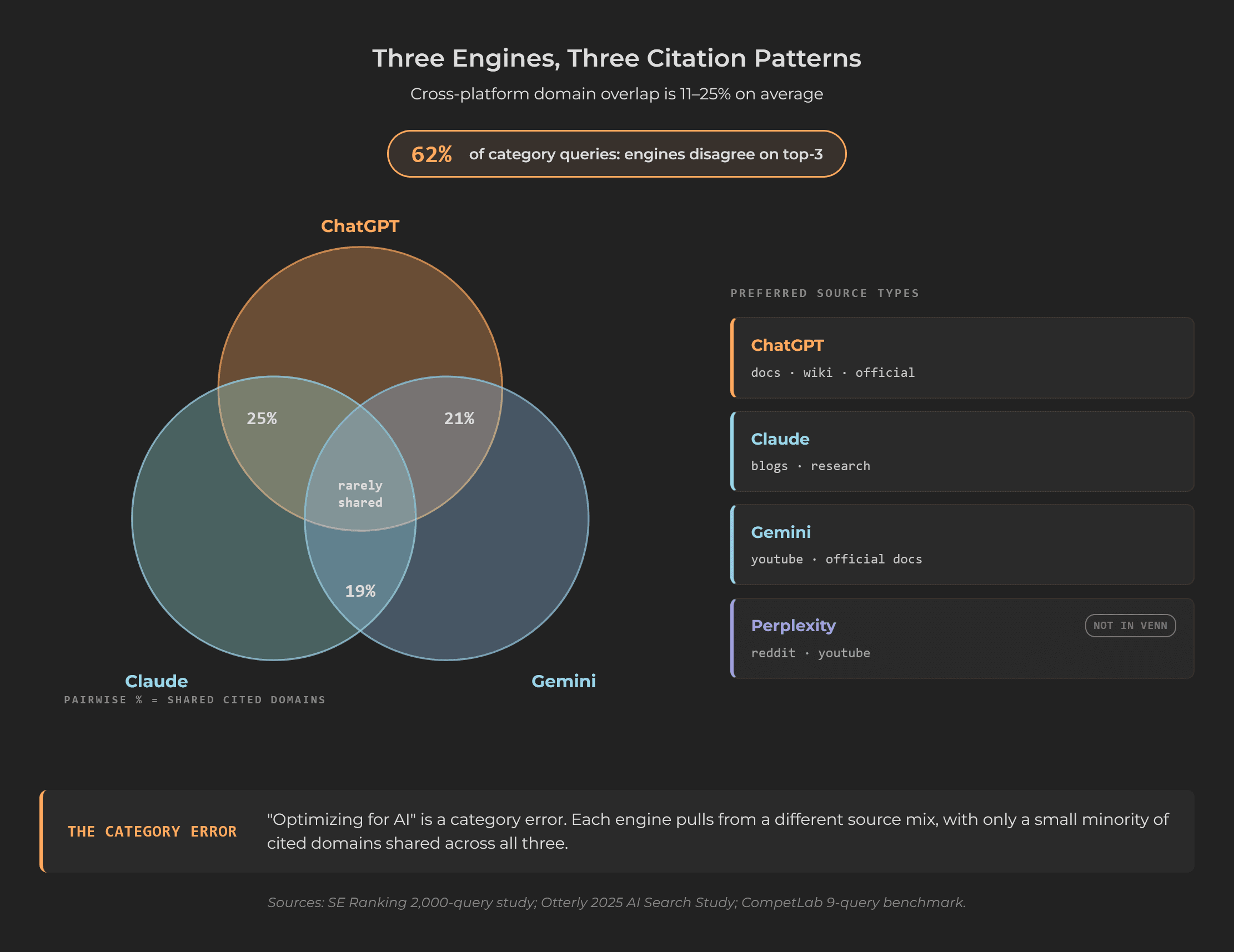
The implication is structural. Optimizing for "AI" generically misses the per-platform fragmentation. Each engine reads by partly different rules, draws from partly different corpora, and rewards partly different signals.
What signals does AI actually use to decide which brands to cite?
AI cites brands that satisfy three layered conditions: extractable content structure, a clean entity profile, and dense third-party signal. Mentions across high-authority external sources matter roughly three times more than backlinks. The same 15 cross-platform domains capture 68% of all citations across major engines. Without all three layers, even strong content gets ignored.
The content layer
AI engines extract passages, not articles. The extraction unit is the section under each H2. RAG pipelines treat H2 and H3 headings as chunk boundaries; each section becomes its own embedding, retrieved independently. This produces measurable structure preferences.
Question-format H2 headings get cited 3.1x more than statement headings in AI Overviews per Searchforged. Pages with clear H1-H2-H3 hierarchy are cited 2.8x more than those with poor heading structure per AirOps's 12,000-URL analysis. Answer-first sections - direct answer in the first 40-80 words, evidence following - give extractors a self-contained unit to lift. The optimal extractable section is 100-300 words with the direct answer in the first 40-80 words; AI Overviews extract units that cluster around 134-167 words.
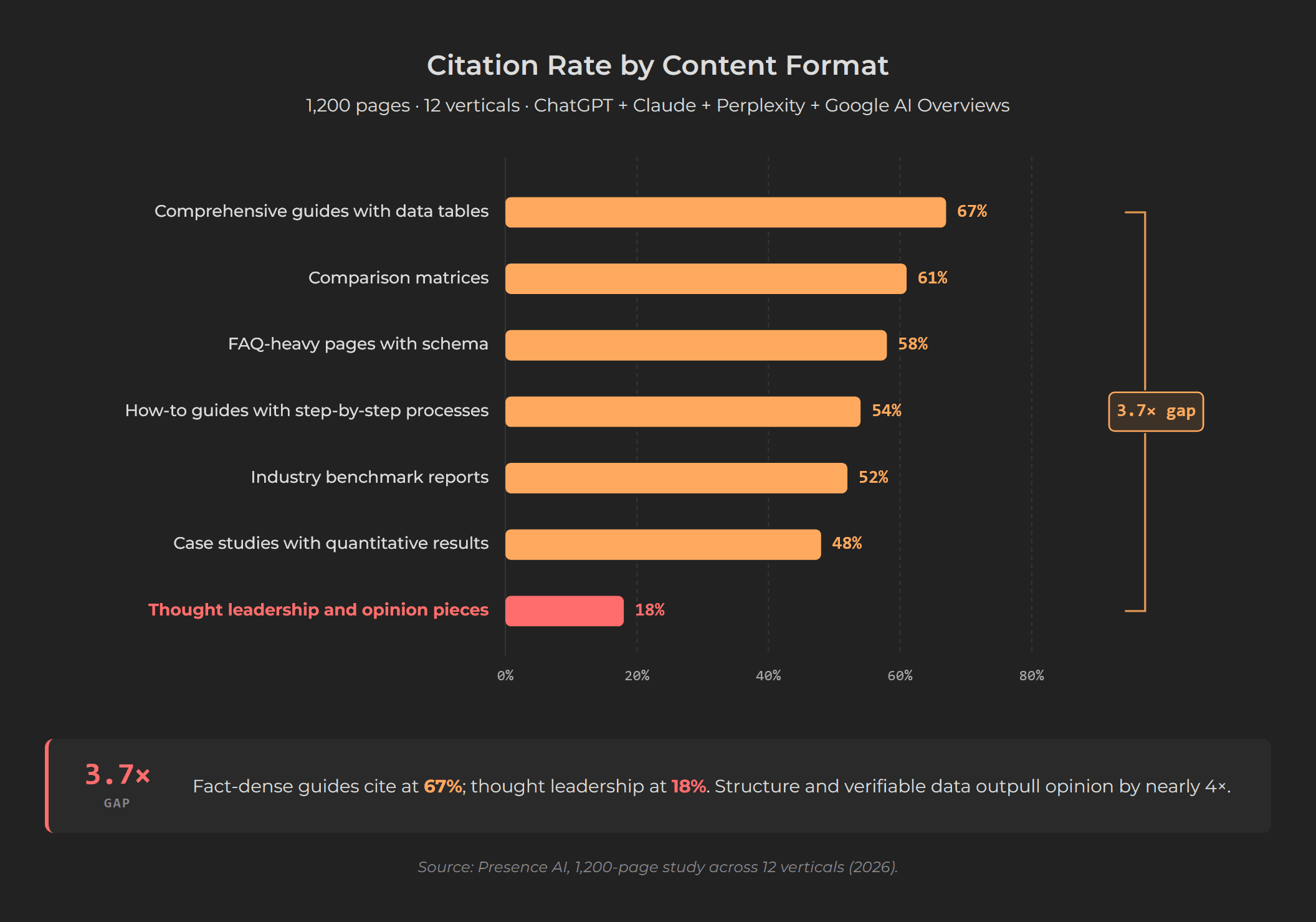
Format hierarchy in citation rates from Presence AI's 1,200-page study across 12 verticals:
| Content Type | Citation Rate |
|---|---|
| Comprehensive guides with data tables | 67% |
| Comparison matrices | 61% |
| FAQ-heavy pages with schema | 58% |
| How-to guides with step-by-step processes | 54% |
| Industry benchmark reports | 52% |
| Case studies with quantitative results | 48% |
| Thought leadership and opinion pieces | 18% |
The 3.7x gap between data-backed guides and thought leadership is not a rounding error. It is the gap between extractable facts and inextractable opinions.
Schema implementation matters in proportion to its quality, not its breadth. SearchAtlas's domain-level study found schema coverage uncorrelated with AI visibility; page-level studies from Search Engine Land, Relixir's 50-site analysis, and Agenxus's 5,000-FAQ-page study found 28-67% citation lift from quality implementations. The hierarchy: HowTo schema delivers 42% higher CTR; FAQ schema 34-50% with substantive 150-300-word answers; Article schema is foundational; Organization schema delivers 85% citation improvement for B2B sites.
Length doesn't matter. Ahrefs analyzed 174,000 cited pages and found correlation between word count and citation at ρ=0.04 - essentially zero. Structure is the predictor.
The consolidation thesis cuts against most AI-visibility advice. SE Ranking's 2.3M-page study found FAQ schema alone has no statistically significant effect once content and authority are controlled. ZipTie's 2026 analysis put authority above schema 3.5:1 in ChatGPT citation decisions. Multiple case studies (VisibleIQ 16 to 74% in 90 days, Discovered Labs 8 to 24% with 288% ROI, Hashmeta 0 to 23.4%) reached AI visibility by restructuring fewer, stronger pages rather than publishing more. AI engines cite one source per topic; fragmenting your authority across five overlapping pages dilutes all five.
The entity layer
About pages account for only 1.9% of AI citations across branded queries per Omniscient Digital's 23,387-citation analysis, but receive 4.6x more citations per crawl than the average page per Trakkr Study 006 across 882 brands and 337,000 citations. They are not the cited URL most of the time. They are the canonical anchor AI uses to build the internal entity profile that informs every other answer about your brand.
Six structural elements concentrate entity signal:
- A canonical category-plus-audience sentence reused across your About page, LinkedIn description, Crunchbase summary, press boilerplate, and review-platform profiles. AI weighs opening sentences heavily when forming entity descriptions; convergence across surfaces lets AI lock the definition. Divergence forces AI to pick the most-repeated external description, usually outdated.
- A compact fact block - founding year, HQ, team-size band, founders, funding stage - presented as bullets. AI hallucinates these most; explicit bullets reduce the guessing surface.
- Organization and Person schema with sameAs links to LinkedIn, Crunchbase, G2, Wikidata. The sameAs property is the highest-leverage schema element: it tells AI that your site, your LinkedIn page, your G2 listing, and your Knowledge Graph entry are the same entity.
- Founder bios with credentials and external profile links nested as Person under the Organization schema's founder property.
- Named entity connections - partners, integrations, named customers in text (not just logos), awards, media mentions. Each named entity is a corroboration edge AI can verify.
- A short identity FAQ separate from any topical FAQ - "When was X founded?", "Where is X headquartered?", "Who uses X?" - with self-contained answer pairs.
Cross-platform consistency beats word count. A 600-word About page with structured facts and clean schema outperforms a 1,200-word narrative that contradicts what LinkedIn and G2 say about you. Status Labs reported 2.4x ChatGPT citation rates within 90 days for clients who expanded About pages from under 300 words to over 800 words with structured facts - but the working variable was structure, not length.
The off-site layer
Mentions matter approximately three times more than links for AI visibility. Ahrefs analyzed 75,000 brands and found brand mentions correlate with AI Overview visibility at ρ=0.664; backlinks at ρ=0.218. AirOps's 21,311-mention analysis found 85% of citations came from third-party domains versus 13.2% from the brand's own site. Brands are 6.5x more likely to be cited via third-party content than their own.
The mechanism is distributional semantics. Language models infer meaning from co-occurrence patterns. A brand name and a category phrase appearing together repeatedly across many independent documents produces a stable model association. Rand Fishkin's documented SparkToro tactic - asking every podcast host, conference, and webinar to introduce SparkToro as "the makers of fine audience research software" - exploits this directly. The phrase now appears on hundreds of indexed third-party pages. ChatGPT, Perplexity, and Claude consistently surface SparkToro for "best audience research tool."
Link properties have shifted from the traditional SEO model. Nofollow and dofollow correlate with AI mentions almost identically - less than 2% difference per Semrush's 1,000-domain study. Wikipedia and Reddit nofollow placements carry full weight. Image backlinks correlate 24% stronger than text links. Authority is nonlinear: median AI mention frequency jumps 3.7x between the 80th and 90th percentile of domain authority. Crossing thresholds matters more than accumulating links.
The cross-platform hub concentration reframes the entire off-site question. 5WPR's 2026 AI Platform Citation Source Index synthesized 680 million citations across ChatGPT, Claude, Perplexity, Gemini, and Google AI Overviews and found that the top 15 domains capture 68% of combined citation share. Reddit alone accounts for roughly 40% of citations across engines. Wikipedia, major business media, and review platforms (G2, Capterra, Trustpilot, TrustRadius - 88% of review-platform citations per SE Ranking) make up most of the rest. Per-LLM optimization matters, but visibility is increasingly mediated by a small cross-platform hub set that the same brands win on every engine.
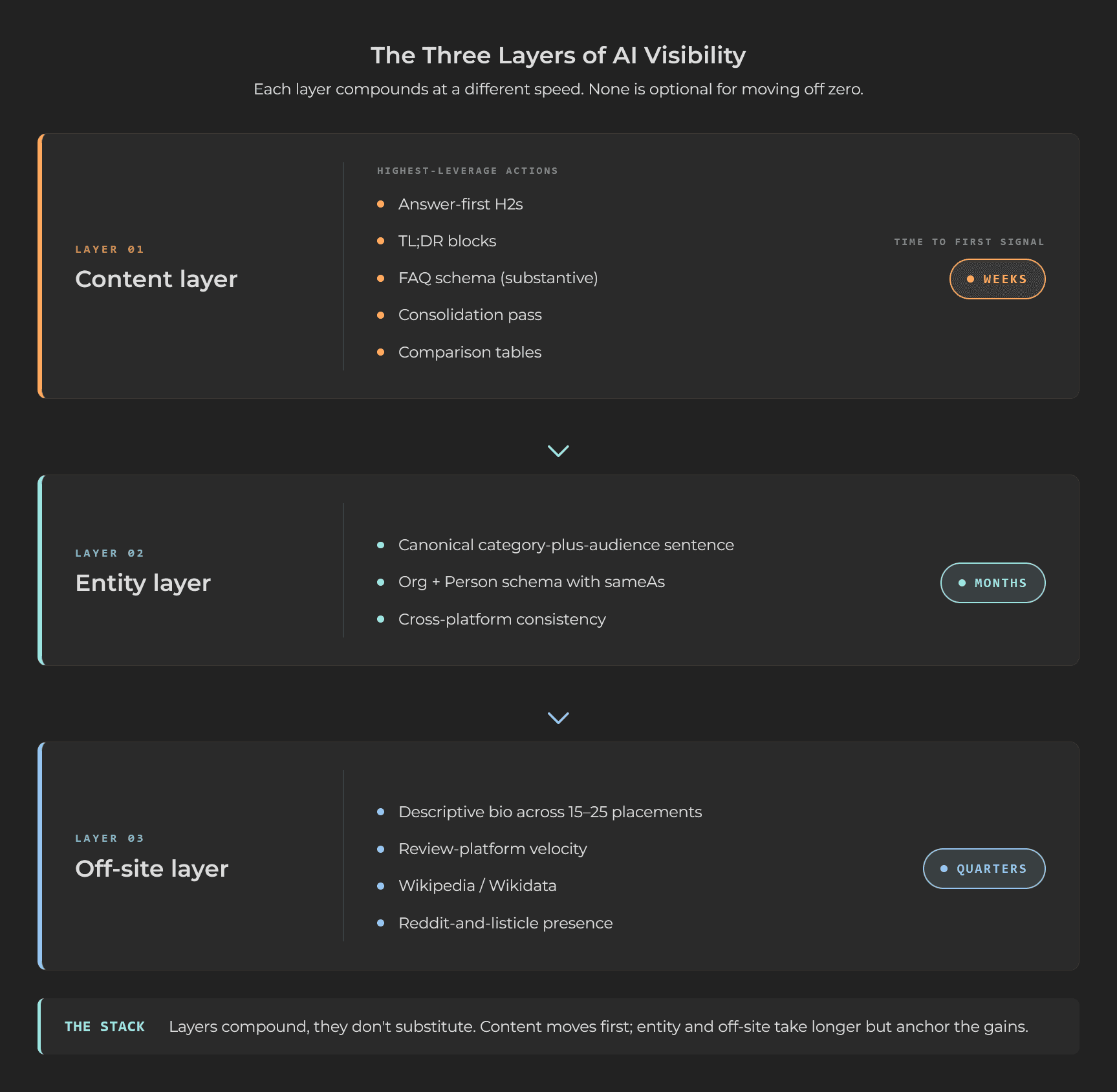
For a B2B SaaS at 0% AI visibility, the practical implication is asymmetric. The content layer can move in weeks. The entity layer compounds in a few months. The off-site layer - the strongest single AI visibility predictor - compounds over quarters. None of the three is optional, but their feedback loops have very different speeds.
Why does AI visibility require per-LLM strategy in 2026?
A single agent-readiness score across Claude, GPT, and Gemini is unreachable in current data. Four of the same agent-readiness signals predict opposite outcomes in Claude versus GPT - both directions cleared FDR significance in a 908-brand correlation study. Gemini reads by yet another pattern. Cross-LLM aggregates cancel the divergence. Per-LLM tuning is the only honest approach.
The empirical anchor is Respectarium's 2026 correlation study of 908 leading B2B SaaS brands tested against three agent-readiness scanners and five LLM-visibility outcomes. Four signals reverse direction at FDR significance:
| Signal | Claude ρ | GPT ρ |
|---|---|---|
| sitemap-exists | +0.134 | -0.172 |
| oauth-discovery | +0.135 | -0.113 |
| robots-txt-exists | +0.125 | -0.104 |
| markdown-negotiation | -0.106 | +0.119 |
Brands with a sitemap are more likely to make Claude's list and less likely to make GPT's list. Brands shipping markdown content negotiation are less likely to make Claude's and more likely to make GPT's. Same checks. Two LLMs. Opposite verdicts. Both directions FDR-significant. The full breakdown of why this happens (two competing hypotheses, neither yet tested) lives in the Claude and GPT reversal article.
Gemini reads by yet a third pattern. Markdown-url-support at ρ=+0.163 and redirect-behavior at ρ=-0.141 dominate Gemini's brand selection at FDR significance. Neither appears in Claude's or GPT's top predictors. On the four signals where Claude and GPT reverse, Gemini is essentially null.
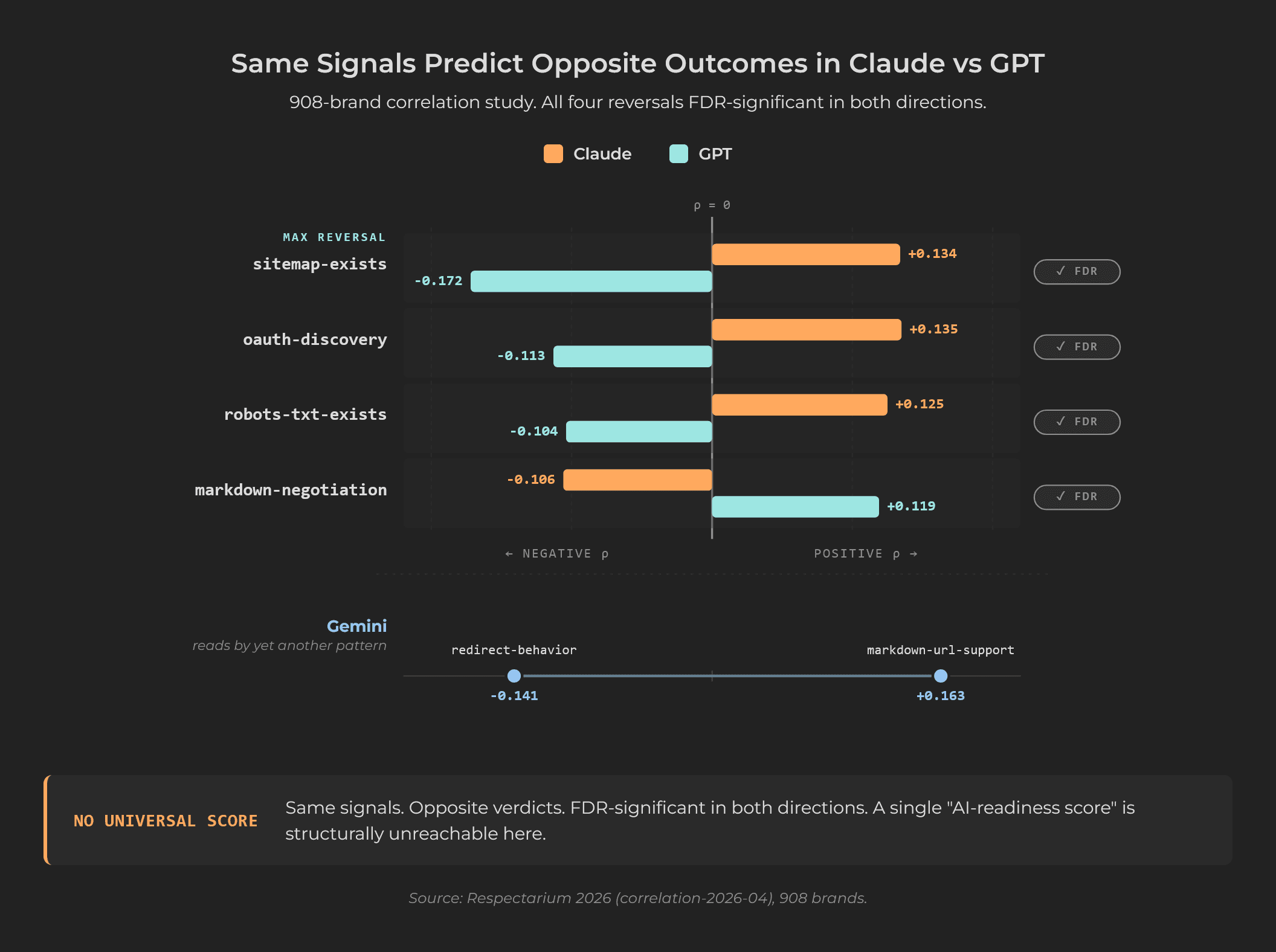
The implication is that any aggregate score that averages across LLMs cancels the per-LLM signal. Respectarium's own scanner aggregate scored mean |ρ|=0.016 across the five LLM-visibility outcomes, FDR-adjusted p=0.69. Zero predictive power. Not because the underlying signals don't matter, but because positive Claude correlations cancel against negative GPT correlations.
Scanner ecosystem fragmentation
Twelve mainstream agent-readiness scanners exist as of 2026. They measure three loosely-defined dimensions: reach (protocol discoverability - Cloudflare's isitagentready.com), read (content accessibility - Fern's Agent Score), and trust (identity and authentication - DataDome, HUMAN Security, Akamai). Most cover one dimension; a few cover two; none cover all three. The scanners produce sharply divergent scores for the same site - Mintlify scores 91 on Fern and 23 on Cloudflare. Cross-scanner correlation on same-named checks is ρ ≈ 0.03. The category has not hardened around shared definitions yet; expect different answers from different scanners and run more than one.
The technical floor
None of the per-LLM strategy matters if AI crawlers cannot fetch your content. AI crawlers (GPTBot, ClaudeBot, PerplexityBot) do not execute JavaScript. They timeout after 1-5 seconds versus Googlebot's 20. Vercel's analysis of crawler behavior found 70% of JavaScript-heavy websites are completely invisible to AI search platforms.
The technical floor checklist is small but non-negotiable:
- Server-side rendering or static generation for any content you want cited
- Native
loading="lazy"is safe for below-the-fold images; JavaScript-based lazy loading is fatal - TTFB under 200ms; degradation begins at 500ms
- LCP element under 2.5 seconds
- Curl test with
curl -A "GPTBot/1.0" https://yoursite.comto verify what AI crawlers actually see
If the curl test does not return your main content in the HTML, no other AI visibility work compounds.
Specs without practice and the first graduation
The agent-readiness protocol stack runs ahead of adoption. Respectarium's 908-brand study found 20 of 66 measured signals at less than 5% adoption - too thin to study. MCP Server Cards: 0.7-1.1% of brands. OAuth Protected Resource: 0.5-1.5%. AGENTS.md: 0.9%. A2A Agent Cards: 1.2-2.4%. The most-discussed protocol family clusters near zero. The x402 micropayments protocol, backed by Coinbase and IETF-aligned, collapsed from $913,000 daily volume in October 2025 to $28,000 by March 2026. Spec arrived. Demand did not.
The first observable graduation came in May 2026. Thunderbit's crawl of the Tranco Top 10,000 domains reported 5.86% valid llms.txt adoption - crossing the 5% variance threshold the original study used to filter non-analyzable signals. The graduation is in the predicted direction: content-layer specs already in production move first; protocol-stack specs lag. The specs-without-practice analysis tracks this on a quarterly cadence.
The strategic implication is to ignore agent-readiness scoring that aggregates across LLMs. Pick the LLM that matters most to your buyer (ChatGPT for mass-market reach, Claude for coding-tool buyers, Gemini for Workspace-bundled accounts), tune for that LLM's specific signals, and revisit as the ecosystem matures. The reversal observed in 2026 is not guaranteed to hold in 2027 as crawler behavior shifts.
How do you measure AI visibility, and what is the 90-day playbook?
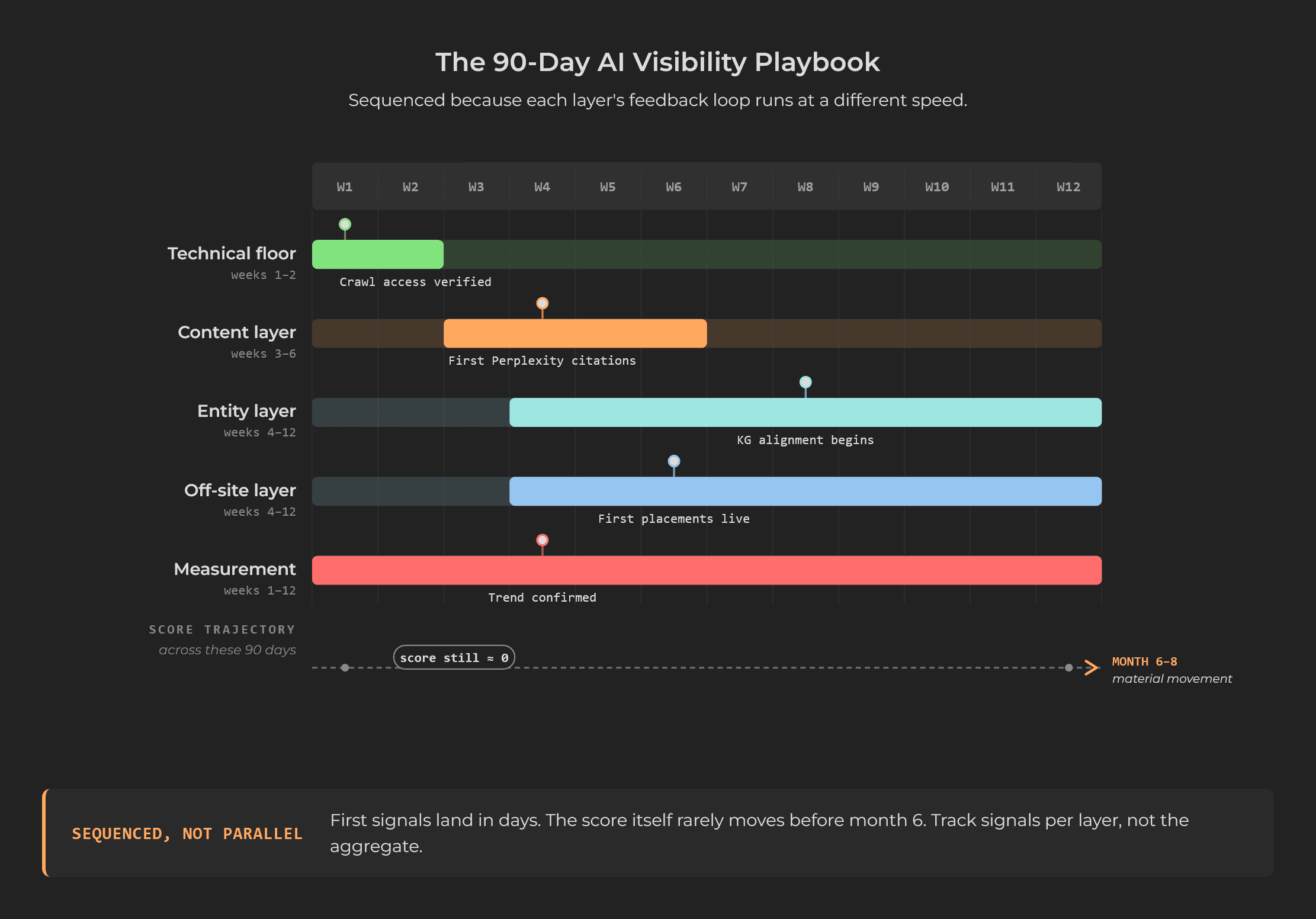
Measurement means counting how often each engine recommends you - per engine, never pooled - with an interval on every count and trend confirmation across two consecutive same-direction moves. The 90-day playbook sequences technical floor first (week 1-2), then content layer (3-6), then entity and off-site layers (4-12), with per-engine measurement running in parallel. First retrieval-time movement appears in weeks; off-site compounding takes quarters; first measurable movement off zero typically takes 6-8 months for a B2B SaaS at thin third-party density.
Measurement that survives LLM noise
LLM outputs are probabilistic. Standard tracking treats them as deterministic and produces noise that looks like signal. On a 9-query test, one query flipping registers as an 11-percentage-point swing - well within LLM variance. AirOps research found only 30% of brands stay visible from one AI answer to the next on the same query; 20% hold presence across five consecutive runs. A single run is a sample, not a reading.
The method that survives this runs in a spreadsheet (worked through, with the evidence behind it, in How to Measure Your AI Visibility):
- Start with the set, not the score: log every company each engine puts forward as an option in its answer - named as a choice, not mentioned in passing - and you have your market as the models draw it. That set is small and static; the first question is whether you are in it
- Count recommendations, per engine: for each company, named in how many of the answers that engine gave. Never pool engines into one score; the per-platform divergence above makes the average meaningless
- Carry the range: with 25 questions, a 20% share is really 9 to 39 percent at 95% confidence; with 50 questions, 11 to 33 percent. Use a Wilson score interval rather than the textbook margin, which collapses to zero width when you were named in none or all of your questions, exactly where a first check lands. Report the range, and treat any move inside it as noise
- Trend confirmation: two consecutive same-direction moves outside the interval before calling a change; oscillations cancel
- Query clusters: 25-50 prompts across awareness, consideration, comparison, and decision intent, run weekly, and re-run the same prompt more than once when you can afford it
- GA4 channel-group regex on AI assistant referrers; the dark traffic problem (users copy-pasting URLs) means the real number is several times higher than what shows in analytics
Position scoring is the approach you will see elsewhere, and we ran it ourselves through most of 2026: a weighted curve over the top positions, which on three engines and a few weeks of history was the right read. Twenty weeks of a public archive and eight weeks of daily checks then showed that a brand named on consecutive checks held its exact position only about half the time, while being named again held at 68 to 79 percent. Presence was the durable quantity, so the position family left our product in September 2026. A position-weighted score still exists as context; rank is a weak metric and comes last, and the counting method above is what we lead with now.
Frameworks in circulation, for orientation: AI Share of Voice (mentions-share, useful for "is my brand cited"), Share of Model (per-platform recommendation rate, useful for "where do I lead and where do I trail"), and Arcalea AEO Industry Index (composite weighting Mention Frequency 25%, AI SOV 25%, Position Power 20%, Recommendation Rate 15%, Platform Consistency 15%). Tools differ in what they prioritize, and CompetLab, which publishes this guide, is one of them: Profound is enterprise-infrastructure-shaped; Peec leads on prompt-panel SOV; Evertune emphasizes statistical scale at 1M+ responses per brand monthly; Scrunch monitors prompt-level behavior across many models; Otterly is RAG-pattern oriented with the broadest engine coverage; CompetLab treats AI visibility as one of six competitive-intelligence dimensions.
The 90-day playbook, sequenced
The order matters. Each layer's feedback loop runs at a different speed; investing in slow layers before fast ones wastes time-to-signal.
Week 1-2: Technical floor. Run curl -A "GPTBot/1.0" against your top 20 pages. Confirm robots.txt allows GPTBot, ClaudeBot, PerplexityBot. Audit JavaScript rendering and convert client-side rendered content to SSR or prerendering. Verify TTFB under 200ms. Validate Article schema on top 10 pages with Google's Rich Results Test. This is the gate; nothing else compounds without it.
Week 3-6: Content layer. Rewrite top 10 highest-traffic pages with answer-first structure: 40-80 word direct answer in the first paragraph of each H2 section, supporting evidence following. Add FAQ schema with substantive 150-300-word answers, not single-sentence stubs. Add TL;DR blocks of 4-6 quotable bullets immediately after each page's H1. Audit for cannibalization - three or more pages targeting the same intent get consolidated into one canonical page with 301 redirects. The retrieval-time channels begin showing first citations in weeks.
Week 4-12: Entity layer. Lock the canonical category-plus-audience sentence and propagate it across the About page, homepage, Organization schema description, LinkedIn company page, Crunchbase summary, G2 short description. Implement Organization and Person schema with sameAs to all major external profiles. Audit for cross-platform divergence; if LinkedIn says "agency" while G2 says "platform," reconcile before further work.
Week 4-12: Off-site layer. Identify 15-25 podcast, conference, guest-post, and review-platform placements. Standardize a 10-20 word descriptive bio across all of them. Pursue G2/Capterra/Trustpilot/TrustRadius profiles with active review velocity. Submit to Wikidata if you have notability evidence. The descriptive-bio mechanism compounds slowly; expect early signals on Perplexity within weeks (live retrieval) and ChatGPT/Gemini movement over 2-3 months.
Week 1-12: Measurement infrastructure. Set up per-engine recommendation counts against 25-50 buyer-intent prompts. Run weekly across at least three LLMs. GA4 channel group for AI referrals. Track each engine separately; the aggregate hides the structural divergence between platforms.
What NOT to do
Documented failures from 2025-2026 case studies:
- Keyword stuffing for LLMs. LLMScout documented two articles where artificially elevated brand or keyword density (20-30% above baseline) stopped being cited entirely. Citations returned only after removing the extra repetitions.
- Thin AI bait content. Five 500-700 word articles targeting basic questions earned zero citations across months of testing; longer structured articles on the same topics were cited consistently.
- Single-platform optimization. ChatGPT, Claude, Perplexity, and Gemini overlap by 11-25% on cited domains. Optimizing only for one engine misses two-thirds of the market.
- Sponsored AI placements without earned baseline. Stormbrain's 2026 analysis warns that paid AI visibility blends with organic recommendations; brands relying on sponsored placements without earned authority face buyer backlash as awareness grows.
- Blocking AI crawlers. Some sites block GPTBot, ClaudeBot, or PerplexityBot in robots.txt while expecting AI visibility. Check your robots.txt before any other AI work.
- Ignoring the channel entirely. 44% of B2B SaaS companies are functionally invisible across major LLMs per the DerivateX benchmark; the gap between top performers and the bottom is widening quarter over quarter.
The 2026 AI visibility landscape rewards sequencing. Technical floor first because nothing else works without it. Content layer second because retrieval-time signals compound in weeks. Entity and off-site layers third because they require time to propagate across the high-authority hubs that mediate most citations. Per-LLM measurement throughout because aggregating cancels the signal. Six to eight months from baseline is the realistic horizon for first measurable movement off zero for a B2B SaaS with thin third-party signal density.
The discipline that works is observable, not aspirational. Pick 25-50 buyer-intent prompts. Count how often each engine recommends you, weekly, per engine, with the interval and trend confirmation. Sequence the work against the playbook. Let the data say when the moves are landing.
CompetLab tracks AI visibility across ChatGPT, Claude, Gemini, Perplexity, and Google AI Overviews: per engine, which brands each one names and recommends, and which pages Perplexity and Google AI Overviews retrieved. 14-day free trial, no credit card. Start here.
Frequently Asked Questions
What is AI visibility and why does it matter differently for B2B SaaS than for consumer brands?
AI visibility is the frequency and prominence with which your brand appears in answers from large language models — ChatGPT, Claude, Gemini, Perplexity — when buyers ask questions in your category. For B2B SaaS specifically, AI visibility matters disproportionately because B2B buyers have moved to AI for vendor research first; consideration sets compress from 12 vendors to 3-5 before any sales conversation, and 95% of winning vendors are on the day-one shortlist (Whitehat 2026). For consumer brands, the impact is mediated through more channels (review aggregators, social, direct search). For B2B SaaS, AI is increasingly the gate.
How long does it actually take to move from 0% AI visibility to measurable mentions for B2B SaaS?
Realistic horizon is 6-8 months for first measurable movement off zero, with material compounding in months 6-18. The fast feedback loops are retrieval-time channels: Perplexity reflects new content within hours to days, Google AI Mode within 24 hours, ChatGPT search citing new content at 8% on day 1 and rising to 42% by day 30 (Semrush 80-page experiment). The slow compounding lives in the off-site layer — third-party mentions, review-platform velocity, Knowledge Graph entry. CompetLab's own 30-day re-run of the original 0% baseline confirmed this asymmetry: content shipped on schedule, off-site stalled, score still 0%.
Should I optimize for ChatGPT, Claude, Gemini, or Perplexity first?
Pick by buyer audience. ChatGPT reaches the largest B2B audience (47% of B2B buyers prefer it, 3x any other model per Memetik 2026); start there if your buyer is mass-market or you have no clear preference. Claude over-indexes for coding-tool and developer audiences. Gemini matters for Workspace-bundled accounts and Google-ecosystem buyers. Perplexity is high-precision for reference-heavy categories with sophisticated buyers. Track all three majors; do not rely on the cross-platform aggregate, which cancels the structural divergence between them.
Does traditional SEO still matter for AI visibility, or is it a different discipline?
Both. Traditional SEO gets you into the candidate pool — about 70% of pages cited in AI Overviews also rank in Google's top 10. But ranking alone does not predict AI citation: 92-96% of AI Overview sources rank outside Google's top 20 (Profound, 30M+ citations). The disciplines diverge at the rerank stage. Traditional SEO optimizes for ranking; AI visibility optimizes for extractability — answer-first structure, structured data, freshness, entity clarity. Run both; they are complementary, not interchangeable.
How do I measure AI visibility without drowning in LLM noise?
Count how often each engine recommends you, per engine, never pooled into one score, and carry the range: with 25 prompts a 20% share is really 9-39% at 95% confidence, with 50 prompts 11-33%, so treat moves inside that range as noise. Use a Wilson score interval; the textbook margin collapses to zero width at 0 or 100%, where a first check lands. Call a trend only after two consecutive same-direction moves outside the interval. Run 25-50 prompts across awareness, consideration, comparison, and decision intent on a weekly cadence. Set up GA4 channel-group regex to capture identifiable AI assistant referrals (ChatGPT, Perplexity, Claude, Gemini, Copilot) - the dark traffic problem means the real number is several times higher than what shows in analytics, but the trend is what matters.
What's the smallest set of changes that will move the needle in the first 90 days?
Five specific moves, sequenced: technical floor in week 1-2 (verify GPTBot can fetch your content via curl test, fix any JavaScript-rendered critical content), answer-first rewrite of top 10 pages in week 3-6 (40-80 word direct answer in the first paragraph of each H2 section), TL;DR blocks of 4-6 quotable bullets above the fold (20-35% citation lift), Organization plus Person schema with sameAs links to LinkedIn/Crunchbase/G2 in week 4-8, and a descriptive bio standardized across 15-25 third-party placements in weeks 4-12. Measurement throughout. First Perplexity citations typically appear in weeks; ChatGPT and Gemini follow in 2-3 months.
See your AI visibility
Find out how ChatGPT, Claude, Gemini, Perplexity and Google AI Overviews answer when buyers look for tools like yours — where you show up, and against whom.
Share this article