How to Measure AI Visibility: Why Rank Comes Last
Why Can't You Just Use Google Rankings to Measure AI Visibility?
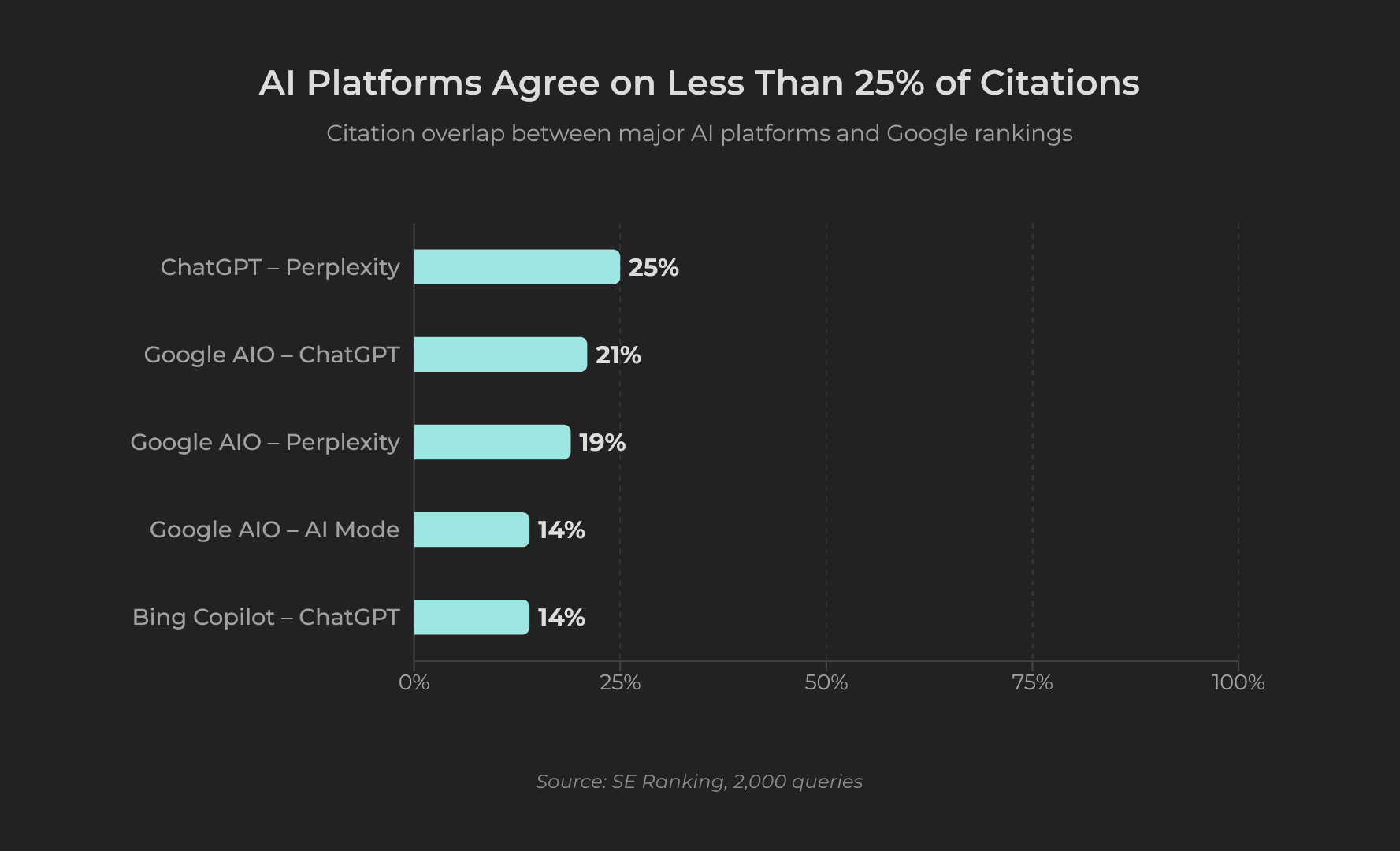
Because AI systems don't follow Google's playbook. Data across 2,000+ queries shows only 14-25% overlap between Google's top results and what AI platforms actually cite. Your page can rank #1 on Google and never appear in a ChatGPT response. Or rank nowhere on Google and get cited repeatedly by Perplexity.
This gap reflects a real difference in how these systems find content.
Google uses lexical search - matching keywords in your query to keywords on pages, weighted by links, authority signals, and hundreds of ranking factors. AI systems use semantic search - matching the meaning of a question to content that answers it, regardless of keyword density or backlink profiles. They weigh both the exact words on your page and what the page means, then combine the two to decide which pages to cite.
Key Takeaways
- Google rankings and AI citations overlap only 14-25%. Ranking #1 on Google says almost nothing about your AI visibility.
- The question is not how visible you are but whether you are in the small, static set of companies the models recommend: in 20 weekly checks across ten software categories, only 5-8 brands per category ever entered the archive's weekly top five, and 87% of the roughly 480 brands ever named never did (Respectarium, a public AI-visibility observatory, CC BY 4.0, free to reuse with credit).
- Position inside an answer (first named, second, third) does not hold, presence does: on two customer projects checked daily, a brand named by ChatGPT or Claude was named again next time 68-79% of the time, but kept the exact same position only 47-51% of the time.
- A score built from three answers per AI engine moved 8-20 points a day on a 0-100 scale, and the noise expected from three answers alone was 1.2-1.3 times that movement. There was no trend in it to track.
- Carry the range: named in 5 of 25 answers is really 9-39% at 95% confidence; in 10 of 50, 11-33%. A move inside the range is not a finding.
- Action: ask 25-50 recommendation questions per engine weekly, log every company named, count how many answers named you (say 5 of 25) with a statistical range (the formula is in the article), keep engines apart, and call a change only when two consecutive checks clear the range.
How big is the divergence?
| Platform Pair | Citation Overlap | What It Means |
|---|---|---|
| ChatGPT - Perplexity | 25% | Highest overlap among major AI platforms |
| Google AI Overviews - ChatGPT | 21% | Moderate divergence |
| Google AI Overviews - Perplexity | 19% | Significant divergence |
| Google AI Overviews - AI Mode | 14% | Google's own AI systems disagree with each other |
| Bing Copilot - ChatGPT | 14% | Lowest overlap between major platforms |
Source: SE Ranking study, an SEO platform's analysis of 2,000 queries. SEO Clarity, an enterprise SEO platform, found only 19% of 12,011 AI Mode citations came from Google's top-20 organic rankings.
Even within Google, their AI Overviews and AI Mode agree on sources only 13.7% of the time across 730,000 responses. Two AI products from the same company, answering the same questions, citing different pages.
Knowing that the two systems diverge is the easy part. The harder problem is that the measurement itself is noisy, and most of the noise is the instrument.
What Goes Wrong When You Track AI Visibility?
Most AI visibility tracking produces noise that looks like signal. The core issue isn't which metrics you pick. It's that AI answers are probabilistic, and standard measurement approaches treat them like they're deterministic. They're not.
The small-sample trap
The simplest approach to measuring AI visibility is a count: for each question, check if your brand appears in the AI answer. Named = 1, not named = 0. Add them up, divide by total queries, get a percentage.
The count is not the problem. The sample is. With 9 answers a day (3 questions on each of 3 AI engines), you get exactly 10 possible scores: 0%, 11%, 22%, 33%... up to 100%. A "22% drop" sounds alarming. It means 2 out of 9 answers flipped. That's Tuesday for a language model.
Point-to-point comparison fires on every check
Compare today's score to yesterday's. If the difference exceeds a threshold, fire an alert. Sounds reasonable.
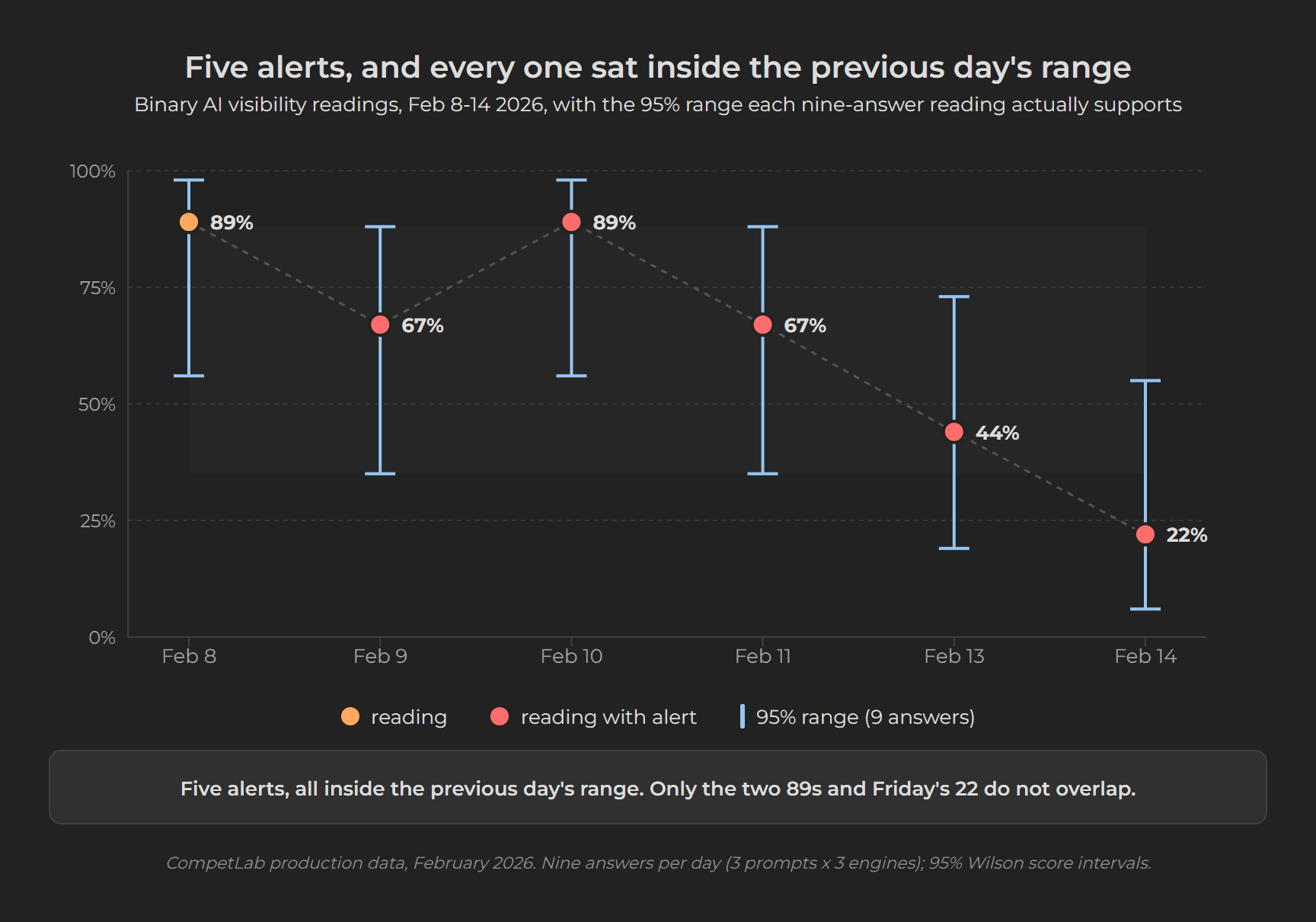
I built this exact system for CompetLab's AI visibility tracking in February 2026. Here is what the first week of daily checks on one tracked project looked like:
| Day | Visibility | Alert | What Actually Happened |
|---|---|---|---|
| Feb 9 | 89% to 67% | "Dropped from 89% to 67%" - CRITICAL | Normal LLM variance |
| Feb 10 | 67% to 89% | "Improved from 67% to 89%" | Bounced right back |
| Feb 11 | 89% to 67% | "Dropped from 89% to 67%" | Same oscillation |
| Feb 13 | 67% to 44% | "Dropped from 67% to 44%" | 2 queries stopped citing |
| Feb 14 | 44% to 22% | "Dropped to 22%" - CRITICAL | Maybe real... or more noise? |
Five alerts in five days. The "top competitor" flip-flopped between two domains from one day to the next. Every morning I opened the alerts to another CRITICAL that meant nothing.

This isn't a CompetLab-specific problem. AirOps research found the same pattern at scale: only 30% of brands stayed visible from one AI answer to the next. Just 20% held presence across five consecutive runs of the same query.
Citation hallucination
Even when you do get cited, the citation might be fabricated. A Tow Center for Digital Journalism study (late 2025) found 60%+ of AI citations across eight platforms were incorrect or misleading:
- GPT-4o: 66% of citations fabricated or contain errors
- Grok 3: 94% inaccuracy rate
- Perplexity: 37% error rate
These numbers will improve as models update, but the structural problem remains - citation accuracy varies wildly across providers.
A domain that gets cited repeatedly might reflect consistent hallucination patterns rather than genuine authority.
Prompt variability
Minor rephrasing of the same question changes which sources an AI platform cites. "Best CRM for small teams" and "top CRM tools for startups" can produce completely different citation lists from the same AI platform, and how ChatGPT decides when to search at all adds a second source of variation on top.
Single-query testing doesn't measure anything useful. You need query clusters - 10-20 variations of a core concept - to get signal through the noise.
What Actually Works for Measuring AI Visibility?
Find the set of companies the engines recommend in your category, then find out whether you are in it. That set is small and it barely moves, so a limited number of questions detects it and more questions only confirm it. Counting how often each engine names you, with a range, is how you tell. It is the working part, not the answer.
That is the method we run today at CompetLab, and it is the third one we have run. Each of the first two was the best read available on the evidence we had. The evidence that came later moved us past both.
Three methods, in the order the evidence arrived
Binary counts, checked daily. The February system above. Nine answers a day, a percentage, an alert on any move. Five false alarms in five days, as the table above shows.
Weighted rank scoring. The fix we shipped next, and the method this article recommended until September 2026. First place scored 1.00, second 0.85, third 0.70, down to 0.25 for sixth and below, with an alert only after two consecutive moves in the same direction. We tested it on six checks over two weeks. On that evidence it was the right call: the swings calmed and the daily alerts stopped. What it could not tell us, with two weeks of history and three engines, was whether the positions it scored meant anything.
A market map: who the models recommend, and whether you are among them. What we run now. Every company the models named for the category, how often each one was named per engine, with a range, and where the customer sits: in the core, on the boundary, or rarely named. The evidence for the change came from two places once the history was long enough: 20 weekly checks across ten software categories and three engines in the public archive of Respectarium, a public AI-visibility observatory (CC BY 4.0, free to reuse with credit; cycles 13 April to 23 August 2026, retrieved 27 August 2026), and eight weeks of daily checks on two of our own customer projects, both narrow B2B categories, July to August 2026, read as aggregates.
Three things the longer history showed:
- Position inside an answer does not hold. Presence does. On the customer projects, a brand named by ChatGPT or Claude on one daily check was named again on the next one 68 to 79 percent of the time. Among brands named on both checks, the exact position repeated only 47 to 51 percent of the time, and a brand in first place was still first the next day 54 to 57 percent of the time. We had been scoring the part of the answer that moves and treating the part that holds as crude.
- A per-engine score built from three answers has no signal in it. On the same customer projects, split nine answers by engine and each score rests on three. Measured day to day, that score moved 8 to 20 points depending on the engine, and the movement you would expect from sampling three answers alone came to 1.2 to 1.3 times the movement we actually saw. The noise was bigger than the signal, so there was nothing left over for a trend to occupy.
- The set of recommended companies is small, static, and quick to find. The archive draws its line as a top five by its own score; we draw ours as a share of answers (below). Both find the same shape. In 20 weeks, only 5 to 8 brands per category ever entered the archive's top five, and 87 percent of the roughly 480 brands the engines named never entered it once. In two categories, uptime monitoring and e-signature, the top five did not change in five months. And the set showed itself early: the brands in the top five for at least 18 of the 20 weeks were already the final set after three weekly checks in six of the ten categories, and after eight checks in nine of ten. Whether you are in that set is a durable fact about your brand. Where you sit inside it on a given day is not.
So on 3 September 2026 positions left our product: no surface stores or shows a position figure for any brand, and nothing fires on a number moving any more, only on a company entering or leaving the set the models recommend. A position-weighted score still exists. Rank will always exist; it is a weak metric, and it comes last. The method behind what comes first fits in a spreadsheet, and tomorrow's evidence may improve it again, in which case it will be covered here.
The method
1. Ask recommendation questions. Not "what is [category]" but "which [category] tools would you recommend for [use case]?" 25 to 50 of them per engine, across awareness, consideration, comparison and decision intent, run weekly. A company that appears in the answer to a recommendation question has been put forward as an option. That is the event you count. A company mentioned in passing, as a comparison point or a warning, has not.
2. Log every company named, not only yourself. One row per company per answer: date, question, engine, company, and the position if the answer gives one, as context. Across all your questions, that list is your market as the models draw it, and it usually contains companies you were not watching.
3. Count, per engine, as named in n of N. For each company and each engine: named in how many of the answers that engine gave, say 5 of 25, and the share that makes. Keep the engines apart. Averaging ChatGPT, Claude, Gemini, Perplexity and Google AI Overviews into one number adds together five different lists and produces a sixth that belongs to none of them.
4. Carry the range. Named in 5 of 25 answers is 20 percent, and really 9 to 39 percent at 95 percent confidence, meaning the true share should land inside that range 95 times out of 100. In 10 of 50, 11 to 33 percent. In 20 of 100, about 13 to 29 percent. Use a Wilson score interval, a confidence range that behaves properly on small samples, rather than the textbook margin: the textbook formula collapses to a zero-width range when you were named in none or all of your answers, which is exactly where a first check lands. Named in 0 of 25 still leaves the true share anywhere up to 13 percent. The formula, in three lines you can type into a spreadsheet:
p = named / n          z = 1.96
centre = (p + z*z/(2*n)) / (1 + z*z/n)
half   = z * sqrt( p*(1-p)/n + z*z/(4*n*n) ) / (1 + z*z/n)
range  = centre - half  to  centre + half
5. Read the map. A company is in the core when even the bottom of its range clears a quarter of the answers. It is rarely named when even the top of its range is under a tenth. Everything between is not yet separable, which is a statement about your evidence and never about the company. Start with those two lines, a quarter and a tenth; they are the ones we use. Move them only if your map looks wrong at the edges: more than a handful of companies clearing the quarter line says the category is unusually crowded, and none clearing it says your questions are off, which the checks below will catch. Two consequences follow. The core usually shows itself within a few checks, as the archive did. And until an engine has given you roughly 55 answers, no company can be ruled out at all, because a single sighting still leaves a range reaching above a tenth.
6. Call a change only when the range says so. Two consecutive checks moving in the same direction, each landing outside the previous range. Put that rule on the February table: 89 percent from nine answers is 56 to 98; 67 is 35 to 88; 44 is 19 to 73; 22 is 6 to 55. Every alert that week fired inside the previous day's range. No two consecutive readings have ranges that separate. The only ones that do are the two 89s, Monday and Wednesday, against Friday's 22, and no single alert described that slide.
7. Order by presence, and say when it is too close. Order the companies on your map by how often each was named, per engine. Where two companies' ranges overlap, the order between them is not known, and the honest report says they are tied rather than inventing a winner.
What not to report
- Never a position as the headline. It repeats about half the time. Report whether you are in the core and how often you are named; treat position as context.
- Never lead with one blended number across engines. One count per engine, with its range.
- Never a small move as news. Inside the range, it is the instrument.
- Never "not recommended" from a low number alone. Check that your questions return companies from your own competitor list first. If they do not, one of two things is true: your questions and your competitor list describe different markets, or your market does not come up in AI answers yet. Neither is a finding about you.
- Never rule a company out early. Ruling out takes more evidence than ruling in. Below roughly 55 answers on an engine, the honest phrase is "not yet ruled out", never "irrelevant".
Per-engine tracking
ChatGPT, Claude, Gemini, Perplexity and Google AI Overviews aren't slightly different. They have different citation philosophies:
- ChatGPT: Favors authoritative knowledge bases. Wikipedia-heavy. Prefers established, well-structured content.
- Perplexity: Prioritizes community discussions and recency. Reddit-concentrated, with a 2-3 day content decay.
- Google AI Overviews: Balanced approach across professional and social platforms.
On one customer's market this week, the same three questions over five checks, 15 answers per engine: Perplexity named the customer in 11 of 15 answers, ChatGPT in 4, Claude in 4, Google AI Overviews in 3, Gemini in 1. One aggregate "AI visibility score" hides a tenfold spread. You can be invisible on one engine and core on another, and the work to fix each is different.
Honestly, most AI visibility tools on the market still show you a single blended number. That's like combining your Google ranking and your Bing ranking into one score and calling it your "search visibility." Nobody does that. Same logic applies here. Per-engine tracking is the measurement scaffolding - the sequenced 90-day playbook this measurement scaffolding plugs into shows where measurement sits in the broader workstream sequence.
Why bother? The business case.
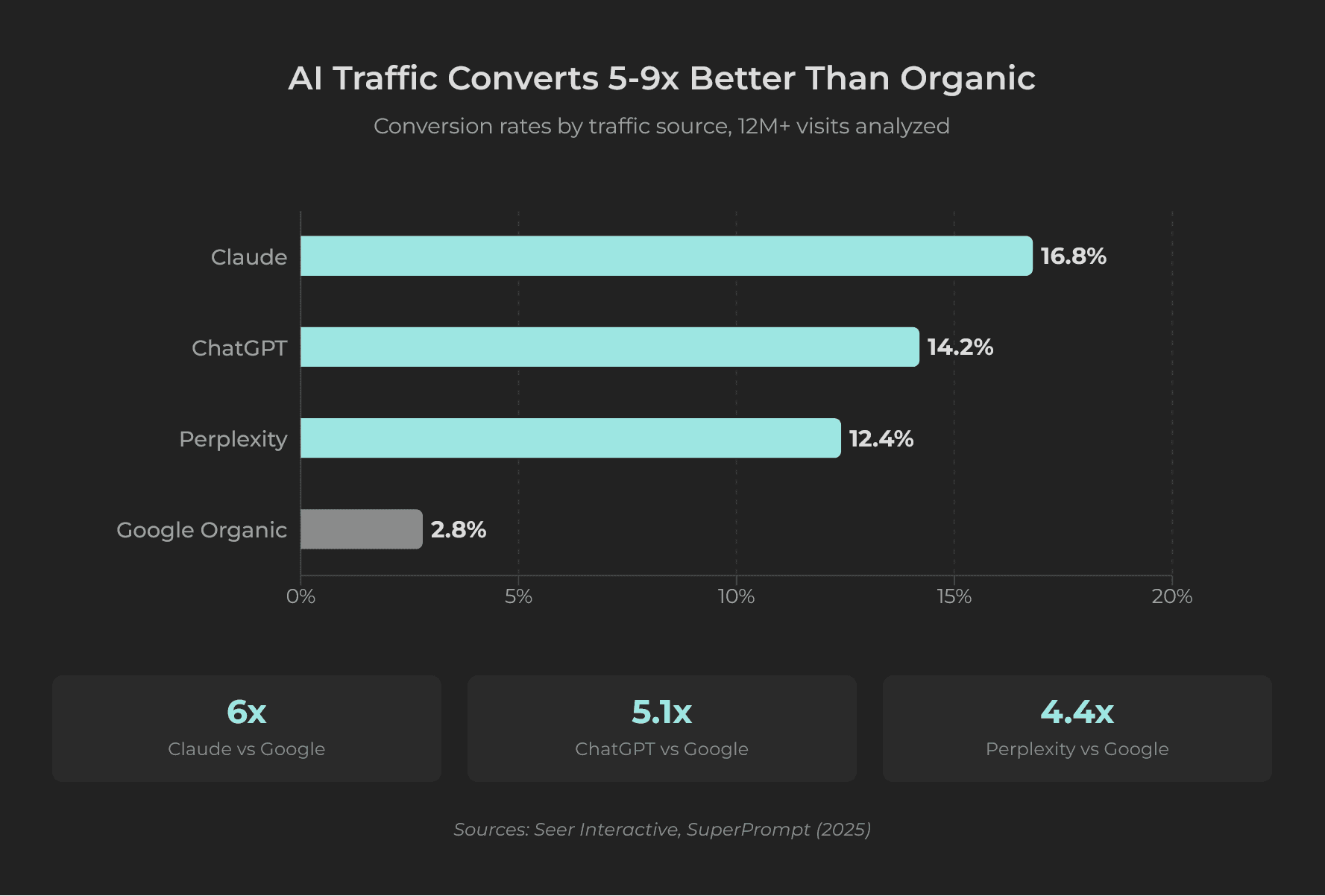
AI referral traffic is small right now - roughly 1% of total web traffic as of early 2026. But the conversion numbers change the math. Analysis of 12 million visits across 350+ businesses:
| Traffic Source | Conversion Rate |
|---|---|
| Claude | 16.8% |
| ChatGPT | 14.2% |
| Perplexity | 12.4% |
| Google Organic | 2.8% |
Source: Seer Interactive and RankScience studies.
AI-sourced customers show 67% higher lifetime value and 73% lower cancellation rates (Superprompt, 2025). One likely reason: someone who trusts an AI recommendation enough to click has often already done their evaluation inside the conversation. They show up pre-sold.
A 4-6x conversion multiplier on a growing channel is worth tracking even at 1% of total traffic.
How Do You Set Up AI Visibility Tracking Today?
Start with manual tracking across 25-50 recommendation questions tested weekly on ChatGPT, Perplexity, Claude, Gemini and Google AI Overviews. Graduate to tools when manual becomes unsustainable. Baseline data matters more than precision right now.
Manual method
Step 1: Define questions across four intent categories, each phrased as a request for a recommendation:
- Awareness: "which [your category] tools would you recommend?"
- Consideration: "best [category] for [use case]"
- Comparison: "[your brand] vs [competitor]"
- Decision: "[your brand] reviews" or "is [brand] worth it"
Step 2: Test each question on each engine. Log every company named: date, question, engine, company, position if given, sentiment (recommended/mentioned/negative), URL cited.
Step 3: For each company, count named in n of N answers per engine, with its range. Keep engines apart. Read your own row against the core, not against an industry benchmark. Respectarium's 20-week archive found 5 to 8 companies per category holding the top five for five months, with the rest below it. Your category's shape is the benchmark.
Step 4: Run weekly. Monthly misses real shifts. Daily burns resources for no extra signal.
Track AI referral traffic in GA4
Most AI-referred visits show up as "direct" because users copy-paste URLs from AI responses instead of clicking. Set up a custom channel group to capture what you can:
Create an "AI Assistants" channel in GA4 (Admin - Data display - Channel groups) with this regex on Session source:
(chatgpt\.com|chat\.openai\.com|perplexity\.ai|claude\.ai|gemini\.google\.com|copilot\.microsoft\.com)This won't catch everything. The "dark traffic problem" means real AI-referred visits are probably several times higher than what shows in analytics. But it gives you a baseline. For the citation layer above the click, Bing Webmaster Tools and Microsoft Clarity, see what you can measure about links in AI answers.
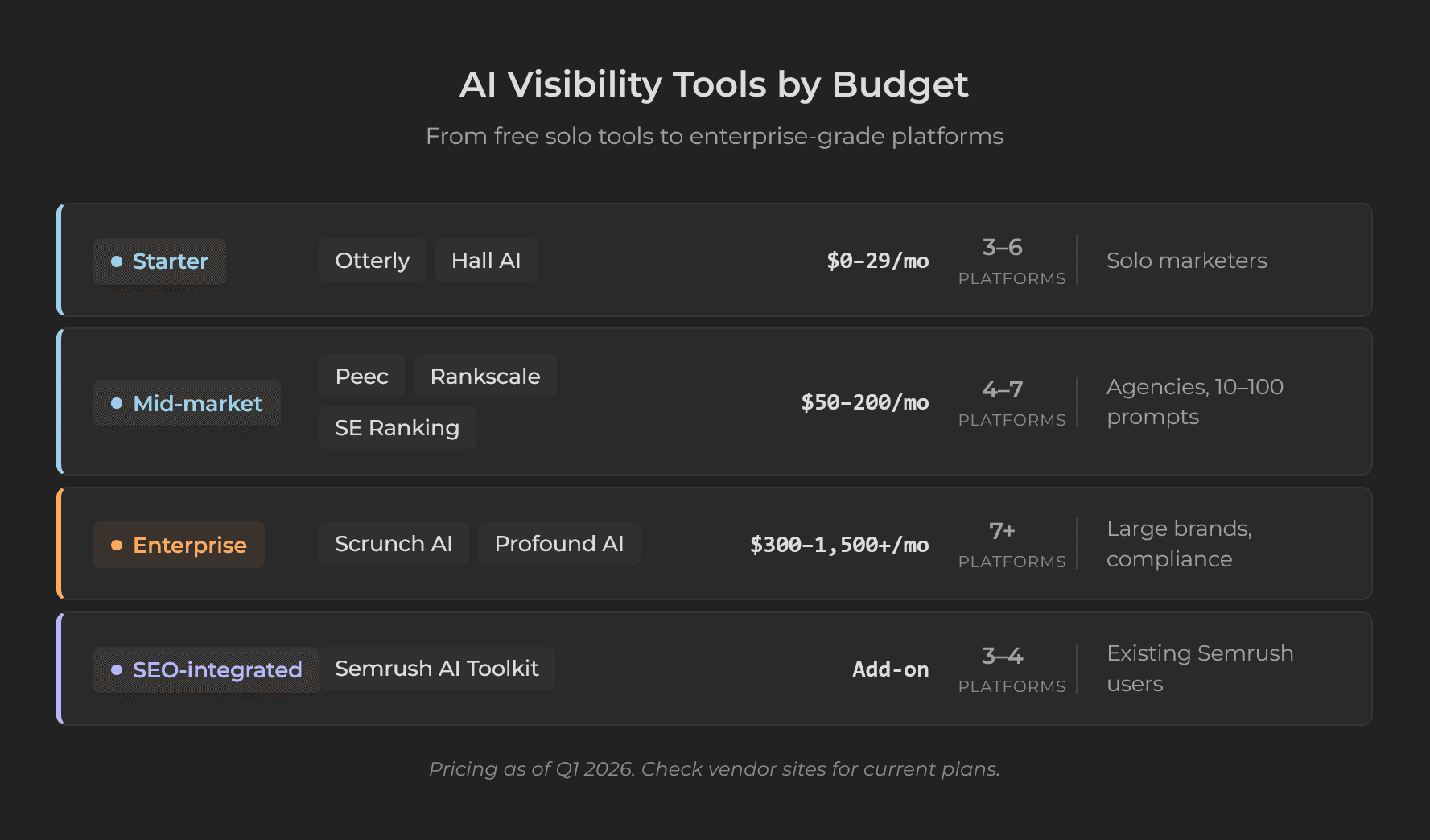
Tool options by budget
Tools by tier, including ours:
| Tier | Tools | Price | Best For |
|---|---|---|---|
| Starter | Otterly, Hall AI | $0-29/mo | Solo marketers, initial monitoring |
| Mid-market | Peec, Rankscale, SE Ranking, CompetLab | $50-200/mo | Agencies and in-house B2B SaaS teams |
| Enterprise | Scrunch AI, Profound AI | $300-1,500+/mo | Large brands, compliance |
| SEO-integrated | Semrush AI Toolkit | Add-on | Teams already using Semrush |
Two things to watch. Some tools query AI platforms through APIs, others scrape the actual web interface, and API-based tools can produce results that differ by 24% from what real users see. And ask what comes first. A score is fine as context; the set the models recommend, and whether you are in it, is the answer. Ask your vendor what they count and what they put first before trusting the numbers.
Minimum viable setup
- Pick 25 recommendation questions relevant to your category
- Test manually across ChatGPT, Perplexity, and Google AI Overviews
- Log every company named in a spreadsheet (date, question, engine, company, position, sentiment)
- Set up the GA4 channel group above
- Repeat weekly for 4-6 weeks, until the core is clear and the ranges are narrow enough to read
- Graduate to a paid tool when the spreadsheet gets painful
What to Do Next
If you're not tracking AI visibility yet, start this week. Pick 10-25 recommendation questions, test them on ChatGPT and Perplexity, log every company named. Set up the GA4 channel group. That's your baseline, and it already answers the first question: who the models recommend, and whether you are among them.
If you're already tracking with a position-weighted score, keep it and keep the history; change what you read first: are you in the set the models recommend, per engine, and how often, with the range. Call a change only when two consecutive checks clear it. The positions were the noise. The presence was the signal all along.
Frequently Asked Questions
How often should you check AI visibility?
Weekly. Monthly misses shifts. Daily produces movement you will spend time reacting to: on two customer projects checked every day, a per-engine score moved 8-20 points a day and sampling noise explained all of it, while the real repositioning we found took weeks to show. Weekly checks, read against the range around each count, catch the real moves without the churn. If a tool collects more often than that, read it weekly anyway.
How many questions do you need before a change is real?
Fewer than you think for the first answer, more for the second. The set of companies the models recommend is small and static: in Respectarium's public archive (CC BY 4.0, 20 weekly checks), three checks already identified the final core, the small set of brands the models keep recommending, in six of ten categories. Whether you are in it is usually clear early. The range matters at the boundary, for brands sometimes named and sometimes not: named in 5 of 25 answers is 9-39% at 95% confidence, in 10 of 50 it is 11-33%. A change is real only when two consecutive checks land outside the previous range.
Does schema markup improve AI citations?
Mixed evidence. FAQ schema shows a marginal edge in some studies. But a study by SearchAtlas, an SEO software vendor, across OpenAI, Gemini, and Perplexity found "domains with complete schema coverage perform no better than minimal or no schema." Implement it because it's good practice. Don't expect it to flip a switch.
What's a good AI recommendation rate?
The wrong first question. What matters is whether you are in the core, the small set of companies the models recommend in your category, and we have not found a rate benchmark that holds across categories. In Respectarium's public archive (CC BY 4.0), ten software categories tracked weekly for 20 weeks, only 5 to 8 brands per category ever entered the weekly top five, and in two categories that set did not change for five months. Your category's shape is the benchmark. Read your own count per engine, with its range, next to the companies in the core.
Does AI visibility actually drive traffic?
Small volume, high quality. About 1% of total web traffic as of early 2026, but 4-6x the conversion rate of Google organic traffic. One risk: restructuring content purely for AI extraction has been documented to drop Google rankings from position 3 to position 9. Track both, optimize for both, sacrifice neither.
See your AI visibility
Find out how ChatGPT, Claude, Gemini, Perplexity and Google AI Overviews answer when buyers look for tools like yours — where you show up, and against whom.
Share this article