Backlinks and AI Visibility: What Actually Works for Link Building in 2026
You've spent months building backlinks. Your domain rating improved. Your organic rankings look healthy. But when you ask ChatGPT or Perplexity about your industry, your brand doesn't exist.
This disconnect frustrates marketers who assumed traditional link building would translate to AI visibility. It doesn't. At least not in the way you expect.
Key Takeaways
- Nofollow links correlate with AI mentions almost identically to dofollow links (<2% difference), making Wikipedia, Reddit, and Quora placements strategically valuable.
- Image backlinks show 24% stronger correlation with AI citations than text links. Original data visualizations are citation magnets.
- Authority exhibits a sharp threshold effect: median AI mentions jump 3.7x between the 80th and 90th percentile of domain authority.
- Unique referring domains matter more than total backlink count. AI systems reward distributed consensus over link volume.
- Action: Audit your current authority tier and focus link-building efforts on crossing to the next threshold, not accumulating incremental links.
A 2025 study by Kevin Indig and Semrush analyzed 1,000 domains and 35,000 datapoints across five AI platforms (ChatGPT, ChatGPT Search, Gemini, Google AI Overviews, and Perplexity). The findings challenge two decades of link-building assumptions.
AI systems don't pass PageRank. They don't care about your carefully crafted anchor text strategy. Instead, they evaluate source authority during retrieval-augmented generation (RAG), using links as one trust signal among many. This shift from "link juice" to "trust signal recognition" demands a new approach.
Why Do Nofollow Links Work for AI Visibility?
Nofollow and dofollow links correlate with AI mentions almost identically. The difference is less than 2%, statistically negligible. This contradicts everything SEOs learned since Google introduced the nofollow attribute in 2005.
The Semrush study measured correlation coefficients between link types and AI mention frequency across ChatGPT, ChatGPT Search, Gemini, Google AI Overviews, and Perplexity:
| Link Type | Pearson Correlation | Spearman Correlation |
|---|---|---|
| Nofollow links | 0.340 | 0.509 |
| Dofollow links | 0.334 | 0.504 |
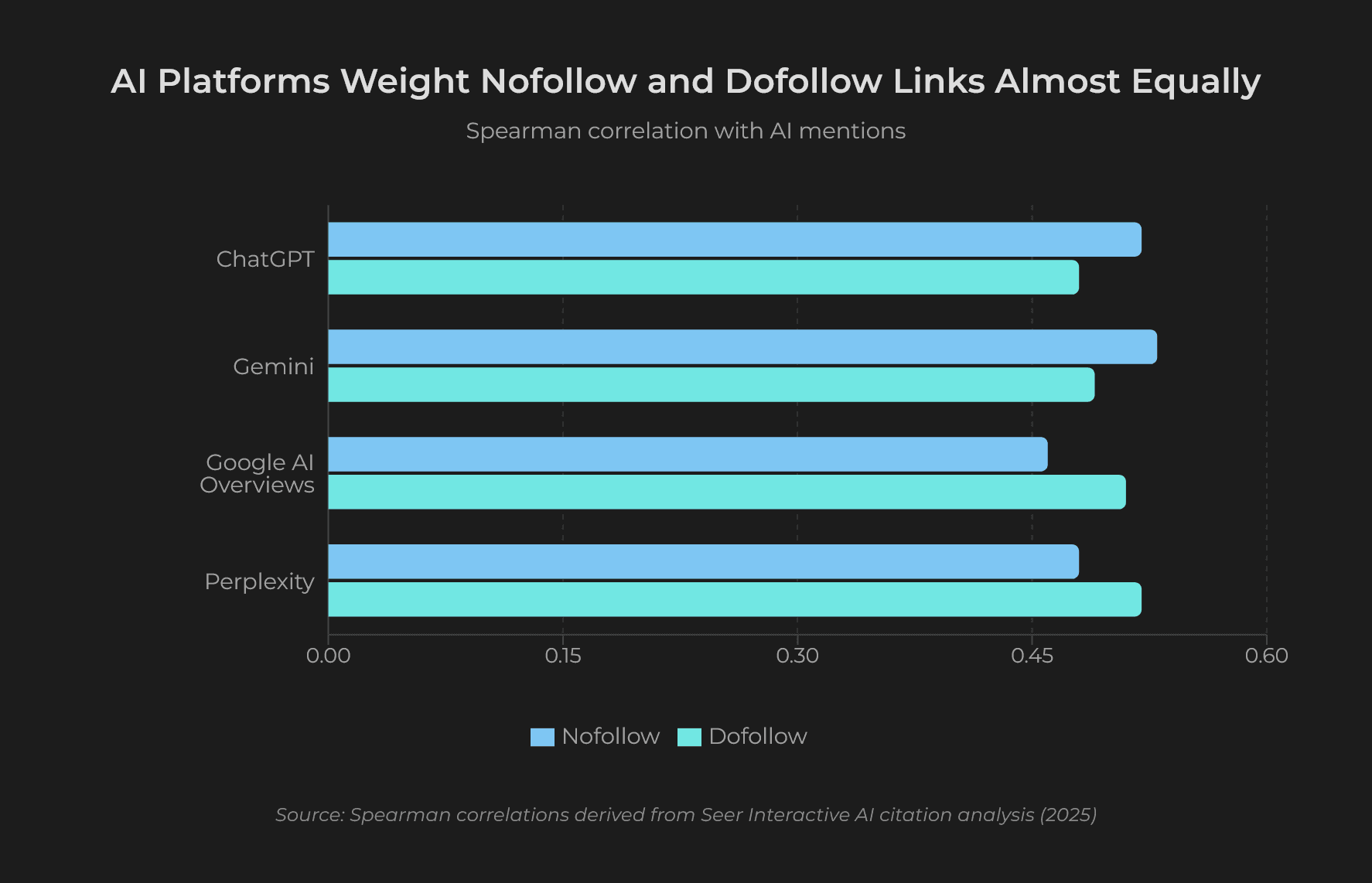
The 0.6% correlation difference demonstrates that AI systems don't differentiate between rel="nofollow" and standard hyperlinks. Traditional SEO treated nofollow as equity-withholding. AI systems treat it as irrelevant.
Platform-Specific Differences
Not all AI platforms weight links equally. The study revealed interesting variation:
| AI Platform | Nofollow Preference | Dofollow Preference |
|---|---|---|
| ChatGPT | Higher | Lower |
| Gemini | Higher | Lower |
| Google AI Overviews | Lower | Higher |
| Perplexity | Lower | Higher |
ChatGPT and Gemini actually weight nofollow links higher than dofollow. Researchers hypothesize this reflects ChatGPT's reliance on Bing's index and Gemini's distinct training approach.
Google AI Overviews and Perplexity maintain closer alignment with traditional authority signals. They still prefer followed editorial links, but both still process and value nofollow placements.
What This Means for Your Strategy
Links from Wikipedia, Reddit, Quora, and major publications using nofollow-by-default remain citation-worthy. The underlying source authority drives AI selection, not the HTML attribute.
Nofollow acquisition from high-authority sources is strategically equivalent to dofollow acquisition. Stop avoiding nofollow placements. Start treating them as equal opportunities.
Why Do Image Backlinks Outperform Text Links?
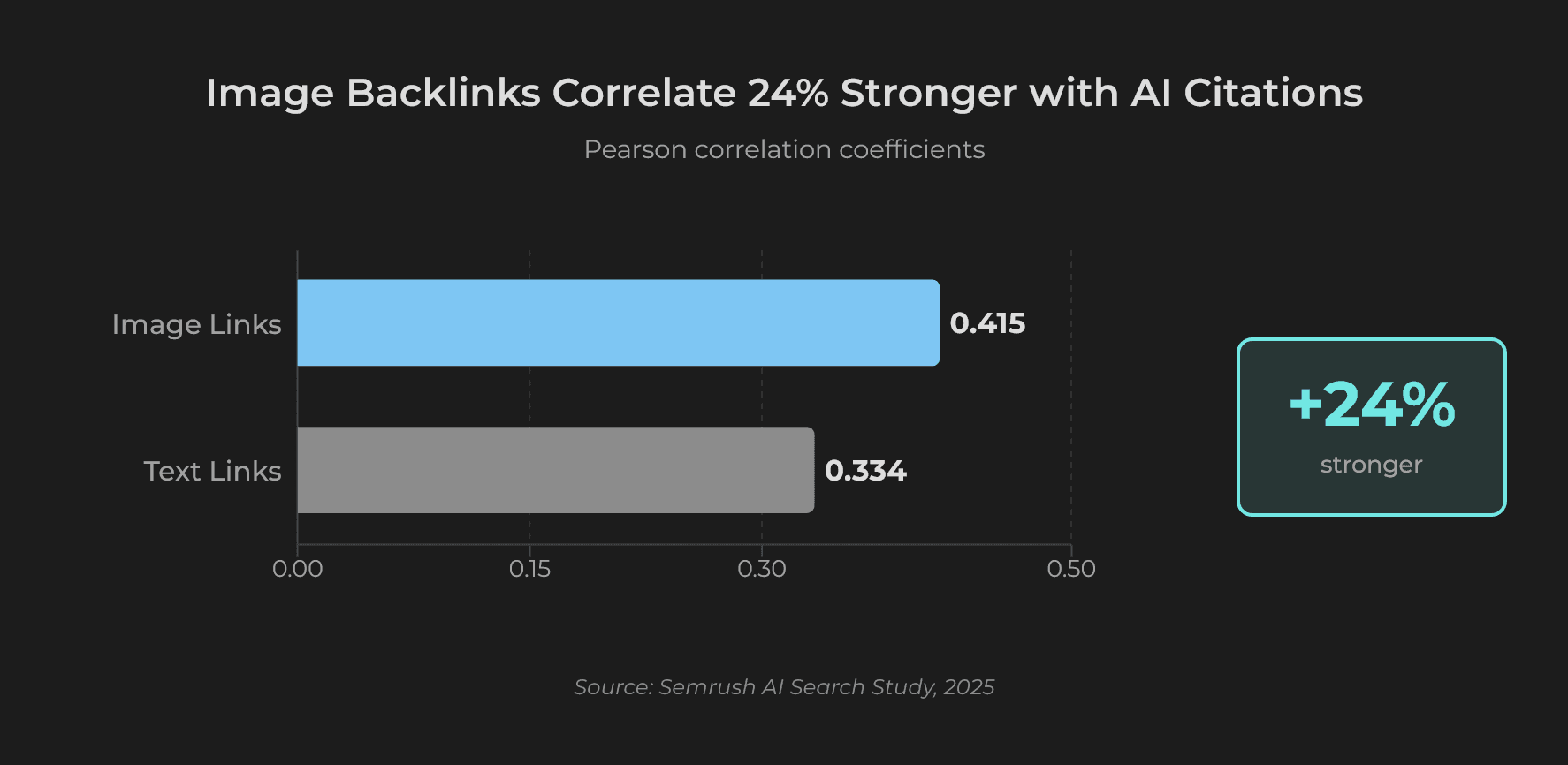
Image-based backlinks show 24% stronger correlation with AI citations than standard text links. This advantage persists across all five analyzed AI systems.
The correlation data tells a clear story:
| Link Type | Pearson Correlation | Spearman Correlation |
|---|---|---|
| Image backlinks | 0.415 | 0.538 |
| Text backlinks | 0.334 | 0.472 |
Perplexity and ChatGPT Search show the strongest image correlation at approximately 0.55 Spearman. ChatGPT and Gemini follow at around 0.50. Google AI Overviews shows the weakest image preference at approximately 0.46, still meaningful.
The Authority Prerequisite
Image link advantage only appears once a domain reaches baseline authority. In low-authority deciles (1-2), image-to-mentions correlation is weak or negative.
This suggests AI systems treat images from untrusted sources as potential manipulation. An infographic from a DR 15 site carries no weight. The same infographic from a DR 60 site becomes a primary citation factor.
In high-authority deciles (7-10), image assets become powerful citation drivers. Original research visualizations (infographics, data charts, comparison diagrams) distributed via reputable publications create legitimate, high-ROI link-building opportunities.
Practical Application
Create shareable visual assets that aggregate statistics and quotable facts. Infographics generate approximately 178% more backlinks than text-only content, according to industry benchmarks. Those extra links, combined with image filename and alt-text optimization, drive both organic rankings and AI citation probability.
When your infographic gets referenced on Reddit, LinkedIn, or Quora, AI systems see multiple mentions of the same visual insight across domains. This strengthens the perceived authority of your original source page.
What Is the Authority Threshold Effect?
Authority's relationship with AI visibility is fundamentally nonlinear. Incremental authority improvements produce minimal returns until crossing specific thresholds. Then citations jump dramatically.
The Semrush study revealed this through divergent correlation patterns:
- Pearson correlation (linear): 0.23 (modest)
- Spearman correlation (threshold-based): 0.36 (stronger)
The 56% gap between these measurements indicates the relationship isn't linear. You can't expect proportional gains from proportional effort.
The Decile 8 to 9 Jump
The most significant finding concerns what happens at the highest authority levels:
| Authority Decile | Median AI Mentions | Change |
|---|---|---|
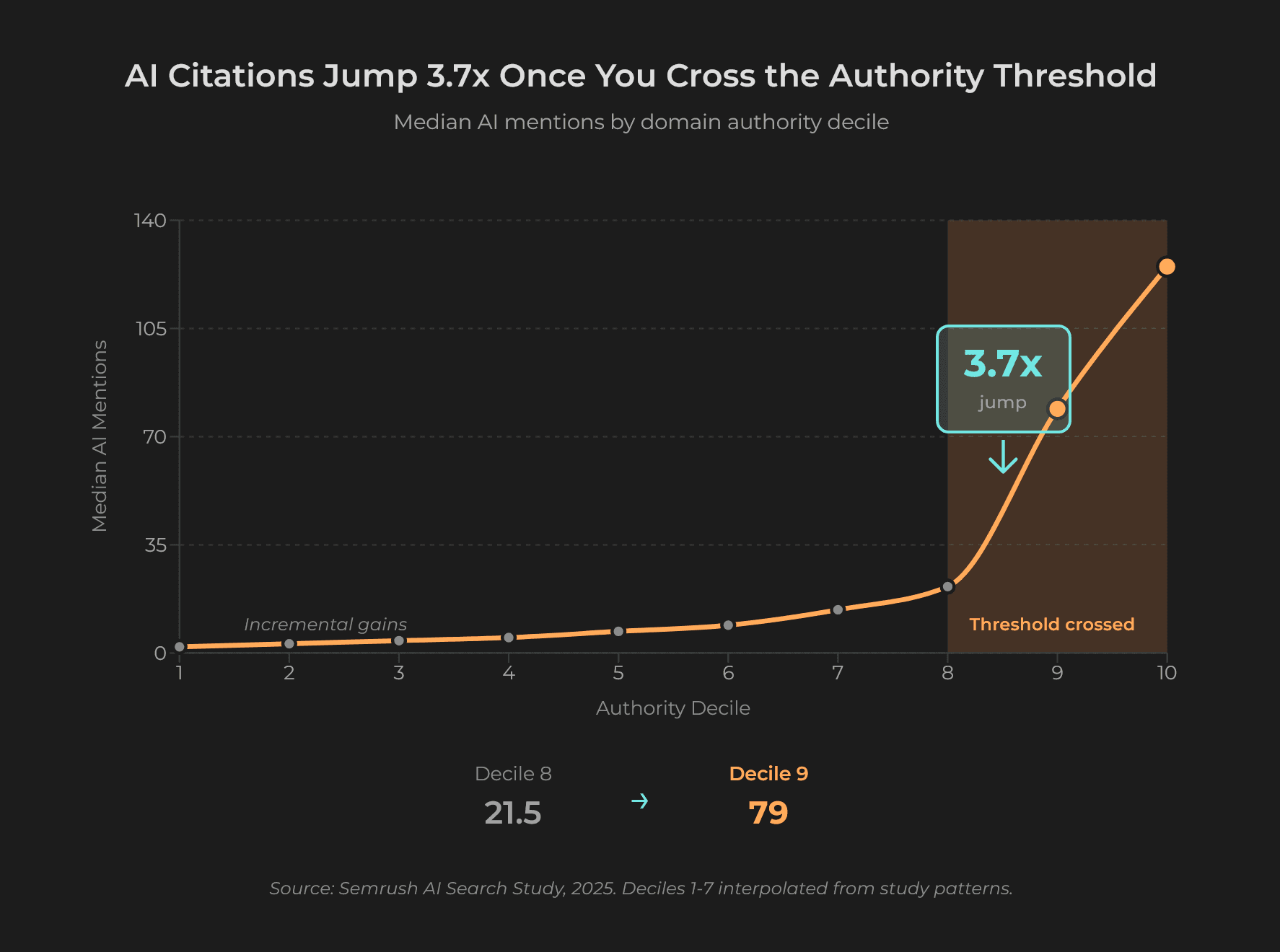
| 8 (80th percentile) | 21.5 | - |
| 9 (90th percentile) | 79.0 | +3.7x |
| 10 (top 10%) | 125+ | Continued high visibility |
Median AI mention frequency nearly quadruples between decile 8 and decile 9. This represents a phase transition in AI visibility. Domains in the top 10% of authority experience exponentially higher citation frequency than those below.
Understanding the Tiers
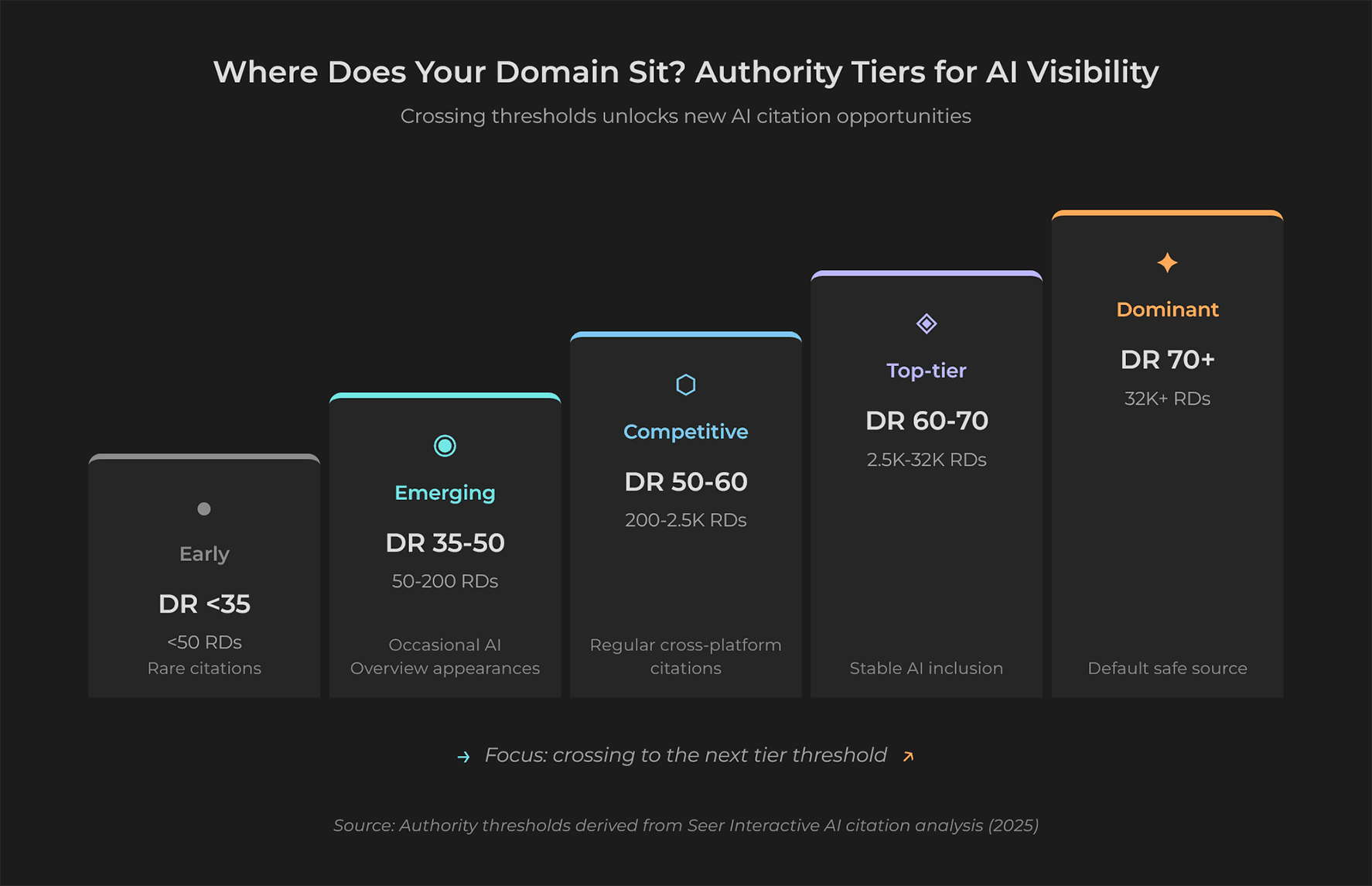
Multiple 2024-2026 studies converge on characteristic breakpoints (these thresholds may shift as AI systems evolve):
| Authority Tier | Domain Rating | Referring Domains | AI Citation Behavior |
|---|---|---|---|
| Early/Low | DR < 30-35 | < 50 RDs | Rare, sporadic citations |
| Emerging | DR 35-50 | 50-200 RDs | Start appearing in AI Overviews when ranking top-3 |
| Competitive | DR 50-60+ | 200-2,500 RDs | Regular citations across platforms |
| Top-tier | DR 60-70+ with deep coverage | 2,500-32,000 RDs | Stable inclusion across AI systems |
| Dominant | Global brands, .gov/.edu | 32,000+ RDs | Default safe source status |
The 3.7x authority jump at decile 8-9 aligns with the "DT>90 + 32k+ RDs" band. AI systems appear to treat these domains as default safe sources unless a niche expert clearly outperforms them.
Strategic Implication
Link-building strategy must prioritize crossing authority thresholds over accumulating incremental links. A domain gaining 10 scattered backlinks experiences negligible citation growth.
But that same domain crossing from 500 to 800 referring domains, if it pushes past an authority threshold, experiences step-function visibility increase. Focus your resources on threshold-crossing campaigns, not incremental link acquisition. Threshold-crossing campaigns matter most when they land on the surfaces AI engines actually concentrate on - see where the off-site layer actually concentrates - and why hub-density beats incremental link acquisition for the full hub-density model and how it stacks with content + entity signals.
How Should You Build Links for AI Visibility?
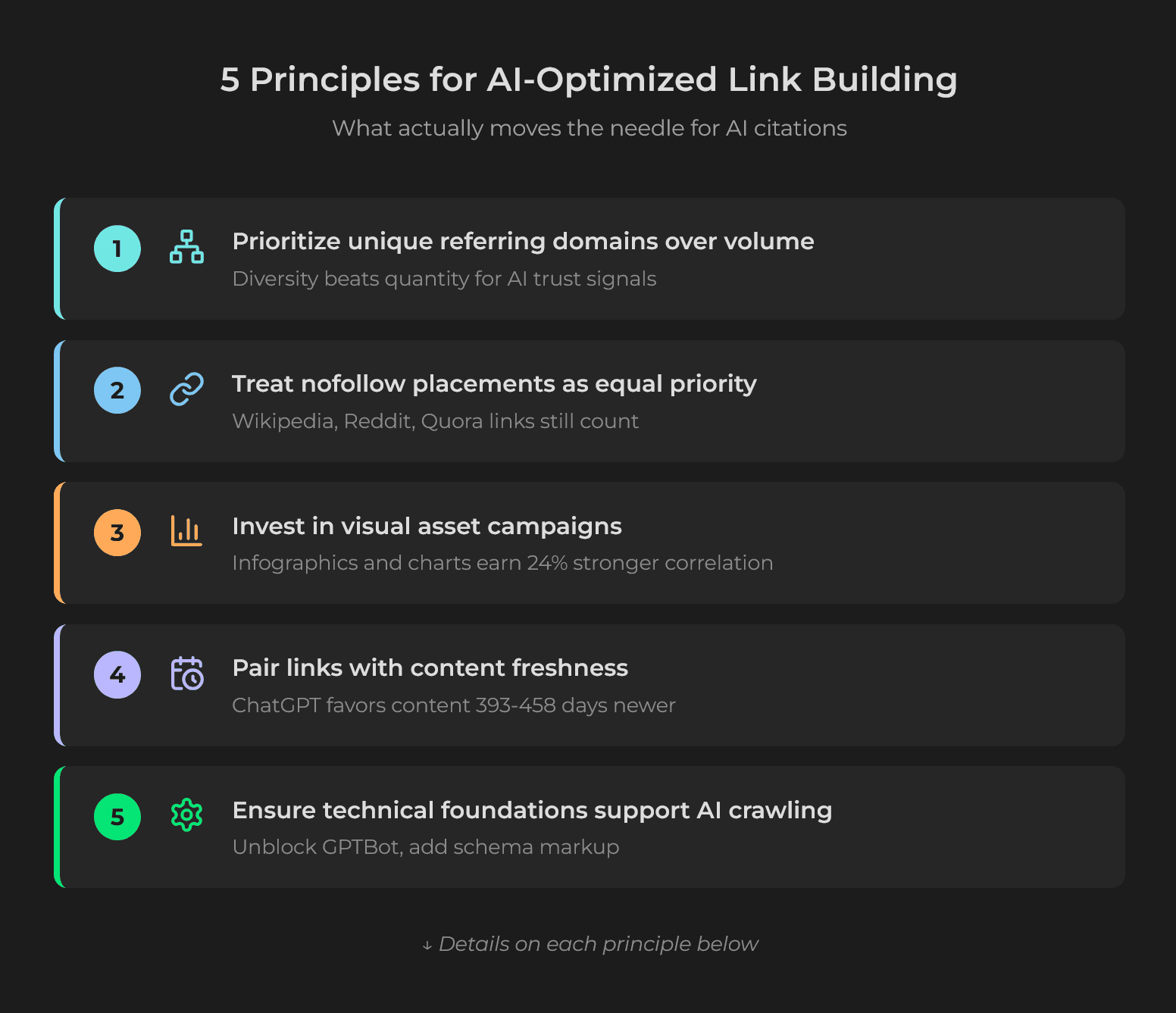
AI-optimized link building requires different tactics than traditional SEO. The data points to five key principles.
1. Prioritize Unique Referring Domains Over Volume
Total backlinks show weak correlation with AI Share of Voice (~0.23 Pearson). Unique linking domain diversity drives the observed 3.7x jump at decile 9.
A domain with 10,000 links from 50 sources signals lower authority than 1,000 links from 500 sources. AI systems weight independent endorsements. Link concentration suggests paid or manipulative acquisition.
Target new domains rather than accumulating multiple links from the same sources.
2. Treat Nofollow Placements as Equal Priority
Acquire links from Wikipedia, Reddit, major publications with equal priority as dofollow. The correlation data shows no meaningful difference.
Systematic Reddit and Quora participation (genuinely helpful answers, not spam) feeds AI's authority graph even when direct links aren't possible. Brand and URL mentions still register.
3. Invest in Visual Asset Campaigns
Create shareable infographics and original research. Distribute with image link acquisition focus. Provide embed codes that include contextual links back to your study page.
Optimize images for AI ingestion: descriptive filenames tied to your topic, rich alt text describing the insight (not just the picture), and placement near clear, machine-readable summaries.
4. Pair Links with Content Freshness
According to 2025 research, ChatGPT cites content 393-458 days newer than Google organic results. Understanding how ChatGPT searches differently helps explain why this emerging recency premium can override authority for time-sensitive topics.
Coordinate link acquisition with 6-12 month content refresh cycles. A page that earns links but goes stale loses citation potential.
5. Ensure Technical Foundations Support AI Crawling
AI crawlers need access to your content. Blocked GPTBot, PerplexityBot, or other crawlers means zero AI visibility regardless of your link profile.
Schema markup also compounds link-building efforts. Studies show 47% higher AI citation rates with well-implemented Article, FAQ, and HowTo schema.
Time to Impact
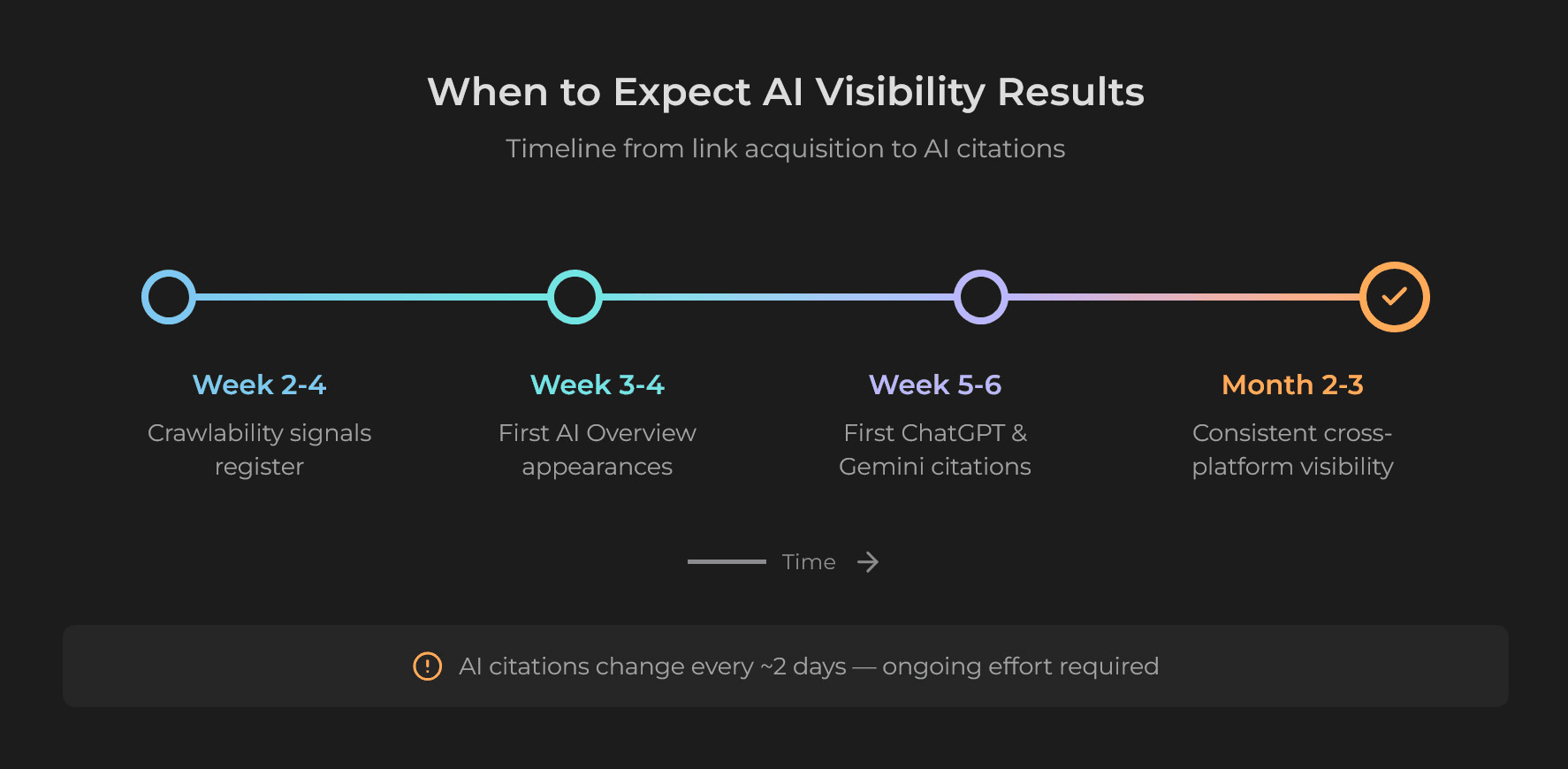
Expect results on this timeline:
- 2-4 weeks: Improved crawlability signals register
- 3-4 weeks: First appearances in Google AI Overviews
- 5-6 weeks: First ChatGPT and Gemini citations
- 2-3 months: Consistent cross-platform visibility
AI Overview content changes roughly every 2.15 days on average. Your new links and authority signals can translate into inclusion relatively quickly, but citations remain fluid, not permanent.
Common Mistakes to Avoid
Based on the research data, these traditional SEO tactics waste resources when optimizing for AI visibility:
Chasing dofollow at all costs. Turning down a Wikipedia mention because it's nofollow is leaving AI visibility on the table. The correlation difference is less than 2%, statistically meaningless.
Prioritizing link volume over domain diversity. Getting 50 links from the same 5 sites does almost nothing for AI citations. AI systems reward independent endorsements from diverse sources.
Ignoring image assets. Text-only content leaves 24% of potential AI citation correlation untapped. If you're not creating shareable data visualizations, you're missing the highest-correlation link type.
Building links without refreshing content. A page that earned great backlinks 18 months ago but hasn't been updated is losing to fresher competitors. ChatGPT specifically favors content 393-458 days newer than what Google ranks.
Blocking AI crawlers while expecting AI visibility. Some sites block GPTBot or PerplexityBot in robots.txt while wondering why they don't appear in AI answers. Check your crawler access.
What to Do Next
Knowing backlinks affect AI visibility differently than traditional SEO is step one. Step two is understanding where you actually stand, and where your competitors stand.
CompetLab's AI Visibility dimension tracks which companies ChatGPT, Claude, Gemini, Perplexity, and Google AI Overviews recommend in your category, and whether you are among them. Instead of guessing whether your link-building efforts translate to AI recommendations, you get concrete data on who each engine recommends.
Start here:
- Audit your current referring domain count and authority tier using Ahrefs or Semrush
- Identify which authority threshold you're approaching
- Shift link-building resources toward crossing that threshold, not incremental accumulation
- Track your AI visibility monthly to measure actual citation impact
The rules have changed. Your link-building strategy should too.
Frequently Asked Questions
Do backlinks still matter for AI search?
Yes, but differently than traditional SEO. Raw backlink count shows weak correlation with AI visibility (~0.23). Authority metrics show strong correlation (0.65). Links feed into AI's trust evaluation during retrieval-augmented generation, not PageRank transfer. Focus on crossing authority thresholds rather than accumulating link volume.
Should I stop pursuing dofollow links?
No, pursue both types. The data shows less than 2% correlation difference between nofollow and dofollow for AI mentions. Diversify your link profile across both, prioritizing source authority over link attribute. A nofollow link from Wikipedia carries more AI weight than a dofollow from a low-authority guest post.
How long until new links affect AI visibility?
Expect first AI Overview effects in 3-4 weeks after significant link or authority improvements. ChatGPT and Gemini citations typically follow in 5-6 weeks. Stable cross-platform visibility takes 2-3 months. Citations are fluid. AI Overview content changes every 2.15 days on average, so results require ongoing effort to maintain.
What's the minimum authority needed for AI citations?
Studies suggest approximately 50 referring domains is a rough tipping point. Below this threshold, AI citations are rare and volatile. Above it, citation counts increase roughly 5x, assuming strong content quality. The real acceleration happens at higher tiers. The 3.7x jump occurs between the 80th and 90th percentile of domain authority.
See your AI visibility
Find out how ChatGPT, Claude, Gemini, Perplexity and Google AI Overviews answer when buyers look for tools like yours — where you show up, and against whom.
Share this article