Why Publishing More Content Hurts Your AI Visibility
Every AI visibility guide tells you to publish more: more blog posts, more FAQ pages, more comparison content. The data says the opposite.
Companies that restructured their existing content for AI search - consolidating overlapping pages, adding answer-first structure, building comparison tables - saw citation rates jump from single digits to 24-74% in 90 days. Companies that kept publishing more posts saw no change. The highest-leverage move for AI visibility in 2026 is not creating more content. It's making your existing content the one source AI systems choose to cite.
Key Takeaways
- Content consolidation (merging overlapping pages into one canonical resource) increases AI citation rates by 40-60% - it's the highest-value pruning action for AI visibility (Agenxus, ZipTie 2026)
- Comprehensive data guides get cited 67% of the time vs 18% for thought leadership - a 3.7x gap that rewards facts over opinions (Presence AI, 1,200 pages, 2026)
- Case studies: VisibleIQ went 16% to 74% citation rate in 90 days by restructuring 15 pages, not publishing new ones. Discovered Labs hit 24% citations with 288% ROI in one quarter
- FAQ schema alone has no statistically significant effect on AI citations (SE Ranking, 2.3M pages). Authority beats schema 3.5:1 in ChatGPT citation decisions
- AI-referred visitors convert 2-4x better than traditional organic - even modest citation gains create outsized pipeline impact for B2B SaaS
- Start by auditing for cannibalization: if 3+ pages target the same intent, consolidate into one definitive resource with answer-first structure and comparison tables
- Consolidation is measurable after the fact: CompetLab reports, per engine, which pages Perplexity and Google AI Overviews retrieved for each of your buying questions, including the retrieved pages that name a competitor and not you - which is how you see whether one page won the topic or five split it (CompetLab)
Why Does Publishing More Content Hurt Your AI Visibility?
AI systems don't reward coverage. They reward clarity. When your site has five pages competing for the same topic, AI engines face a choice: which one is the authority? The answer is usually none of them.
Traditional SEO rewarded volume. More pages meant more keyword coverage, more indexable URLs, more chances to rank. AI search inverts this. ChatGPT, Perplexity, and Google AI Overviews select one best-answer source per topic. If your authority is fragmented across multiple overlapping pages, each page has weaker signals than a competitor's single consolidated resource. The competitor gets cited. You don't.
The data supports this. Agenxus' GEO research estimates that strategic content consolidation - merging overlapping pages into one comprehensive resource - increases citation rates by 40-60%. ZipTie's 2026 AI visibility guide frames consolidation as "the highest-value pruning action for AI visibility," because it concentrates link equity, topical authority, and entity density on a single URL instead of scattering them.
This isn't hypothetical. 90.63% of indexed pages receive zero organic traffic. For most sites, the majority of pages are dead weight that dilutes the signals AI systems use to find your best content.
For more on how AI systems select which sources to cite, see How AI Answer Engines Actually Select Content. The broader content layer of the AI signal stack, where consolidation sits alongside answer-first structure, schema, and format hierarchy places consolidation inside the larger content-layer model.
What Does the Data Say About Content Format and AI Citations?
Not all content formats get cited equally. Presence AI's 2026 study - 1,200+ pages across 400 domains and 12 verticals over 90 days - measured citation rates by content type across ChatGPT, Claude, Perplexity, and Google AI Overviews.
| Content Type | Citation Rate |
|---|---|
| Comprehensive guides with data tables | 67% |
| Comparison matrices / product reviews | 61% |
| FAQ-heavy pages with schema | 58% |
| How-to guides with step-by-step processes | 54% |
| Industry benchmark reports | 52% |
| Case studies with quantitative results | 48% |
| Thought leadership / opinion pieces | 18% |
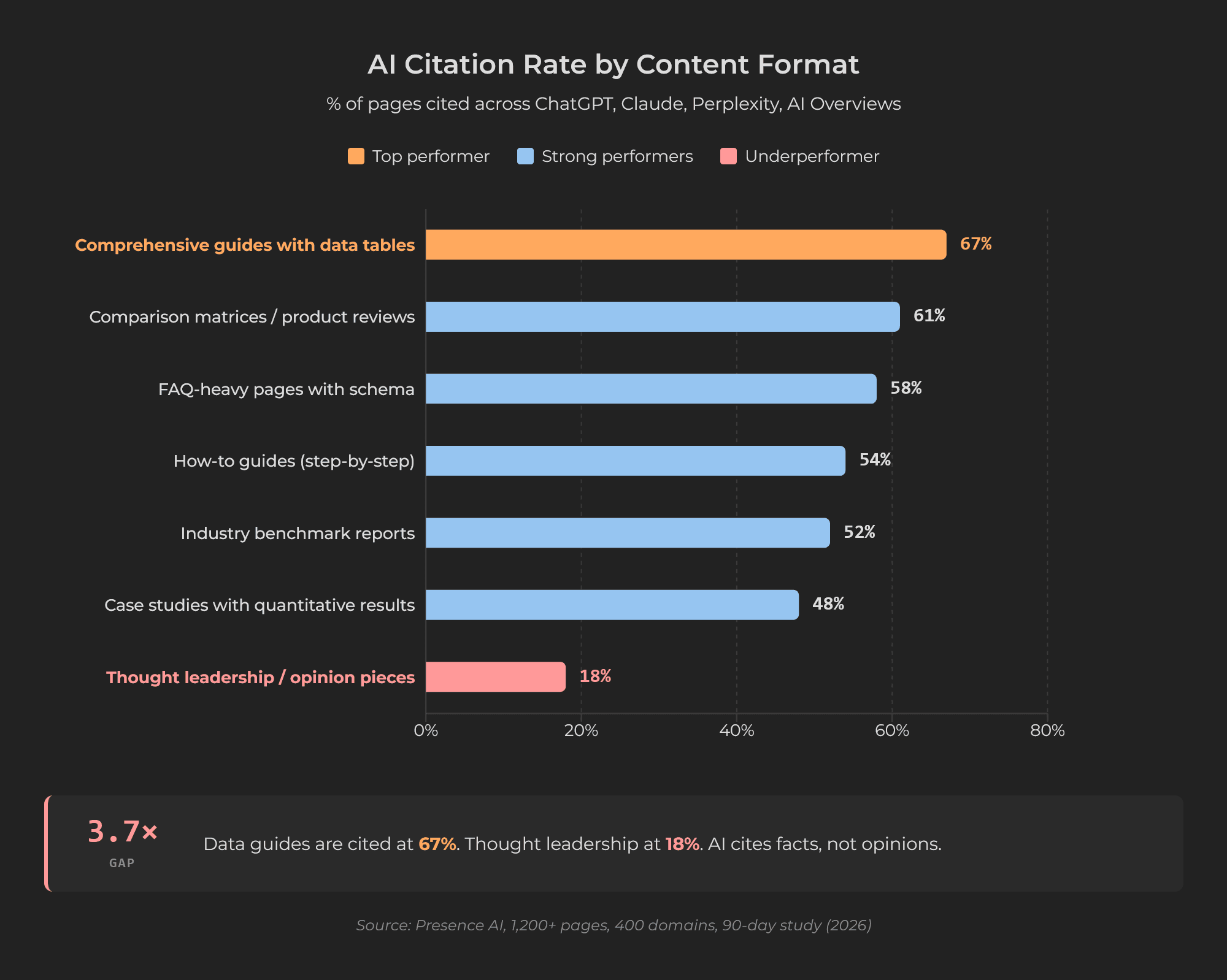
The gap between data-backed guides (67%) and thought leadership (18%) is not a rounding error. It's a 3.7x difference. AI systems cite content they can extract facts from. Opinion pieces - no matter how insightful - lack the structured, verifiable claims that AI needs for confident citation.
Pages with clear H2/H3 hierarchy are 3.2x more likely to be cited than poorly structured content. Pages with comparison tables get 2.8x more citations than text-only equivalents. Structure and format are not nice-to-haves. They determine whether AI can use your content at all.
For how to structure your body content for maximum extraction, see How to Structure Content That AI Systems Actually Cite.
What Happens When Companies Actually Consolidate?
The case studies from B2B SaaS companies that restructured content for AI visibility in 2025-2026 share a consistent pattern: the biggest gains came from restructuring existing pages, not publishing new ones.
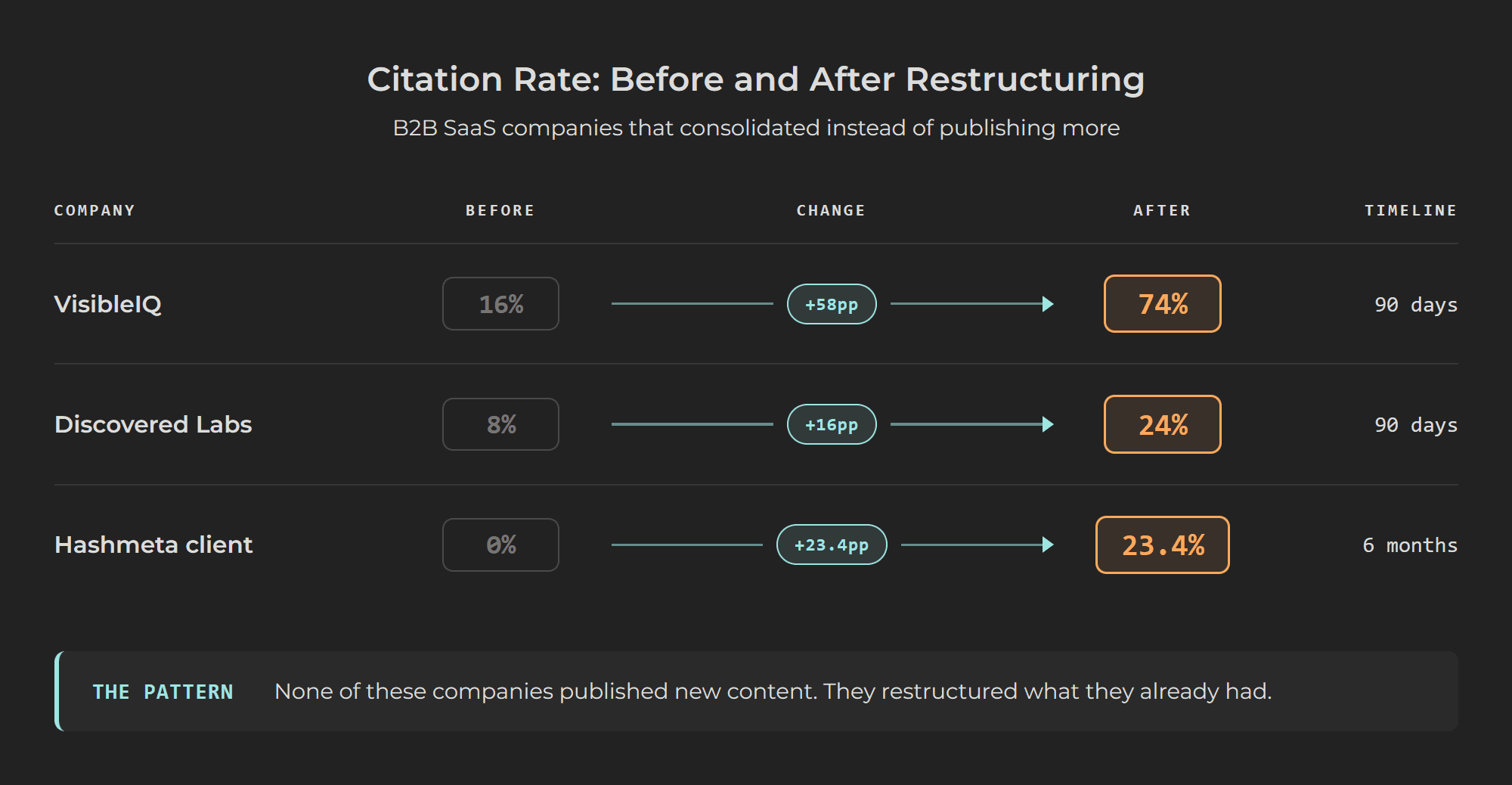
Hashmeta client (project management SaaS): Audited 247 pages, rewrote 32 core pages into answer-first format, created 15 "ultimate guides" with comparison tables and case data, added structured schema. ChatGPT citation rate went from 0% to 23.4% across tracked prompts over 6 months. AI visitors converted to trials at 42% higher rates than Google organic visitors.
VisibleIQ client ($10M ARR B2B SaaS): Explicitly did not add more content. Instead, they rewrote titles and schema on 15 key pages, added "what is" and "who is this for" sections, and built six structured comparison pages. AI citation rate jumped from 16% to 74% across 50 buyer-intent prompts in 90 days. AI search influenced $1.2M in pipeline.
Discovered Labs client ($25M ARR SaaS): Shifted from publishing 8-12 blog posts per month to restructuring existing pages with answer-first openings, comparison tables, and FAQ sections. Citation rate across 100 buyer-intent prompts rose from 8% to 24% in 90 days. AI-referred leads converted to SQLs at 18.7% versus 6.7% for traditional organic - 2.8x higher.
Gumlet (video hosting SaaS): Restructured "money pages" around conversational AI queries, created 17 "context anchor" pieces mapped to specific prompts like "best video hosting for SaaS teams." By mid-2025, roughly 20% of inbound revenue came from users who discovered Gumlet via ChatGPT or Perplexity. AI-aware users were 60% more likely to visit pricing pages.
The pattern across all cases: fewer, better-structured pages targeting specific buyer prompts outperform high-volume publishing. Not one of these companies won by producing more content. They won by making their existing content extractable.
What Specifically Doesn't Work for AI Citations?
The negative findings are as valuable as the positive ones. Multiple 2025-2026 studies document tactics that don't move AI visibility on their own.
FAQ schema alone has no effect. SE Ranking's analysis of 2.3 million pages in Google AI Mode found that adding JSON-LD FAQ schema markup had no statistically significant impact on AI citations once you control for content and authority. Pages with visible FAQ content in the body got more citations. Pages with FAQ schema on top of that didn't get additional lift. The model cares about the content itself, not the metadata wrapper.
Authority beats schema 3.5:1. ZipTie's 2026 FAQ-schema study quantified this with a direct comparison: a site with perfect FAQ schema but only 420 referring domains captured 12% of ChatGPT citations, while a competitor with no schema and roughly 3,200 referring domains captured 68%. Schema is infrastructure, not a shortcut.
Publishing more AI-generated content backfires. The ReddiReach case study documents a SaaS founder who initially tried publishing more AI-generated blog posts. It produced no AI visibility gains. What worked instead: replacing narrative blogs with a small number of "citation-ready" comparison and implementation pages, then seeding them into high-intent Reddit threads.
Thought leadership gets 18% citation rates. Against 67% for data-backed guides. AI systems don't value opinions - they value extractable facts, comparisons, and data. An executive perspective piece might build human trust, but AI systems can't cite "I believe the market is shifting" with any confidence.
For the metadata layer that complements these content-level findings, see Schema Markup for AI Citations.
How Do You Consolidate Without Losing Rankings?
Consolidation sounds risky. You're deleting pages, merging content, and redirecting URLs. Done badly, it destroys traffic. Done well, it concentrates authority.
Step 1: Audit for cannibalization. Find all pages competing for the same core query or intent. If you have "How to Choose a CRM," "CRM Buying Guide," "Best CRM Features," and "CRM Selection Criteria" - those four pages are cannibalizing each other. AI sees four weak signals instead of one strong one.
Step 2: Classify each page. Label every overlapping page as one of four types:
- Canonical - the strongest page, becomes the consolidated destination
- Merge - has useful content that folds into the canonical
- Archive - obsolete, adds no value
- Redirect - weaker duplicate, 301 redirect to canonical
Step 3: Consolidate and redirect. Merge the best content from "merge" pages into the canonical. 301 redirect all other URLs to the canonical. Update internal links to point to the new destination. 301 redirects preserve 90-99% of link equity.
Step 4: Structure the consolidated page for extraction. Apply answer-first formatting, question-style H2s, comparison tables, and FAQ sections. The consolidated page should be the definitive resource AI systems find when they search your topic.
The timeline is faster than you'd expect. The Discovered Labs case saw citation rates move from 8% to 12% by week 4 and reach 24% by day 90. VisibleIQ saw little movement in the first 4 weeks, then rapid gains in weeks 5-12 as entity and comparison fixes took hold. Perplexity responds fastest because it searches the live web. Google AI Overviews follow within weeks as pages get recrawled.
One case study quantified the classic consolidation playbook directly: Noel Ceta merged 87 weak articles into 12 comprehensive guides. Organic traffic increased 156% in 90 days, with typical consolidation projects delivering 80-200% traffic lifts over 10-12 weeks.
Measure the result after consolidation. CompetLab's AI Visibility tracking reports, per engine, how often ChatGPT, Claude, Gemini, Perplexity, and Google AI Overviews name your brand, and which pages Perplexity and Google AI Overviews retrieved for each buying question - so you can see whether one page now carries the topic where five used to split it. For setting up measurement, see How to Measure Your AI Visibility.
Frequently Asked Questions
How many pages targeting the same topic is too many?
If you have more than two pages competing for the same core query or buyer intent, consolidation is overdue. AI systems select one best-answer source per topic. Three overlapping pages don't triple your chances - they split your authority three ways, making each weaker than a competitor's single consolidated page. Audit by searching your own site for your target queries. If multiple pages appear, those are cannibalization candidates.
Won't deleting pages hurt my organic traffic?
Temporarily, yes - expect a 2-4 week dip as redirects settle. But the case studies consistently show strong recovery: 156% organic traffic increase after merging 87 articles into 12 guides, +104% organic sessions after pruning dead-weight pages, and 70% traffic recovery for a B2B SaaS after consolidating 40 posts into 12 comprehensive guides. 301 redirects preserve 90-99% of link equity. The net result is almost always positive within 90 days.
Does content consolidation work for all AI platforms equally?
The principles apply across platforms, but response times differ. Perplexity responds fastest because it searches the live web - changes can appear within days. Google AI Overviews follow within 2-4 weeks as pages get recrawled and reindexed. ChatGPT's base model updates more slowly, but its web search layer (triggered in about 34.5% of prompts) picks up changes relatively quickly. Consolidation benefits all platforms because the underlying signals it strengthens - authority concentration, topical clarity, entity density - are universal.
Should I consolidate before or after adding schema markup?
Consolidate first. SE Ranking's 2.3M-page study found that FAQ schema alone has no measurable effect on AI citations. Schema is a force multiplier on good content, not a substitute for it. Get your content architecture right - one authoritative page per topic, answer-first structure, comparison tables - then layer schema on top. The case studies with the biggest wins (VisibleIQ's $1.2M pipeline, Discovered Labs' 288% ROI) all restructured content first and added schema as part of the package.
What content formats should the consolidated page use?
Presence AI's 2026 study across 1,200 pages found that comprehensive guides with data tables (67% citation rate) and comparison matrices (61%) dramatically outperform opinion content (18%). Your consolidated page should include: answer-first opening paragraphs under each H2, comparison tables for any evaluative content, FAQ sections addressing specific buyer questions, and cited statistics throughout. Structure it so every section passes the "snippet test" - readable and useful if quoted alone by an AI system.
See your AI visibility
Find out how ChatGPT, Claude, Gemini, Perplexity and Google AI Overviews answer when buyers look for tools like yours — where you show up, and against whom.
Share this article