We Scored 0% AI Brand Visibility. Here's What That Means for Yours.
AI brand visibility is the frequency and prominence with which your brand appears in responses from large language models - ChatGPT, Claude, Gemini, Perplexity - when users ask questions relevant to your product category. If a buyer asks "what are the best competitive intelligence tools?" and your brand is not in the answer, your AI brand visibility for that query is zero.
Unlike traditional SEO, which measures where you rank on a search results page, AI brand visibility measures whether you exist in the AI's answer at all. As Forrester's VP and research director Amy Bills put it in the 2026 State of Business Buying report: "Generative AI searches are now the starting point for many business buyers, who then turn to internal colleagues and external influencers to validate and de-risk decisions."
Key Takeaways
- CompetLab scores 0% AI visibility across ChatGPT, Claude, and Gemini - not a single mention. Re-tested on 54 fresh queries in August 2026: still 0%.
- Vendor research reports AI-cited vendors seeing 2.3x higher demo requests and 34% shorter sales cycles - directional figures, not controlled studies
- Enterprise CI tools dominate AI recommendations while the entire SMB tier is invisible
- The strongest predictor of AI visibility is brand search volume, not product quality or backlinks
- Realistic timeline from a standing start is 6 to 8 months, not the weeks some case studies advertise
We Scored 0% AI Brand Visibility. Here's What That Means for Yours.
Why AI Brand Visibility Directly Affects Your Pipeline
We built CompetLab over six months. Shipping features, fixing bugs, building an API, an MCP server, an npm SDK. The dev side is strong. Marketing? That is a different story.
Turns out, it does not matter how good your product is if AI does not know you exist. And your buyers are asking AI before they ever visit your website.
Forrester's 2025 Buyers' Journey Survey found that generative AI tools became the single most cited meaningful interaction type for researching purchases. Not Google. Not peer referrals. Not review sites. AI.
The numbers are consistent across multiple studies. TrustRadius reports that 45% of buyers (51% of enterprise buyers) now use AI tools in their software buying process. Their finding: "80% of AI use cases in buying are research/search replacement" - buyers are not adding AI on top of Google. They are replacing Google with AI. Magenta Associates found 66% of UK senior decision-makers use AI to research and evaluate suppliers. Among buyers aged 25-34, that number hits 85%.
What does this mean for vendors? Memetik's analysis of 50,000+ B2B buying journeys puts specific numbers on the impact (note: Memetik is a vendor in this space, so take the exact figures directionally, but the pattern is consistent with Forrester and TrustRadius findings):
| Metric | Effect |
|---|---|
| Demo request rate | 2.3x higher for AI-cited vendors |
| Sales cycle length | 34% shorter for AI-referred buyers |
| MQL-to-SQL conversion | Jumped from 23% to 41% |
| Vendors considered | Dropped from 11.7 to 3.8 per purchase |
| Website visit after AI citation | 89% within 48 hours |
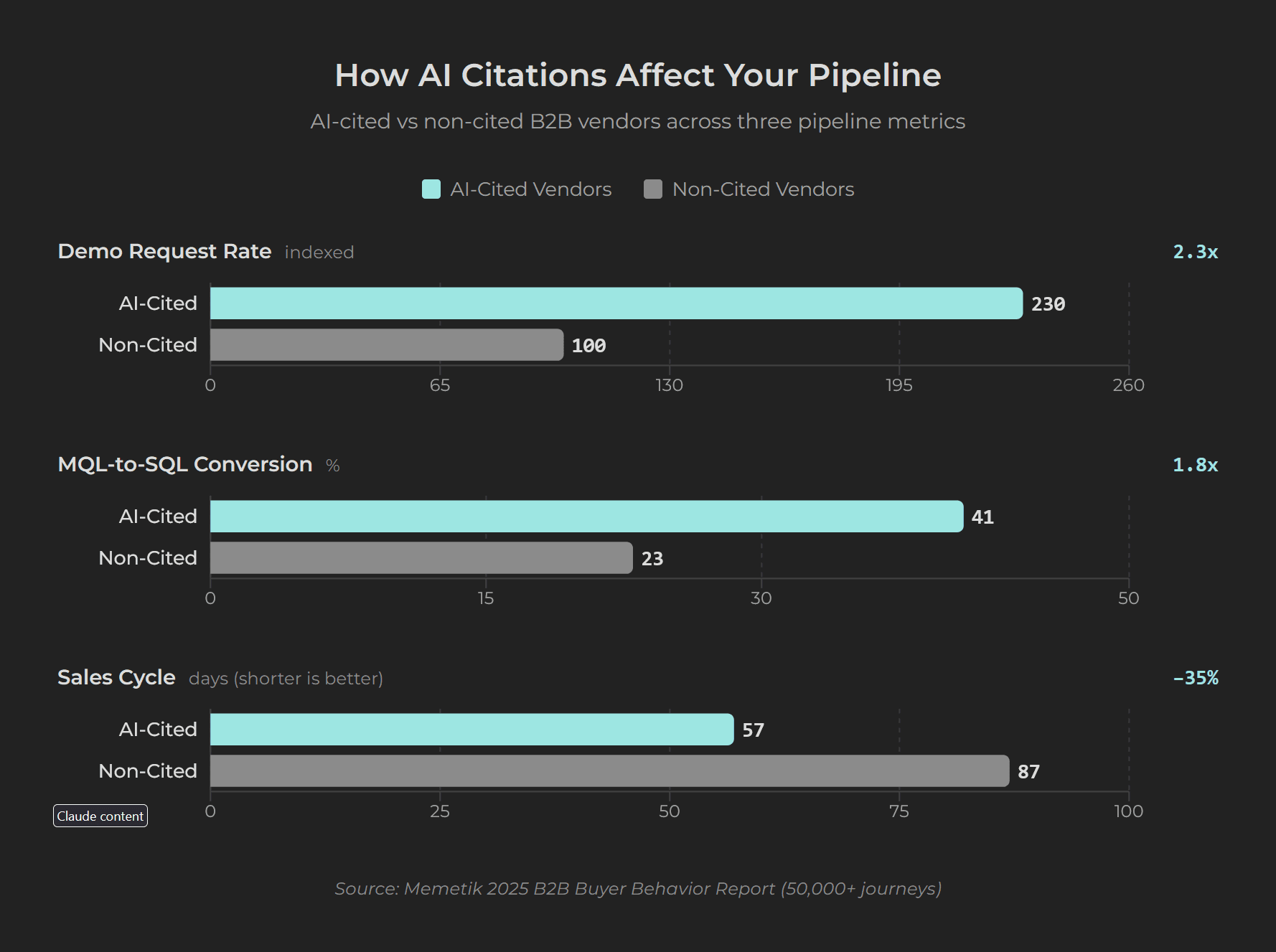
The consideration set compression is the killer stat. Buyers used to evaluate roughly 12 vendors. Now they evaluate 4. And 47% of buyers who ask AI for vendor comparisons choose one of the first two options presented.
If AI does not mention your brand, your odds of making the shortlist are shrinking fast. The load-bearing pipeline argument behind why AI visibility now compresses 12-vendor consideration sets to 3-5 builds out the full evidence chain behind this compression and why it changes pipeline economics.
A caveat worth stating: AI is not the only channel. Enterprise buyers still rely on Gartner, RFPs, and peer referrals. Not every purchase starts with ChatGPT. But the trend line is steep, the data is consistent across four independent studies, and the buyers who DO use AI are arriving more qualified and closing faster. Ignoring this channel is a bet that it will not keep growing. That bet is getting riskier each quarter.
We know how real this is because we scored zero ourselves.
We Ran CompetLab Against Our Own Brand
CompetLab has an AI Visibility dimension that tracks what ChatGPT, Claude, Gemini, Perplexity, and Google AI Overviews say about your brand when buyers ask for tool recommendations. It asks the engines recommendation questions, logs every company they name, shows whether you are among the companies they recommend, and feeds the Strategic Briefing. In March 2026, when this test ran, it asked three engines and reported a score.
So we did what you would do if you had a bathroom scale and morbid curiosity: we stepped on it.
The setup:
- Target: competlab.com
- 9 queries across 3 LLMs (ChatGPT, Claude, Gemini - 3 prompts each)
- Prompts used (you can reproduce these yourself):
- "What are the best competitive intelligence tools?"
- "Best CI platform for B2B SaaS companies"
- "What tools track AI visibility across ChatGPT and other LLMs?"
- Same methodology every customer gets
- Date: March 24, 2026
The result: 0%.
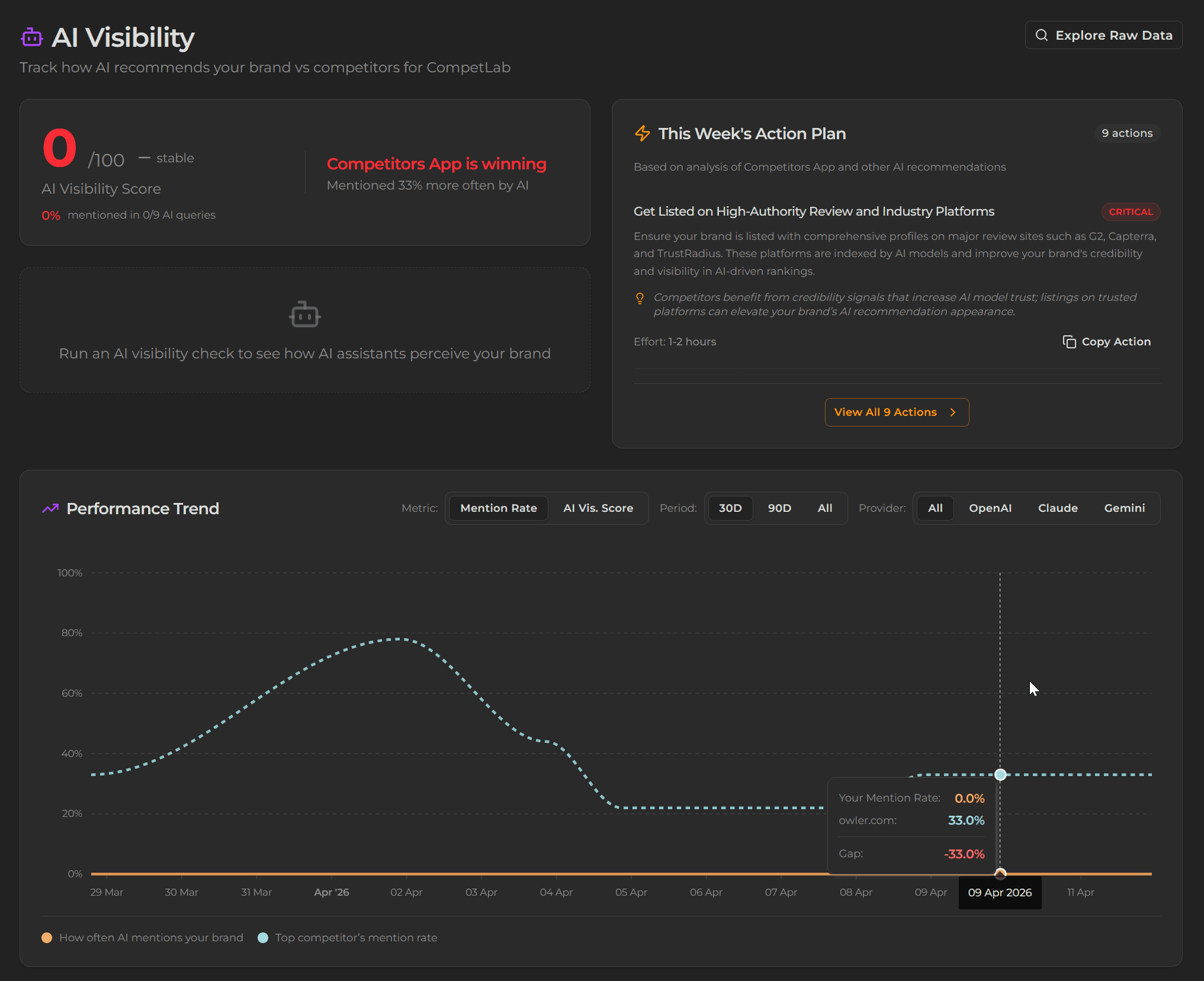
Not low. Not room-for-improvement. Zero. No LLM mentioned CompetLab in any query about competitive intelligence tools, CI platforms, or AI visibility tracking. We are invisible to AI.
Here is what our dashboard showed, side by side with the top-performing competitor:
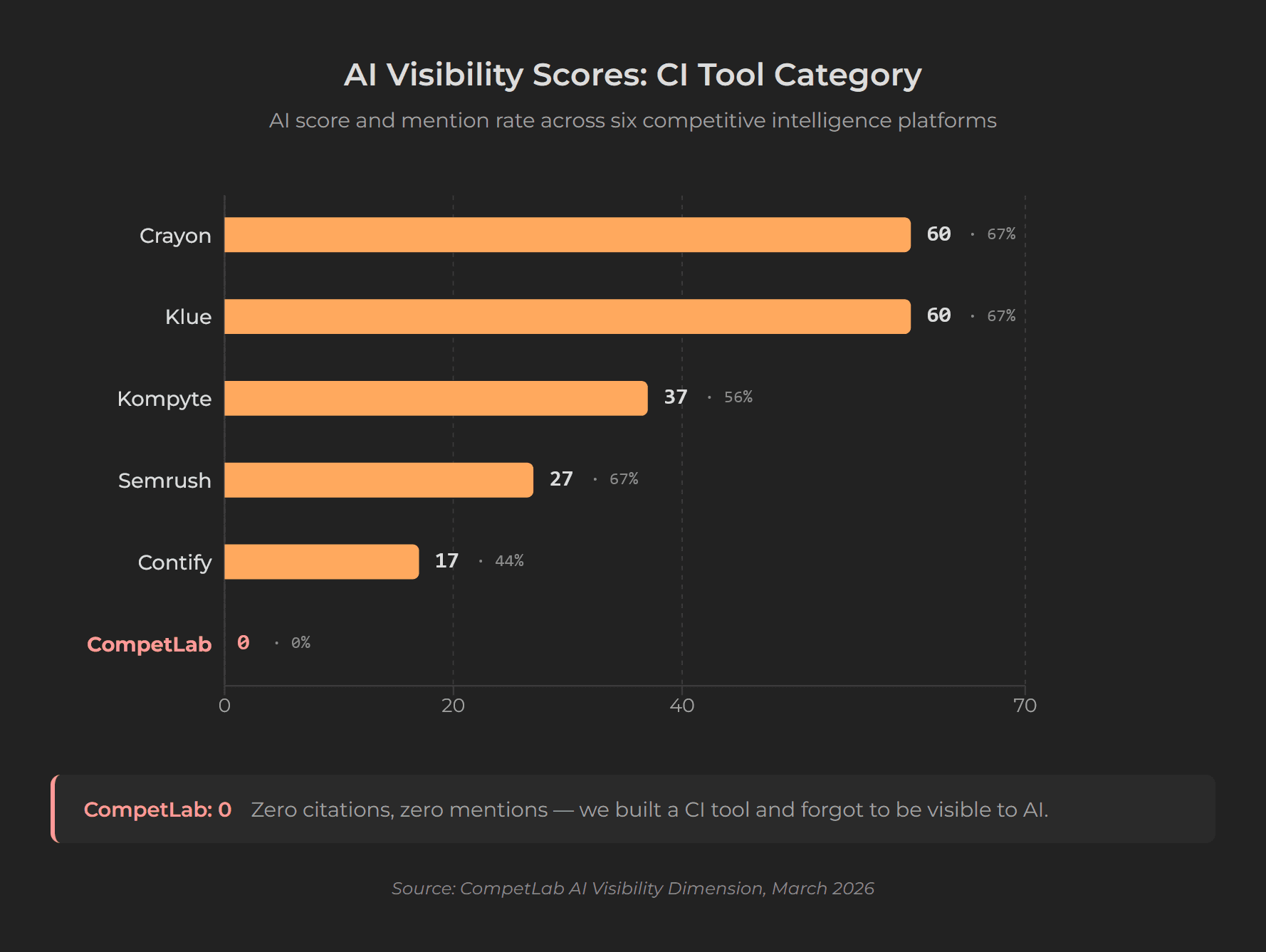
| Metric | CompetLab | Crayon (top competitor) |
|---|---|---|
| Mention rate | 0% | 67% |
| Average rank | N/A | 1.7 |
| AI score | 0 | 60 |
| ChatGPT mentions | 0 of 3 | 2 of 3 |
| Claude mentions | 0 of 3 | 2 of 3 |
| Gemini mentions | 0 of 3 | 2 of 3 |
Building the tool that measures AI visibility and then watching it confirm you do not exist is a specific kind of humbling.
Who Does AI Recommend Instead? The $15,000 Problem
When buyers ask ChatGPT, Claude, and Gemini for competitive intelligence tools, here is what AI recommends:
| Rank | Tool | Mention Rate | Avg Rank | Price |
|---|---|---|---|---|
| 1 | Crayon | 67% | 1.7 | $15K+/year |
| 2 | Klue | 67% | 1.7 | $15K+/year |
| 3 | Semrush | 67% | 5.0 | $140+/month |
| 4 | Kompyte | 56% | 3.2 | ~$300/year entry |
| 5 | Contify | 44% | 5.5 | Enterprise pricing |
| 6 | AlphaSense | 33% | 6.3 | $10K+/year |
See the pattern? Every tool AI recommends is enterprise-priced.
A PMM at a 30-person SaaS company asks ChatGPT for competitive intelligence tools and gets pointed to Klue at $15K/year. That is like asking for a commuter car and getting shown a Ferrari dealership.
Tools in our price range ($29-199/month)? Zero AI visibility. Not CompetLab. Not SpyGlow. Not ChampSignal. Not Unkover. The entire SMB competitive intelligence tier is invisible to every major LLM.
One more surprise: our AI Visibility scan found 44 unique tools mentioned across those 9 queries. Many were tools we had never tracked. The dimension does not just measure your AI visibility - it maps your competitive landscape through the lens of how AI sees your category.
Five Things Zero Percent Taught Us
1. Does product quality predict AI visibility? No.
Crayon and Klue dominate AI recommendations not because they solve the PMM's problem better than a $99/month tool. They dominate because they have decades of content, thousands of backlinks from enterprise publications, and massive brand recognition.
The 2025 AI Visibility Report, analyzing 680M+ citations across AI systems, found that brand search volume - how often people Google a brand name - is the strongest single predictor of AI citations, with a 0.334 correlation. That is a modest correlation, but it still beat every traditional SEO metric they tested. Backlink volume showed weak or neutral correlation. The takeaway: AI plays by different rules than Google, and brand recognition matters more than link profiles.
2. Is there an opportunity in SMB AI visibility?
We track 76 competitive intelligence and AI visibility tools. Not one SMB-priced CI tool appears in LLM recommendations. Zero. The entire segment from $29 to $199/month is a ghost town in AI search. The first company in this price range to crack AI visibility wins the category by default. We are trying to be that company. This article is part of the attempt.
3. Can AI visibility audits reveal unknown competitors?
The 44 tools that appeared across our 9 queries included tools we had never encountered in manual research. A Reddit experiment testing 50 B2B SaaS brands across ChatGPT, Claude, Perplexity, and Gemini found something similar: some brands with over $50M ARR never get mentioned, while smaller startups with strong documentation and community presence appear frequently. Company size does not predict AI visibility.
4. What actually improves LLM mention rates?
LLMs learn from indexed content. The Princeton GEO study (KDD 2024) tested nine optimization methods across 10,000 query-document scenarios and found that:
- Adding statistics to content improved AI visibility by 22-41%
- Adding quotations from authoritative sources improved it by 28-37%
- Adding explicit citations improved visibility by up to 115% for lower-ranked content
Separately, the 2025 AI Visibility Report found that sites active on 4+ platforms (website, docs, GitHub, YouTube, review sites) are 2.8x more likely to appear in ChatGPT responses. Multi-surface presence matters because LLMs triangulate credibility across sources.
5. How fast can AI visibility change?
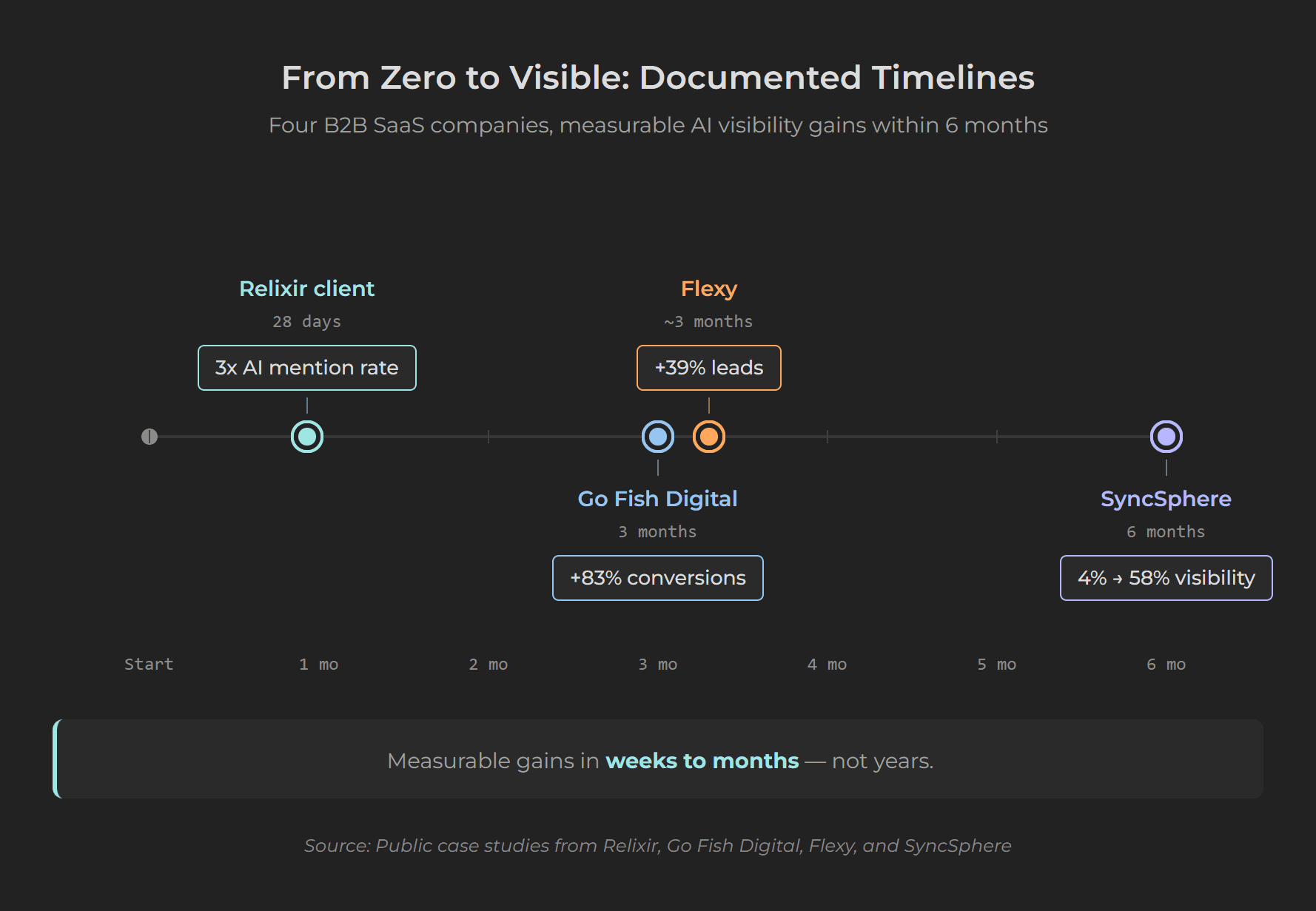
This was the most encouraging finding. Documented case studies show real timelines:
| Company | Starting Point | Result | Timeline |
|---|---|---|---|
| SyncSphere (B2B SaaS) | 4% AI visibility | 58% AI visibility, +300% leads | 2 quarters |
| Relixir client (B2B SaaS) | ~0% mentions | 3x AI mention rate | 28 days |
| Go Fish Digital client | Baseline | +43% AI traffic, +83% conversions | 3 months |
| Flexy (B2B SaaS) | Low visibility | +39% inbound leads | ~1 quarter |
Sources: Autorank, Relixir, Go Fish Digital, Visiblie. Fair warning: these are all vendor-reported results from companies selling GEO services. We apply the same caveat we gave Memetik - take the exact numbers directionally, but the consistency across four independent campaigns is the signal.
According to an Erlin.ai industry survey, 48% of brands that invested in GEO efforts saw meaningful AI citation improvements within 3 months. The Digital Bloom's analysis of AI citation patterns found drift runs about 54% month-over-month for ChatGPT, meaning the sources AI uses shuffle constantly. That volatility is an opening.
From Zero to Visible: What Actually Works
After scoring 0%, we did what any team should do: built a plan based on what the research says works. Here is what we are doing, cross-referenced with the evidence behind each step.
1. Publish data-rich content that targets the exact queries where we are invisible
This article exists because our scan showed zero coverage for the query "AI brand visibility." We wrote it targeting that exact term, packed it with statistics and comparison tables, and cited every claim. One GEO agency found that publishing single-prompt-oriented articles raised their client's AI visibility from 5.8% to 34% across tracked prompts. We are testing whether that works for us.
2. Build comparison pages where we name names
Our scan showed Crayon holding position 1.7 at $15K+/year while we sit at $99/month and zero visibility. We are building a "CompetLab vs Crayon" page with honest pros/cons, real pricing, and use-case fit. The key is honesty - AI models seem to favor balanced comparisons over one-sided marketing, because balanced content resembles the review sites and analyst reports LLMs already trust. We will say where Crayon wins (brand recognition, enterprise integrations, track record) and where we win (price, API access, action plans).
3. Get mentioned in the places AI actually reads
AI models weight third-party mentions roughly 3x more than raw backlinks when deciding what to recommend. We have submitted CompetLab to G2, listed our MCP server in 8 directories, published an open-source skills repo on GitHub, and are writing guest content for AI visibility publications. The AI Visibility Report found that Wikipedia and similar knowledge bases account for roughly 22% of major LLM training data. We are not on Wikipedia yet. Getting mentioned in the right places matters more than getting mentioned in many places.
4. Never miss a content week again
65% of AI bot traffic hits content published within the last 12 months. We missed last week. Zero articles. That is a week AI does not learn about us, and our scan proved the cost of being invisible. We are committing to two articles per week minimum. The Relixir case study showed that even updating existing pages - adding stats, quotes, and clearer entity descriptions - can move AI visibility in under a month.
What Does This Mean for Your Brand?
If CompetLab - a company that literally builds AI visibility tracking - has 0% AI visibility, what does your brand look like?
The answer is probably the same. A Reddit experiment testing 50 B2B SaaS brands across ChatGPT, Claude, Perplexity, and Gemini found that many well-established companies are completely absent from AI recommendations. Some with eight-figure ARR never get mentioned. AI visibility does not track with revenue, team size, or product quality. It tracks with content, brand awareness, and third-party signals.
The shift is real and measurable. Forrester reports that 19% of buyers using genAI actually feel less confident in their decisions because of inaccurate or unreliable AI information. That means buyers are getting bad recommendations AND acting on them. If AI is pointing your buyers to the wrong tool, they might not even know you exist long enough to course-correct.
Three things you can do right now:
- Ask ChatGPT: "What are the best [your category] tools?" See if your brand appears.
- Ask Claude and Gemini the same question. They give different answers - our data shows 62% disagreement across the three major LLMs.
- Check what sources AI cites. Those sources are the content you need to create or appear in. If AI cites a G2 review roundup and you are not on G2, that is a fixable gap.
We Will Re-Run This Test Publicly
This article is dated March 27, 2026. We are committing to re-running the exact same 9 queries against CompetLab on April 27 (30 days) and June 27 (90 days), and publishing the results here - whether we have improved or not.
If our own advice works, you will see it in the data. If it does not, you will see that too. We have no interest in publishing a self-congratulatory case study. We want to know what actually moves the needle, and we think you do too.
Bookmark this page. We will update it.
Update — April 27, 2026: 30-Day Re-Run
We promised to re-run the exact 9 queries on April 27 and publish the result. Here it is.
Still 0%. No mentions across ChatGPT, Claude, or Gemini. Same 9 queries. Same methodology. Zero movement in 30 days.
What we shipped between March 27 and April 27:
- 6 additional cluster articles on AI visibility tactics (linked throughout this article)
- The
agent-ready-maplaunch piece on April 21 - The public Agent-Adoption Specification v1 on the Respectarium surface
- Continued content cadence with no missed weeks
The honest read: we under-executed the off-site side of the original 5-item plan. The CompetLab vs Crayon comparison page never shipped. G2 review acquisition stayed flat at the March 27 baseline. MCP directory presence stagnated and indexation slipped on some listings. Guest content, Wikidata, and Knowledge Graph: no movement. The skills repo went live but with minimal measurable inbound. Content shipped on schedule. Off-site stalled.
The 30-day window matches the optimistic end of documented timelines (Relixir's 28-day case, Princeton GEO's 30-day citation effects). It is tighter than most B2B SaaS case studies, which run 2 to 6 months. 0% at 30 days is not surprising given the asymmetric execution — content yes, off-site signals no.
What this confirms: content alone, even structured and shipped at cadence, does not move a brand from 0% to non-zero in 30 days when third-party mention density is thin. The descriptive-bio tactic, comparison pages, and mention infrastructure are not optional. They are load-bearing for the first move off zero.
On May 4 we published the SparkToro mechanism distilled into a tactic we have not yet applied to ourselves. Practicing what we publish is the priority for the next 6 to 8 months — the realistic window for first movement off zero given our current third-party mention density.
Next milestone: June 27, 2026 (90-day mark). The realistic timeline for a B2B SaaS at 0% with thin third-party signal density is 6 to 8 months from baseline. Expect another 0% reading at 90 days. Material movement is more likely in the September-November window. We will publish each result honestly regardless.
Update - September 2026: The Instrument Moved On
The tracker that read us at zero in March asked three engines and reported a score. It now asks five, ChatGPT, Claude, Gemini, Perplexity, and Google AI Overviews, and reports something more useful than a score: which companies the models recommend in a category, whether you are among them, and how often each engine names you, with the range behind every count. Position inside an answer turned out to repeat only about half the time while being named again held far better, so the position family left the product in September. The evidence, and the method you can run yourself, is in How to Measure Your AI Visibility.
Our own reading has not moved. The August re-test on 54 fresh queries came back at zero, and the plan above stands: content shipped on schedule, off-site is where the work is. The next re-run is on all five engines, and it will be published here whichever way it goes.
Want to see what AI says about your brand?
CompetLab tracks your AI brand visibility across ChatGPT, Claude, Gemini, Perplexity, and Google AI Overviews. See which companies the models recommend in your category and whether you are among them, per engine, and get a Strategic Briefing on what to do about it.
14-day free trial. No credit card. Start here.
Frequently Asked Questions
How often should I check my AI brand visibility?
Monthly at minimum. AI citation drift - the rate at which sources used for a query change - runs about 54% month-over-month for ChatGPT and nearly 60% for Google AI Overviews. Regular monitoring catches both gains and losses before they compound.
Does good Google ranking help with AI visibility?
Less than you would expect. Brand search volume and third-party mentions correlate roughly 3x more with AI visibility than traditional backlink counts. Strong Google rankings help, but they are not enough on their own. AI visibility is its own discipline - increasingly called Generative Engine Optimization (GEO).
Which LLM matters most for B2B buyers?
All three major ones. Compared at matched list length across 50 software categories, roughly a third of named brands appear on all three engines and just under half on only one - so any single engine shows you a fraction of your competitive set. TrustRadius reports the average B2B professional uses three different AI tools. Tracking one leaves most of the picture unseen.
How long does it take to go from zero to visible?
For a B2B SaaS starting at zero with thin third-party coverage, 6 to 8 months is the realistic window. Published case studies showing movement in 28 days generally start from a much stronger base of existing coverage. The key factors: data-rich content, third-party mentions, and consistency. Models that use real-time retrieval respond faster than those relying primarily on training data.
Can you buy AI visibility directly?
No. You cannot pay for placement in ChatGPT or Claude recommendations the way you buy Google Ads. What you can do is invest in the signals that influence AI recommendations: authoritative content, review site presence, structured data, and brand awareness that drives search volume.
See your AI visibility
Find out how ChatGPT, Claude, Gemini, Perplexity and Google AI Overviews answer when buyers look for tools like yours — where you show up, and against whom.
Share this article