The Descriptive Bio Tactic: One Phrase, Hundreds of Sites, AI Citations
Rand Fishkin asks every podcast host, conference, and webinar to introduce SparkToro the same way: "the makers of fine audience research software." That phrase now propagates across hundreds of indexed third-party pages. Ask ChatGPT or Perplexity for the best audience research tool, and SparkToro consistently appears at the top.
This is the descriptive bio tactic. Standardize one keyword-rich phrase about your brand. Get it published verbatim across the third-party surfaces AI engines actually cite. Wait for the co-occurrence pattern to compound. The mechanism is well-documented. The playbook is straightforward. The B2B SaaS company-level evidence is thinner than the personal-brand case studies suggest, and the failure modes are real. This article works through all four.
Key Takeaways
- Rand Fishkin asks every host to use the line "SparkToro, makers of fine audience research software." It now appears across hundreds of indexed third-party pages, and AI engines consistently surface SparkToro for "best audience research tool."
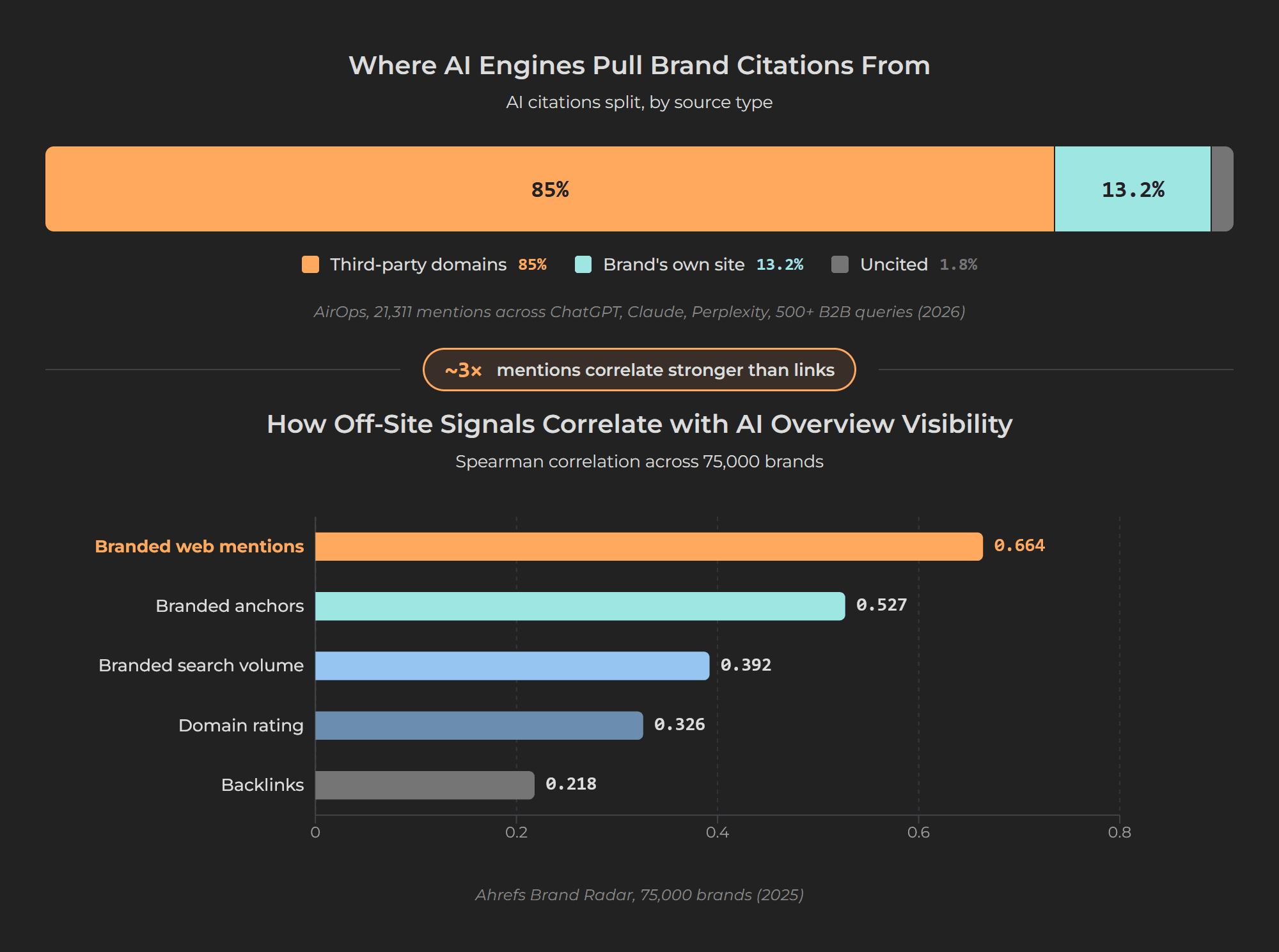
- AirOps analyzed 21,311 brand mentions and found 85% came from third-party domains, only 13.2% from the brand's own site. Earned media is roughly 6.5x more likely to be cited.
- Mentions matter roughly 3x more than links. Ahrefs studied 75,000 brands and found web mentions correlate ρ = 0.664 with AI Overview visibility versus 0.218 for backlinks.
- Realistic timeline: 2-4 weeks for Perplexity to reflect new mentions, 2-3 months for ChatGPT, 3-6 months for AI Overviews. The compound is slow.
- The strongest case studies are personal brands. Public B2B SaaS company-level wins (Ramp, 1840, Carta, Discovered Labs anonymized mid-market) bundle bio work with content, reviews, and Reddit. No isolated company-level bio experiment has been published.
What does the SparkToro case actually show?
Rand Fishkin asks every podcast host, conference, and webinar to introduce SparkToro the same way: "the makers of fine audience research software." That phrase now propagates across hundreds of indexed third-party pages, and ChatGPT, Perplexity, and Claude consistently surface SparkToro when buyers ask for the best audience research tool.
Fishkin confirmed the wording was deliberate in an October 2025 SparkToro post. He edits the bio specifically so hosts copy it into show notes, conference speaker pages, podcast feeds, and YouTube descriptions. Independent tests by Content Guppy and a Greg Digneo LinkedIn analysis both record SparkToro appearing as ChatGPT's first or second result for "best audience research tool."
The mechanism is two layered ideas. Distributional semantics: language models infer meaning from co-occurrence patterns. When a brand name and a category phrase repeatedly appear in the same context across many independent documents, the model learns the association. A 2024 ACL paper on association capabilities in large language models, and a 2023 EMNLP paper on co-occurrence bias, both show the effect quantitatively. Model preference scales with co-occurrence frequency, and the bias persists even when it overrides stored facts.
The second layer is retrieval. AI answer engines that sit on top of LLMs (ChatGPT with browsing, Perplexity, Google AI Overviews) preferentially cite third-party sources. The bio phrase plants the brand-category association specifically on the surfaces those engines crawl.
What the SparkToro case does not show: a controlled experiment isolating the bio line from Rand's broader prominence. He is an ex-Moz founder, runs original research, appears on dozens of podcasts, and writes widely-cited content. Single-subject and confounded. The mechanism is well-grounded. The bio's marginal contribution above a strong baseline is not isolable from public data.
Why do third-party mentions beat first-party for AI?
Mentions matter roughly 3x more than links for AI visibility. That is the cleanest takeaway from the largest available study. Brand mentions across the open web correlate ρ = 0.664 with AI Overview visibility. Backlinks correlate only 0.218.
Ahrefs analyzed 75,000 brands for that finding. Domain rating came in at 0.326. Branded anchors at 0.527. Branded search volume at 0.392. Web mentions out-pulled every other off-site signal Ahrefs tested. Brands in the top quartile of web mentions averaged 169 AI Overview mentions each. Brands in the bottom half averaged zero to three. For more on link building's evolving role in AI visibility, see link building for AI visibility.
The first-party vs third-party split is even more lopsided. AirOps analyzed 21,311 brand mentions across ChatGPT, Claude, and Perplexity for 500-plus commercial-intent B2B queries. 85% of citations came from third-party domains. 13.2% came from the brand's own site. Brands were 6.5x more likely to be cited via third-party content than via their own. Roughly 90% of those third-party mentions came from listicles, comparisons, and review pages.
The source mix matters too. Omniscient analyzed 23,387 citations across 240 branded prompts spanning ChatGPT, Perplexity, Gemini, AI Mode, and AI Overviews. Earned media (editorial sites, forums, reviews, directories) accounted for 48% of citations. Commercial brand content (third-party brand-authored pages) added 30%. Direct owned content was 23%.
Within earned media, the dominant single domains are predictable. A 150,000-citation Semrush study put Reddit at 40.1% of citations, Wikipedia at 26.3%, and YouTube at 23.5%. Among software review platforms, an industry analysis put G2 alone at 33% to 75% of review-platform citations across major engines. SE Ranking's review-platform analysis found five sites (Gartner Peer Insights, G2, Capterra, Software Advice, TrustRadius) account for 88% of all review-platform links in AI Overviews.
Practical reframing: a repeated descriptive phrase increases the brand-category co-occurrence count, and it does so specifically on the surfaces AI engines preferentially cite. That is what makes consistent third-party bios more valuable than the same phrase repeated only on a company's own site. The descriptive-bio tactic is one move inside a larger off-site layer — see where the descriptive-bio tactic sits in the larger off-site layer — and why this single move compounds the way it does for how third-party signal density compounds with content structure and entity consistency.
How do you apply the descriptive bio tactic?
Define a 10 to 20 word clause that pairs your brand with a specific category and a specific audience. Standardize that clause across the surfaces AI engines actually cite. Wait two to six months for the effect to compound.
The phrase format is narrow. Pattern: "[Brand], a [specific category] for [specific audience]." Generic versions ("the leading SaaS platform") fail because they create no entity-discriminating signal. Stuffed versions (four clauses of synonym variations) get rewritten by editors and devalued by generative engines. The working examples in the research all hit a tight middle: "SparkToro, makers of fine audience research software" (10 words), "GEO consultant and creator of the MoonInMental Method" (10 words), "an AI-powered competitive intelligence platform for B2B teams" (9 words).
Where to plant it, in priority order based on AI citation frequency:
- Your own homepage and Organization schema description. This is the canonical entity anchor. The first sentence of your About page, the schema description, and your sameAs links all need to use the same clause. For more on the entity-anchor mechanics, see About Us pages for AI.
- LinkedIn company page and founder headline. A Semrush analysis of 89,000 LinkedIn URLs cited in AI search found LinkedIn appears in 11% of AI responses across ChatGPT Search, Perplexity, and Google AI Mode. AI descriptions of brands often mirror the semantics of their LinkedIn copy.
- G2, Capterra, Software Advice, TrustRadius short descriptions. For B2B SaaS this is the highest-leverage cluster. The 88% review-platform concentration above means a clean profile description on these sites gets disproportionately reused.
- Crunchbase and Wikidata, plus Wikipedia if notability supports it. These feed the Knowledge Graph that pre-trained models lean on for stable entity facts.
- Podcast bios, conference speaker bios, guest-post author bylines. Only valuable where the bio renders as crawlable HTML. Image-only podcast cards and JS-rendered speaker components are invisible to AI crawlers. Insist hosts publish a static bio page.
Volume needed: 15 to 25 well-placed collaborations typically produce 50-plus indexed third-party mentions, because each podcast or guest post replicates across two to four URLs (host site, episode page, recap, social posts).
Timeline expectations differ by engine:
| Engine | First-citation latency | Why |
|---|---|---|
| Perplexity | 2-4 weeks | Live retrieval, freshness-weighted |
| ChatGPT with browsing | 2-3 months | Mix of training data and retrieval |
| Google AI Overviews | 3-6 months | Recrawl plus Knowledge Graph cycles |
| Gemini | 3-6 months | Slower to reflect new entities |
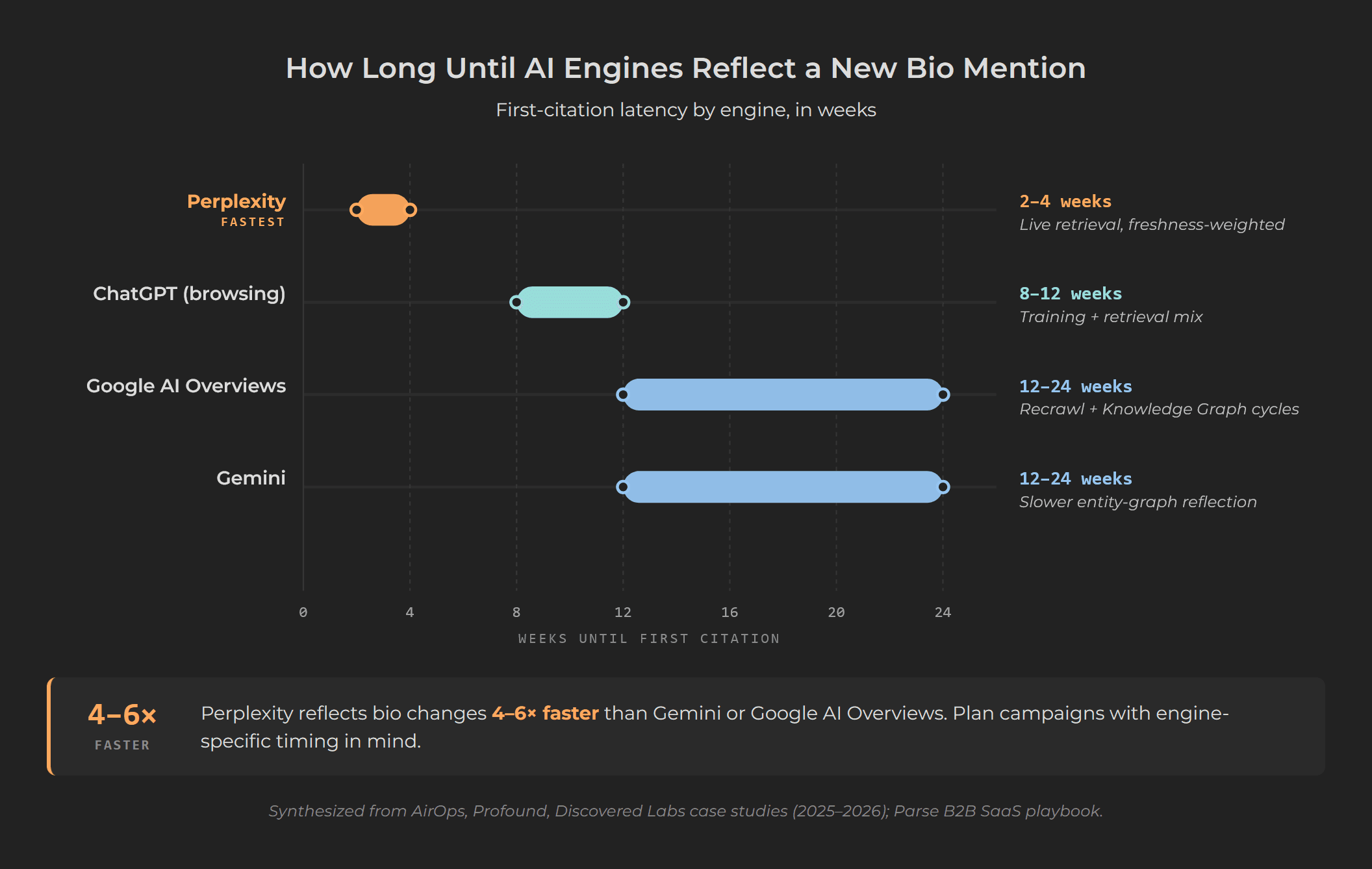
These ranges assume the placements are on credible domains and the rest of your visibility fundamentals (own-site content, schema, reviews) are not actively broken.
Semantic consistency, not exact-string matching. Keep the core triple stable (brand name, category label, audience). Allow minor syntactic variation per platform so the language reads naturally to humans. AI engines cluster semantically similar descriptions as one entity with richer context.
Where does the descriptive bio tactic fail?
Five failure modes are documented in the research. Generic phrasing is the most common. Outdated phrasing is the hardest to fix. Spam-adjacent distribution is the only one that crosses into Google-risk territory.
Wrong or outdated phrasing locks in. Once a description propagates across 100-plus pages, the entity association is sticky. SEO consultant Matt Earle documented a Knowledge Panel case where a company's headquarters city showed wrong on Google because an old speaker bio mentioned the founder as "based in Calgary." The panel flipped within roughly two weeks of cleanup. LLM training cutoffs mean stale phrases persist longer in pre-trained models. If you pivot products or markets after the bio has propagated, you inherit a slow correction job across the highest-authority third-party pages.
Generic kills the signal. "The leading SaaS platform" creates no co-occurrence pattern that distinguishes your brand from any other. Speaker-bio guides treat clichés as functionally invisible to humans and to language models alike. The minimum specificity threshold is roughly category plus audience. "AI-powered competitive intelligence platform for B2B SaaS teams" works. "Innovative growth solution" does not.
Keyword stuffing gets rewritten. Hosts and editors trim bios that read like SEO copy. A four-clause synonym stack ("AI-powered competitive intelligence software, AI competitive intel tool, AI SaaS competitor analysis platform") is exactly the bio that gets cut to "an analytics tool" by an editor on deadline. Your engineered consistency dies in someone else's draft. Generative engines also flag heavy keyword density as a quality signal against citation.
Inconsistency fragments the entity. "Agency" on LinkedIn, "platform" on G2, "tool" on Crunchbase, "consultancy" on a podcast bio. AI sees four entities, not one. Discovered Labs documented an anonymized mid-market B2B SaaS case where inconsistent company descriptions across the website, LinkedIn, and Crunchbase were one of four root causes of zero AI visibility across 50 buyer-intent prompts.
Spam-adjacent distribution. The tactic is benign when bios appear on legitimate podcasts, conferences, and editorial sites with nofollowed or organic links. It crosses into Google-risk territory when the same phrasing rides paid-link networks or guest-post-for-link schemes. Google's 2021 link spam update specifically targeted this pattern. Bio consistency on real placements is not the risk. Bio consistency as scaffolding for low-quality link distribution is.
Does this work for B2B SaaS at the company level?
The honest answer is that no published case study isolates bio consistency as the single tested variable for a B2B SaaS company. Every named win bundles entity work with content production, schema cleanup, review-platform campaigns, and Reddit seeding. The personal-brand evidence is mechanism proof. The company-level evidence is bundled-program proof.
The strongest named B2B SaaS cases:
- Ramp moved AI visibility in the "accounts payable" category from 3.2% to 22.2% over roughly 10 weeks (December 2024 through mid-February 2025). The intervention was AI-targeted comparison pages and category framing. Entity clarity was a design goal. Cross-platform bio normalization was not the named lever. Source: Profound's published case study.
- 1840 & Co. went from 0% to 11% AI visibility in remote staffing queries within one month after publishing one strong comparison page (Profound).
- Carta reported a 75% citation rate on new pages and an average three-day lag from publication to first AI citation, attributed to brand-kit consistency across content (AirOps).
- Discovered Labs, working with an anonymized mid-market B2B SaaS, moved AI citation rate from 0% to 22% across 50 buyer-intent prompts in four weeks. Their audit named inconsistent company descriptions across the website, LinkedIn, and Crunchbase as one of four root causes. The fix was bundled with daily content publication, Reddit seeding, and a G2 review velocity campaign.
These are agency-published case studies. Profound, AirOps, and Discovered Labs sell AEO services. Take the numbers directionally and the pattern more seriously than any single brand outcome. None of them isolated bio consistency in the way SparkToro's personal-brand example does.
For a B2B SaaS PMM or founder reading this, the practical implication is unflashy. The bio tactic is a low-cost necessary layer in a broader off-site program, not a standalone growth lever. Get the canonical clause defined. Roll it out across the highest-leverage surfaces. Pair it with content and reviews. Measure visibility per AI engine over a quarter, not a week. For the measurement methodology that catches real shifts under LLM noise, see how to measure AI visibility.
If your starting point is closer to zero than to mid-market, the 0% AI brand visibility case is the honest read on what an SMB B2B SaaS sees in the first scan.
See whether your bio cleanup is moving anything before you commit another quarter to it.
CompetLab tracks AI visibility per engine across ChatGPT, Claude, Gemini, Perplexity, and Google AI Overviews: which companies each one recommends, whether you are among them, and the range behind every count. 14-day free trial. No credit card. Start here.
Frequently Asked Questions
Does the descriptive bio tactic work for B2B SaaS at the company level, or only for personal brands?
The mechanism (co-occurrence and third-party preference) applies regardless. The honest evidence picture is asymmetric. Strong personal-brand case studies exist (SparkToro, Darlene Killen, Susye Weng-Reeder). Public B2B SaaS company-level wins (Ramp 3.2% to 22.2%, 1840 & Co 0% to 11%, Carta 75% citation rate, Discovered Labs anonymized mid-market case) all bundle bio normalization with content, reviews, and Reddit campaigns. None isolate bio consistency as the single tested variable. Treat the tactic as a low-cost necessary layer, not a standalone lever.
What happens if my company pivots after the phrase has propagated across 100 sites?
The old description sticks. Once an entity-category association consolidates across high-authority third-party pages, it becomes the default in pre-trained LLMs and Knowledge Graph descriptions. Cleanup requires updating the canonical sources first (homepage, Organization schema, LinkedIn, G2, Crunchbase, Wikidata if present), then working through the highest-traffic third-party pages. Knowledge Panel changes typically reflect within two to eight weeks after Wikipedia or Wikidata updates. AI assistants update on different cycles, with Perplexity fastest and Gemini slowest.
Is this spam? What's the line between bio consistency and link manipulation?
Boilerplate bio text on legitimate podcasts and conferences is low-risk for Google. Duplicate content alone is not penalized. The line crosses when bio repetition rides paid-link networks, guest-post-for-link schemes, or PBN distribution. Google's 2021 link spam update specifically targets that pattern. The bio tactic itself is not the issue. Spammy distribution channels are. Ethical AEO practitioners frame consistent bios as brand clarity (helping humans and machines understand the entity), not algorithm manipulation.
How long until AI starts recommending my brand?
Different engines update at different speeds. Perplexity uses live retrieval and reflects new mentions within 2 to 4 weeks. ChatGPT with browsing typically takes 2 to 3 months as a mix of training updates and retrieval cycles. Google AI Overviews and Gemini are slowest at 3 to 6 months. Brands in the bottom half of web mentions are effectively invisible to AI Overviews per Ahrefs data, so you typically need 50-plus indexed third-party mentions before stable AI inclusion appears.
Does the exact same wording matter, or is semantic consistency enough?
Semantic consistency is enough. Keep the core triple stable: brand name, category label, audience. Allow minor syntactic variation per platform so the language reads naturally. AI engines cluster semantically similar descriptions as one entity with richer context. The fragmentation problem is when descriptions pull in different directions ('agency' vs 'platform' vs 'consultancy', or B2B vs consumer). That fragments the entity. Synonym variation around a stable core does not.
See your AI visibility
Find out how ChatGPT, Claude, Gemini, Perplexity and Google AI Overviews answer when buyers look for tools like yours — where you show up, and against whom.
Share this article