About Us Pages for AI: Entity Anchor, Not Citation Magnet
If your About page is not showing up when ChatGPT describes your company, that is expected. Brand-foundation pages (About, home, FAQ, contact) make up only about 4% of AI citations in large branded-query datasets. They are not the citation target.
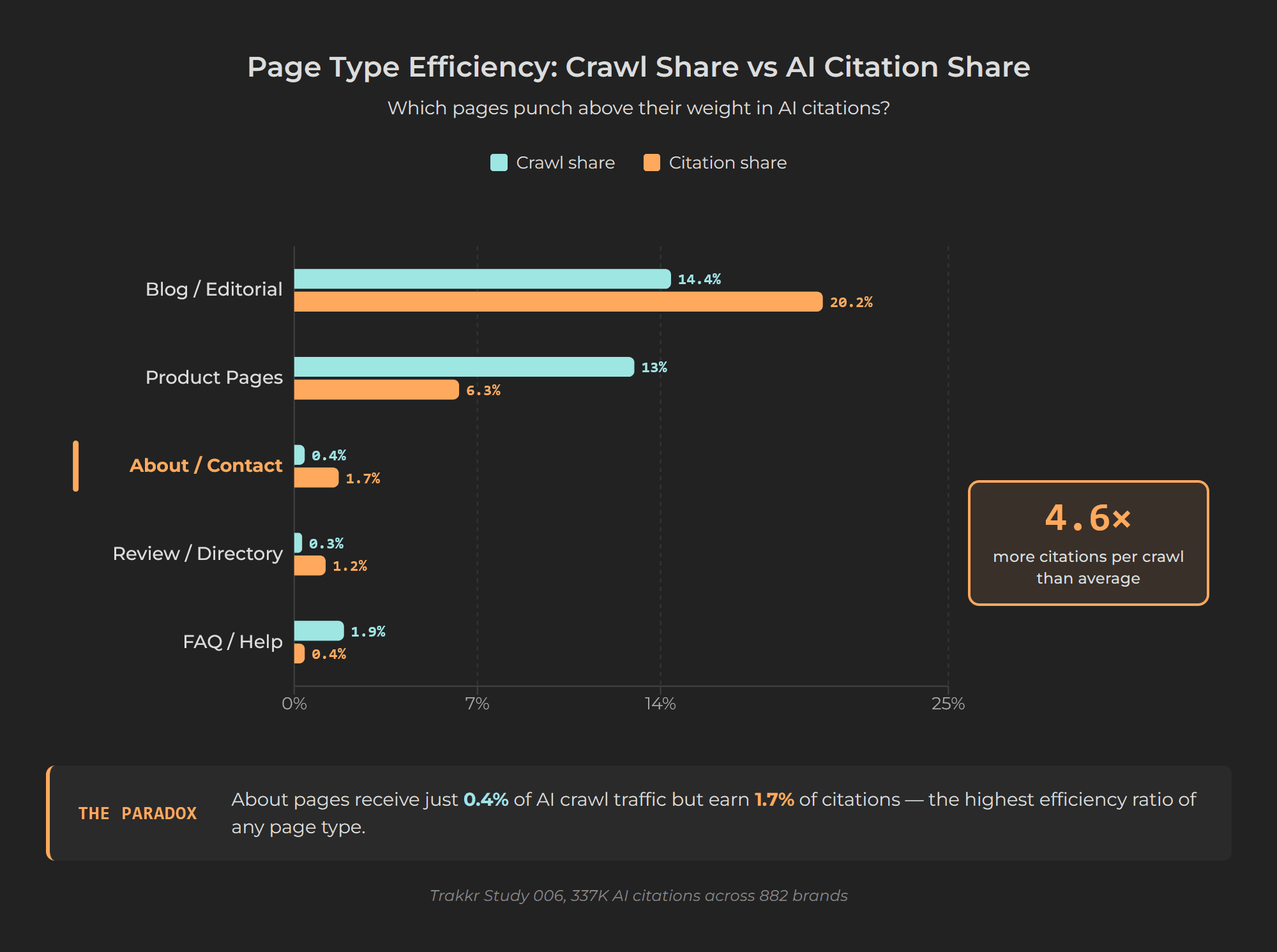
But the same pages get cited 4.6 times more often than their crawler share predicts. About pages are a minority of citations and a structural anchor for how AI describes your brand. This article walks through the mechanism, the leverage points, the failure modes, and how to test whether your changes actually moved AI output.
Key Takeaways
- About Us pages account for ~1.9% of AI citations (Omniscient Digital, 23,387 branded citations across ChatGPT, Perplexity, and Gemini) but get cited 4.6x more often than their crawler share predicts (Trakkr Study 006, 337K citations across 882 brands).
- AI doesn't cite your About page to answer user questions. It reads your About page to build the internal entity profile it uses for every other answer about you.
- The highest-leverage elements are a one-sentence canonical definition, 5-15 named entities in one place, and Organization plus Person schema with sameAs links to LinkedIn, Crunchbase, G2, and Wikidata.
- Cross-platform consistency beats About-page word count. If LinkedIn, Crunchbase, and G2 describe you differently, AI defaults to the most-repeated external description, not your site.
- Status Labs clients who expanded About pages from under 300 words to over 800 words with structured facts saw 2.4x higher ChatGPT citation rates in 90 days.
- Action: audit your About, LinkedIn, Crunchbase, and G2 profiles for conflicting category labels and founding facts before rewriting the page.
What Does AI Actually Do With Your About Us Page?
Not what most SEO advice says it does. Two datasets make this clear.
Omniscient Digital's 2026 analysis of 23,387 citations from 240 branded prompts across ChatGPT, Perplexity, and Gemini found About pages account for 1.9% of citations. Homepages get 1.8%. FAQ, contact, legal, and jobs pages combined add another 0.7%. Over 95% of branded-query citations go elsewhere - to reviews, listicles, third-party profiles, and topical guides.
So About pages are rarely the cited URL. But Trakkr's Study 006 cross-referenced 337,000 AI citations with 11.4 million crawler visits across 882 brands and found About and Contact pages receive 0.4% of crawler traffic but produce 1.7% of citations. That is 4.6x more citations per crawl than the average page. Review and directory pages are the only class with higher efficiency.
Both findings are correct. They measure different things.
About pages are a minority of total citations because most user queries are not "who is this company." They are "best tools for X" or "how to do Y," and topical content wins those. When AI does need to describe your brand, though, it leans on your About page disproportionately hard. Nothing else on most sites concentrates entity signals that tightly.
The mechanism is entity resolution. AI reconciles everything it reads about you - your site, LinkedIn, Crunchbase, G2, Wikipedia, press, Reddit - into one internal brand profile. Your About page is the canonical anchor that ties the graph together. When the anchor is clean, AI describes you the way you describe yourself. When it is weak, AI defaults to whatever third-party description is most-repeated, which is often outdated PR copy or a wrong category label on G2.
The Agentcy 2026 AI Visibility Index reports 46% of B2B marketing leaders who audited their AI positioning judged it inaccurate or mixed. Most of those errors trace back to conflicting signals between the brand's own site and third-party profiles, not missing content. For the broader motivation behind tracking AI visibility, see We Scored 0% AI Brand Visibility.
What Should an AI-Optimized About Us Page Actually Contain?
Six elements. About pages punch above their crawl weight because they concentrate entity signals, sit at low crawl depth (linked from every page through nav or footer), and carry definitional language AI can lift directly into answers. The six elements below are the structural features that make that concentration happen. The entity layer of the AI citation stack, where About-page consistency sits alongside off-site mention density and content structure frames where About-page entity signals fit alongside the other two layers.
1. A canonical sentence you reuse everywhere. One line defining category plus audience plus outcome. Put it at the top of the About page, at the top of your LinkedIn company description, in your Crunchbase summary, in your press boilerplate. AI weights opening sentences heavily when forming entity descriptions. When every surface starts with nearly identical copy, AI converges on that definition. When they disagree, AI picks the most-repeated version across third-party sources - usually not yours. The SparkToro mechanism for making sure your phrase IS the most-repeated version across third-party sources walks through how to put that canonical line on the surfaces AI actually weighs.
Example: "CompetLab is a competitive intelligence platform for B2B SaaS teams that tracks AI visibility across ChatGPT, Claude, Gemini, Perplexity, and Google AI Overviews."
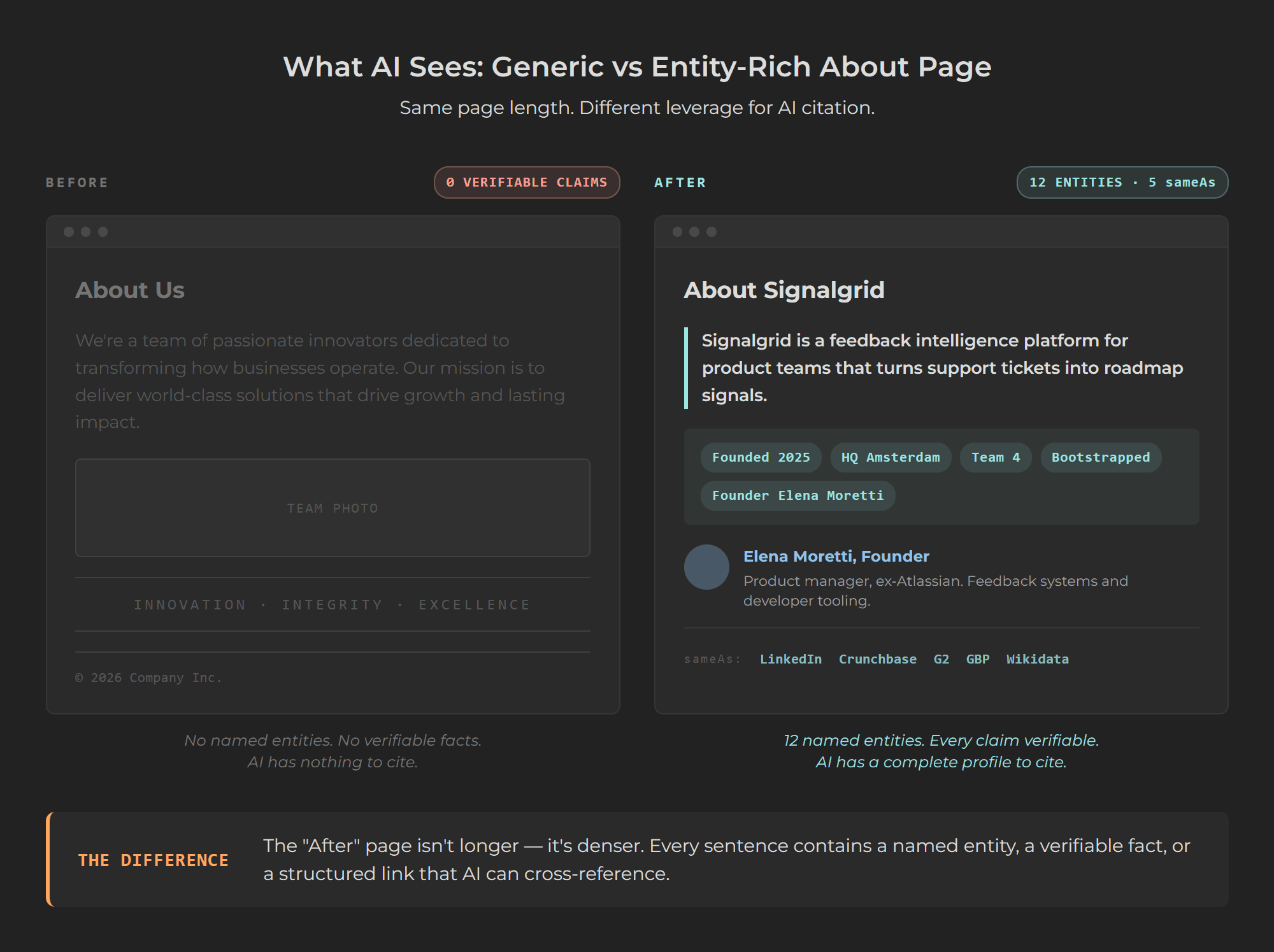
2. A compact fact block near the top. Founding year, HQ city, team-size band, founders, funding stage if material. Present as bullets. These are the facts AI hallucinates most. Explicit bullets reduce the odds AI has to guess and give it extractable passages for identity queries.
3. Organization and Person schema with sameAs. The single highest-leverage schema property is sameAs. It explicitly tells AI "the organization on my site is the same as these external URLs." List LinkedIn, Crunchbase, G2, Google Business Profile, Wikidata if you have one, and primary social accounts. One case from AI Advantage Agency describes a law firm that began appearing in ChatGPT for its core practice-area queries within five weeks of implementing Organization, Person, FAQPage, and LegalService schema with complete sameAs chains. For deeper schema type selection, see Schema Markup for AI Citations.
4. Founder and leadership section. Real names, third-person bios with credentials, LinkedIn links. Nest Person schema under Organization via the founder property. Names plus verified external profiles connect your brand entity to person entities AI already trusts.
5. Entity connections. Partners, integrations, named customers (in text, not just logos), awards, media mentions. Each named entity is a corroboration edge AI can trace to verify your claims. Logos alone are invisible. AI cannot read them.
6. A short identity FAQ. "When was X founded?" / "Where is X headquartered?" / "Who uses X?" Self-contained Q&A pairs AI can reuse directly. This is different from a topical FAQ. The About FAQ exists only to answer identity questions. For answer-first body structure on your topical pages, see How to Structure Content That AI Cites.
Length guidance: 500 to 800 words is the working convention. A Status Labs case report found clients who expanded About pages from under 300 to over 800 words with structured facts saw 2.4x higher ChatGPT citation rates within 90 days. Structure matters more than the word count itself. A 1,200-word wall of narrative underperforms a 600-word page with clear sections, bullet lists, and H2 headings aligned to real identity questions.
What Breaks About Us Pages for AI?
The biggest failure on most About pages is not on the About page. Five failure modes live on the page itself. The sixth, inconsistency across LinkedIn, Crunchbase, G2, and old press releases, is where most of the damage actually lives.
1. Generic mission copy with zero entities. "We help businesses succeed" gives AI nothing to anchor on. No category, no audience, no product. AI falls back to third-party sources, which may be five years out of date.
2. Image-only or JavaScript-rendered content. Hero images that contain your canonical description as graphics are invisible to AI crawlers. Content hidden behind tabs or accordions that require client-side rendering is invisible too. If your About page relies on JS to reveal key facts, check the raw HTML source. What AI sees is what lives there.
3. Outdated leadership, HQ, or product information. When your About page contradicts your LinkedIn company page or Crunchbase entry, AI downweights the site claim in favor of the aggregated external record. Update both together, every time a fact changes.
4. Missing or half-built Organization schema. No sameAs. No foundingDate. Schema implemented once and never updated when the business changed. Schema that conflicts with visible facts is worse than no schema. AI parsers detect the mismatch and trust neither source.
5. No single canonical entity home. Brand facts scattered across Team, About, Press, Contact, and Company pages with no definitive source of truth. Pick one URL as the entity home. Consolidate the rest into it or link to it unambiguously.
6. The entity graph is inconsistent across platforms. If your About says "AI competitive intelligence platform" but your G2 category is "Market Research Software," LinkedIn calls you a "Business Intelligence Company," and an old TechCrunch piece describes you as "a startup building analytics dashboards," AI sees four conflicting descriptions and defaults to whichever is most-repeated across third-party sources. Usually not yours. This is the entity-drift problem, and it is more common than most founders realize. Fixing it requires auditing every platform, not just the website.
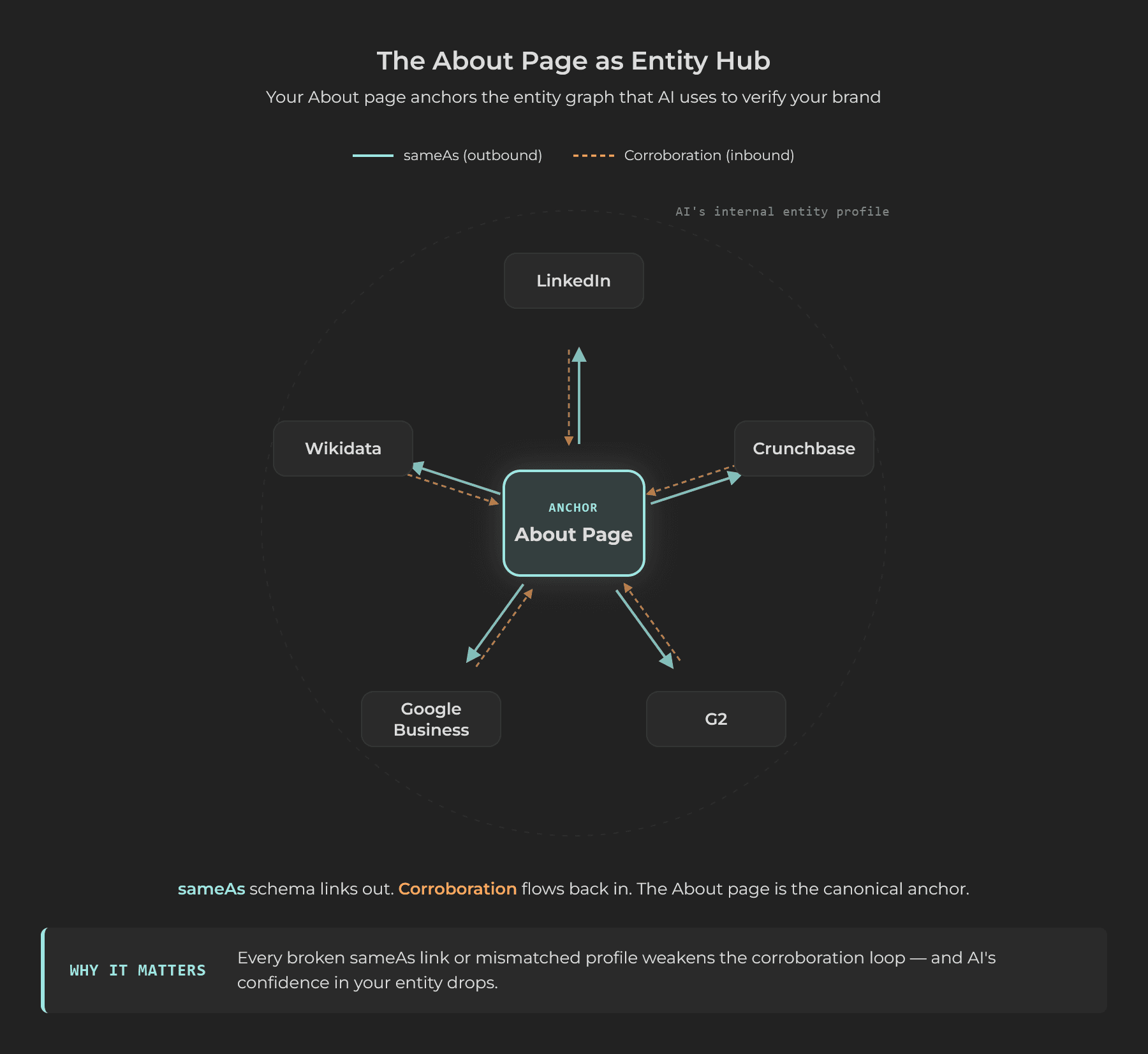
Fixing the About page alone is necessary but not sufficient. If G2 has the wrong category tag and an old press release still ranks for your brand name, AI will keep citing those signals. The entity graph has to be consistent across every surface AI reads. In practice that means auditing six to ten external profiles before or alongside the site rewrite.
How Do You Test Whether Your About Page Change Moved AI?
Manually, with a repeatable prompt protocol. Run three prompt types across ChatGPT, Perplexity, Gemini, and Google AI Overviews.
- Identity prompts: "Who is [Brand]?" / "What does [Brand] do?" / "When was [Brand] founded?"
- Category prompts: "Best [category] tools for [ICP]" / "Top [category] platforms."
- Comparison prompts: "[Brand] vs [Competitor] for [use case]."
For each prompt, log: was your brand mentioned? Was the description accurate? Which URLs got cited? Repeat before the changes, then at weeks 2, 4, and 12.
Timeline expectations vary by platform. Perplexity runs live retrieval and can reflect changes within days. ChatGPT with browsing typically updates in 2 to 5 weeks. Google AI Overviews and Gemini are slowest, taking weeks to months as recrawl cycles and Knowledge Graph updates catch up.
Two useful reference points. Status Labs reported the 2.4x ChatGPT citation lift within 90 days mentioned above. SEO practitioner Ann Smarty documented in a 2025 Wix AI Search Lab post that Google AI Mode and ChatGPT refreshed their descriptions of her within days of her updating her About pages.
Both are case-based, not controlled. No randomized, About-page-only experiment exists. The evidence is correlational plus anecdotal. Act on it, but measure your own changes.
What counts as a meaningful change? Three patterns separate signal from LLM noise.
- Inclusion shifts. Your brand was not mentioned at week 0 but is mentioned at weeks 4 and 12 across two or more platforms. The platforms matter. If only Perplexity shifts, that is the live-retrieval layer catching up. If ChatGPT and Gemini both shift, the underlying index rebuilt around the new signals.
- Description shifts. Your brand was described as "a marketing tool" at week 0 and "a B2B competitive intelligence platform for SaaS teams" at week 12. This is the clearest signal the entity graph moved. Log the exact wording each run. AI descriptions drift between identical prompts, so you want the trend, not the snapshot.
- Source shifts. At week 0 AI cited a G2 review or an old press release. At week 12 it cites your About page or a recent press mention. That shift means the anchor you built is now load-bearing.
One run that improves and a second run that reverts is noise. Two consecutive runs in the same direction are signal. Three are evidence.
We have not done this on competlab.com yet. It lands in the April 27 rerun cycle alongside the 0% baseline test. The results will update that baseline article, honest either way.
Run the 3-prompt protocol on your own brand. Identity, category, comparison. See what AI says about you before you fix your entity graph, then watch whether the description moves.
CompetLab runs those prompts automatically across ChatGPT, Claude, Gemini, Perplexity, and Google AI Overviews. See the description each engine gives you, compare against competitors, and catch the moment a fix lands. 14-day free trial. No credit card. Start here.
Frequently Asked Questions
Does AI actually cite About Us pages directly?
Rarely. About pages account for about 1.9% of AI citations in large branded-query datasets (Omniscient Digital, 2026). The page's real job is to anchor AI's internal entity profile for your brand, not to show up as a cited source link. When AI describes you in answers to other questions, it draws on the description it built from your About page, even when the actual URL it cites is a review, listicle, or topical guide elsewhere.
Do I need a Wikipedia page for AI to describe my company correctly?
Helpful, not mandatory. Wikipedia drives a large share of ChatGPT citations and gives a significant visibility lift in brand-level studies. But Kalicube notes under 0.1% of Knowledge Graph entities have Wikipedia pages, and many brands get recognized through schema plus consistent third-party profiles. If you are not yet notable enough for Wikipedia, focus on Organization schema with sameAs links, LinkedIn, Crunchbase, and at least one major review platform.
How important is Organization schema on the About Us page specifically?
It is the second-priority location after the homepage. The highest-leverage property is sameAs. It tells AI which external profiles (LinkedIn, Crunchbase, G2, Google Business Profile, Wikidata) represent the same organization, which lets AI reconcile your brand across platforms. Schema without sameAs misses most of the value. Schema that contradicts visible page content is worse than no schema at all.
What is the right length for an AI-optimized About Us page?
500 to 800 words is the working convention. One Status Labs case found clients who expanded from under 300 to over 800 words with structured facts saw 2.4x higher ChatGPT citation rates in 90 days. Structure matters more than the word count itself. A 1,200-word wall of narrative underperforms a 600-word page with canonical sentence, fact block, short sections, and H2 headings aligned to real identity questions.
How do I check what AI currently says about my company?
Run identity prompts ("Who is [Brand]?" / "What does [Brand] do?" / "When was [Brand] founded?"), category prompts ("Best [category] tools"), and comparison prompts ("[Brand] vs [Competitor]") across ChatGPT, Perplexity, Gemini, and Google AI Overviews. Log the description, accuracy, and cited URLs. Repeat after any About-page or cross-platform change. Expect changes within days on Perplexity, weeks on ChatGPT, and longer on Google AI surfaces.
See your AI visibility
Find out how ChatGPT, Claude, Gemini, Perplexity and Google AI Overviews answer when buyers look for tools like yours — where you show up, and against whom.
Share this article